benlong
Sajar Plastics Inc: What This Ohio Injection Molder Actually Does
If you Googled Sajar Plastics Inc. and ended up here, you’re presumably seeing some business directory data — sales figure, employee number, and not much else — and that is hardly useful to assess whether a particular molder will suit your project. So, in short, let’s answer the key questions: who is the company, what does it actually produce, which processing techniques it employs, who owns it now, and what should you clarify about it before you send the design out.
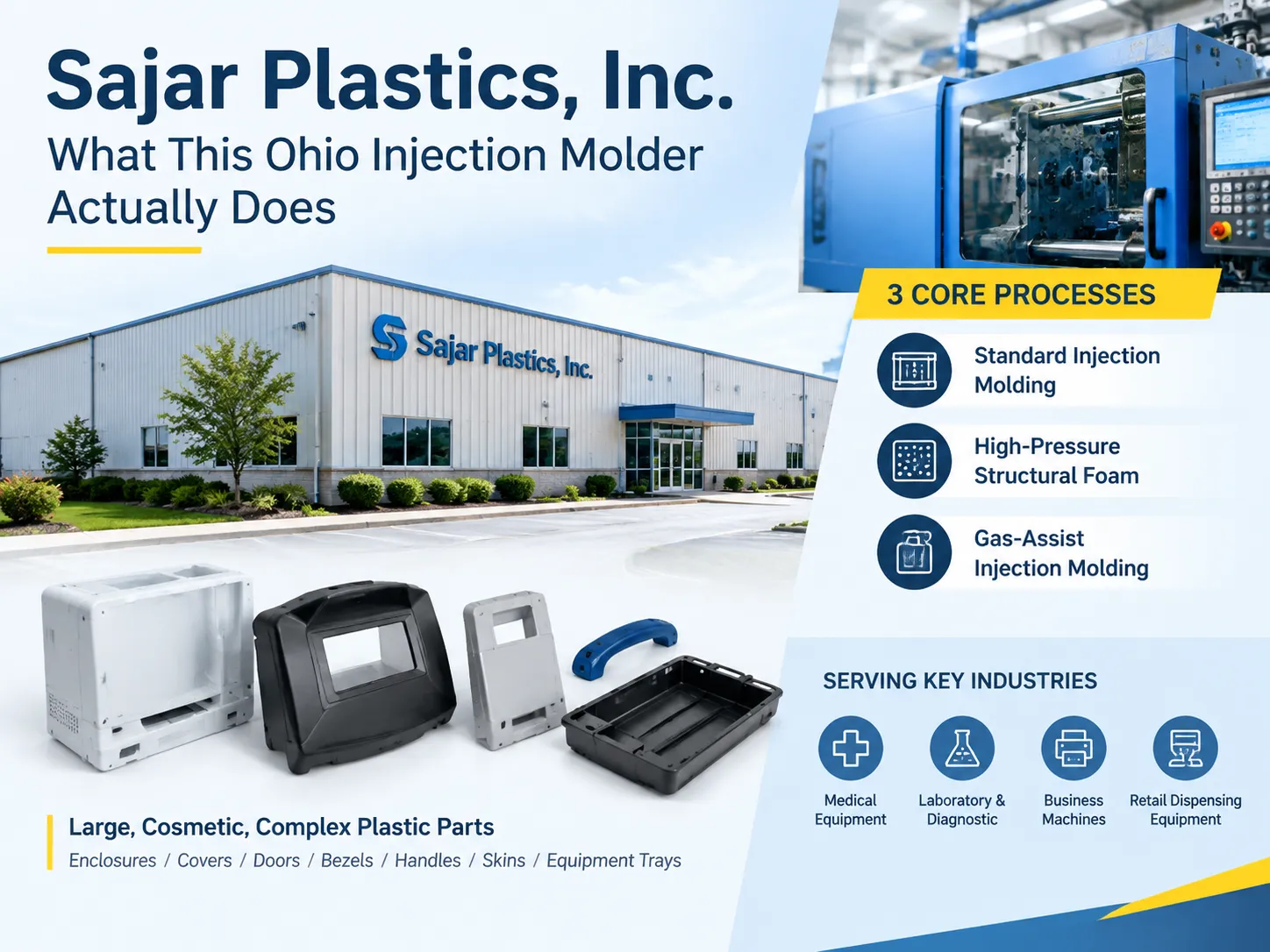
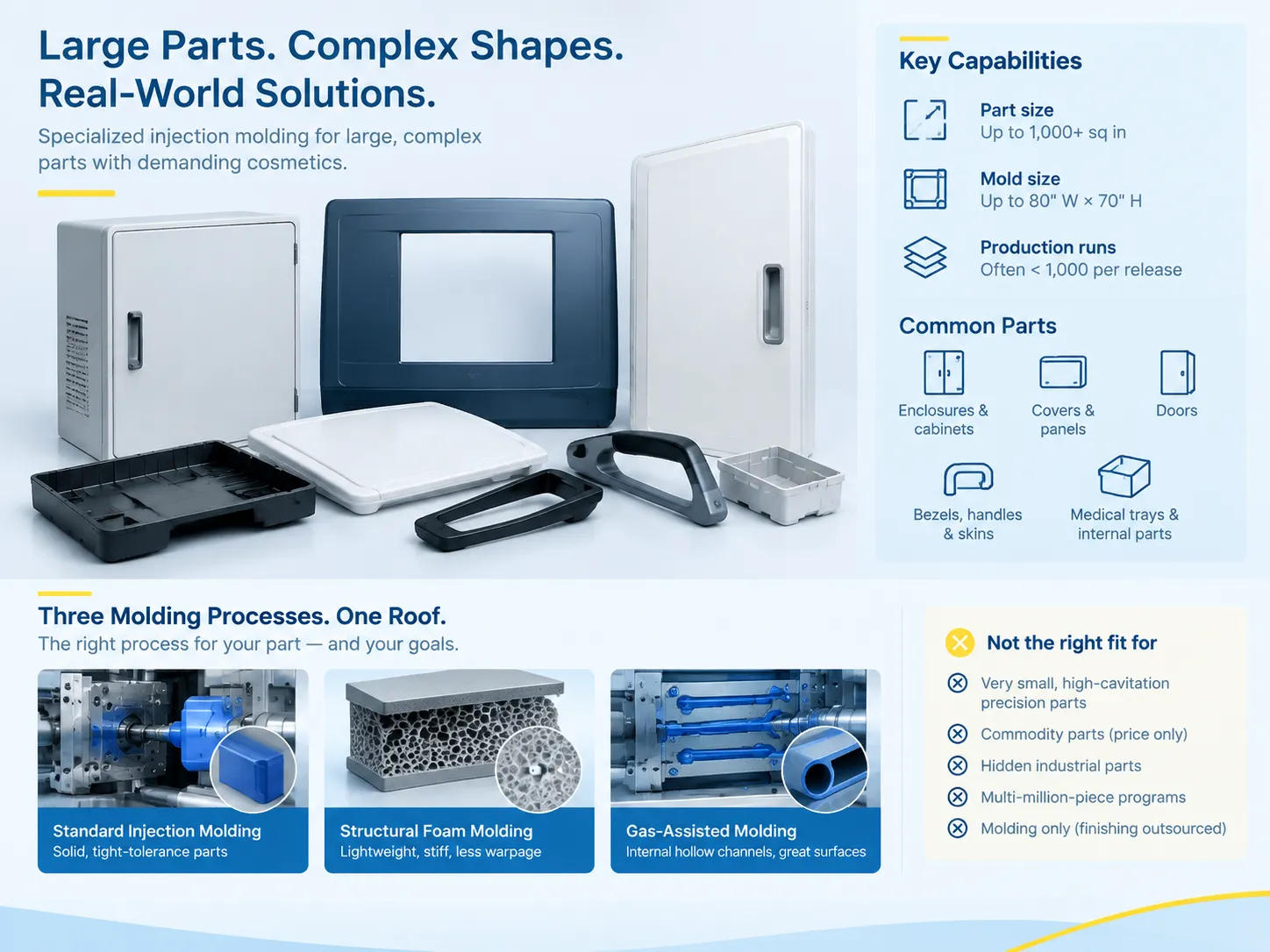
Sajar Plastics, Inc. is a custom injection molder located at 15285 South State Avenue in Middlefield, Ohio, established in 1949. There are estimated 17 presses in this facility ranging from 85 to 1,500 tons and covering over 150,000 square feet of area. Their expertise lies in three different injection molding process- standard injection molding, high-pressure structural foam, and gas-assist injection molding of which they were one of the original developers in early 1980s. Sajar Plastics was taken over by Universal Plastics Group, a thermoformer located in Holyoke, Massachusetts in 2017 but is still functioning under the same name as Sajar Plastics, Inc. The main products provided by Sajar Plastics, Inc. include complex large plastic parts bizarrely shaped like enclosures, covers, doors, bezels, handles and others.
Who Sajar Plastics is, and who owns it now
The majority of questions people have touched upon who owns the company, since it is still known by the same name. Sajar began its operation in 1949 in Middlefield, Ohio, with a few injection molding machines that produced only basic injection molding components. It has been steadily developing for the next 70 years and grew to the area of 150,000 square feet by the time it celebrated its 70th anniversary in 2019.
In 2017 the company got purchased by Universal Plastics Group, which is a manufacturer of thermoforming, based in Holyoke, Massachusetts, and has been in the area for over fifty years. The name of its brand is said to be descriptive in the sense that it means covering the two types of processes. The fact implies that the customer being Sajar customer enters the territory of Universal Plastics Group; however, only after the product moves from one type of processing to another or is transformed from proto-thermoforming products into higher volume molded products.If you require this information about the current legal status of the vendor file, proceed to the Ohio Secretary of State site or call to the company directly at the phone number stated, instead of relying on the online directories that do not provide consistent information about it.
What they actually build — the product mix
The published specialty of Sajar is manufacturing large, intricate parts requiring high aesthetics. This is a very specific specialty as compared to ‘custom injection molding,’ and this is something you must take into account while deciding what work to assign.
Different parts produced by Sajar include:
- Housings and equipment cabinets
- Covers and lids, including panels required for cosmetic appearance
- Shutters, including special types of shutters for businesses
- Bezels, handles, and skins
- Equipment trays and support structures of medical equipment
The main feature of Sajar is the part size. The company claims it can produce parts ranging from the size of 1,000 square inches or even bigger with the mold dimensions of about 80×70 inches. The production is said to be sustainable at any scale — usually, no more than 1,000 parts are produced. If your part happens to be a small unit that requires continuous mass production, Sajar may not be the right choice for you.
| What they are good at | What they are not set up for |
|---|---|
| Large parts over 1,000 sq in | Very small precision parts at high cavitation |
| Complex geometry that needs design freedom | Commodity parts competing purely on piece price |
| Cosmetic surfaces on customer-facing equipment | Hidden industrial parts where finish is irrelevant |
| Short to medium runs, often under 1,000 per release | Multi-million-piece annual programmes |
| Parts needing molding plus finishing plus assembly | Molding only, with finishing outsourced elsewhere |
The three processes, and why the difference matters to your part
For a shop of its size, it is unusual to have three molding operations under one roof. However, this is one of the main reasons why Sajar can quote diverse part sizes without rejecting any jobs.
| Process | How it works | Best suited to |
|---|---|---|
| Straight (standard) injection molding | Conventional high-pressure fill and pack | Solid, tight-tolerance parts and internal structural components |
| High-pressure structural foam | Chemical blowing agent creates a cellular core inside a solid skin | Thick, stiff, lightweight parts where warpage is a concern |
| Gas-assist injection molding | A short shot of material is displaced by pressurized nitrogen, forming internal hollow channels | Large parts needing rigidity, good surfaces and less material |
The level of automation involved is not just a matter of appearance. In large-scale cosmetic manufacturing, a press is successful only if it can produce consistent results from one cycle to another, as even one flaw in a part with an area of 1,000 square inches can be quite costly.That is the same argument that drives investment decisions across the industry, and it is where the trade-off between fully automated and semi-automated molding and assembly lines stops being theoretical. Reject rates will highlight the issue before invoices do if the data for molders is derived from visual inspection at the end of the assembly process rather than utilizing a controlled procedure.
Gas-assist molding: the specialty worth understanding
Gas-assist injection molding is the thing Sajar does exceptionally well with a story that is more than just hype. The company was among a handful of original pioneers of this technology in the early 1980s and has so far commercialized around 500 parts via gas-assist technology for OEMs. It is a remarkable journey in a market where the majority of molders have done only a few gas-assist projects.
The principle itself is not very difficult to explain. Rather than filling the cavity with polymer completely, the machine injects a small dose of the polymer and then pumps gas in. This results in a hollow section in the produced part.
- Lightweight structure without compromising stability. A hollow structure can exhibit rigidity similar to that of a much heavier monolith. Whenever rigidity is brought to the part, geometry must take precedence over weight.
- Reduced costs of production. A significant reduction of mass results in lowered costs of production, which is of great significance when producing large parts where materials take up a considerable portion of expenses.
- Quality surfaces. The keeping of the part under gas pressure allows making many any sink marks on the top of the part — exactly why the technology is suitable for different types of enclosures and panels.
- There are drawbacks to consider also: manufacturing processes are more complicated; there are narrow limits for the process functioning and the design must be changed for it which means designing from scratch.What you can do is make the process repeatable at the equipment level — presses, gas injection units and part handling that turn a narrow process window into a line you can run three shifts a day, which is the layer our production line and molding equipment is built for.
Secondary operations — where a lot of the real cost lives
Sajar is able to serve as a complete solution for multi-part projects because it performs molding and finishing at the same location. The portfolio of services includes design and engineering, tooling manufacture, tool repairs, and fixture building, as well as painting, pad printing, labeling, inserting parts, and packing products.
Every purchasing manager knows how much grief is avoided by using one vendor for both molding and painting. When these processes are performed by different suppliers, additional costs are incurred for shipping and the company must deal with two quality systems, two lead times, and disputes over who is responsible for any defects in a product caused in transit. While consolidation is costly, it is usually less expensive than dealing with far more complex logistics.It is also the part of a molding business where labour content is highest — painting, assembly and inspection are still stubbornly manual in most plants — which is why secondary operations are where the cost pressure on machinery manufacturers and their customers is felt most sharply in 2026.
Industries served
| Industry | Typical parts | Why the process fits |
|---|---|---|
| Medical equipment | Equipment trays, housings, covers | Complex geometry, cleanable surfaces, stable dimensions |
| Laboratory and diagnostic | Covers, panels, instrument enclosures | Cosmetic quality on benchtop equipment, moderate volumes |
| Business equipment and retail | Doors, bezels, cabinets, register housings | Large cosmetic parts, short-to-medium releases |
| Manufacturing and industrial | Machine covers, guards, enclosures | Structural foam and gas-assist for rigidity at low weight |
Just to highlight: The company has stated that it has begun branching into furniture manufacturing, transport industry and big medical parts. If the part you are looking for belongs to one of these categories and you see that the company you are interested in has less experience, make sure to request details regarding the reference parts manufactured and the history of the molds.
How to evaluate any custom molder, Sajar included
This sheet which can apply to any molder, not just this particular one in question:
- Acquire the press tonnage that suits the part you want to produce. Be sure to check the highest and lowest presses but not only the one with the largest width from the catalogue. For example, a 1,500-ton press is of no use producing parts that need only 150 tons.
- Inquire as to which technique they will employ in producing this part of yours. If they claim they will use the same technique irrespective of the part, you can assume you are offered capacity rather than the actual production technique.
- Get clarity on who owns the tools. Find out who owns the mold, who will take care of it, what will happen to it in case of leaving or if it can be transferred to another molder.
- Establish where secondary processes take place, or get details on whom they subcontract this process to, if necessary.
- Require proper information on the process to be used, including the weight of the shot, time of the cycle, pressure in the cavity, or other scientific information on the qualification trial.
- Verify the quality assurance system used rather than blindly trusting it. The requirements of clients in the medical area, for instance, extend far beyond the possession of the ISO 9001 certificate.
- Conduct overall capacity checks. A molder which is 95% loaded will be late, and all their customers seem to be aware of that, and the questions that separate builders who can deliver from those who can only quote are laid out in the automated production line buyer’s guide.
Where automation changes a molder’s economics
For many years in the past, molding has been automated — this is known as a modern press. What has changed here is everything that is around the machinery: handling of materials, removal of parts, degating, placement of inserts, inspection, assembling, and packaging. These processes dictate the ability of a molder to compete with a large part produced in a long cycle time as a press is an expensive piece of machinery and idle time spent by a press results in the loss of money.
We are working in this domain at benlongkj. We create automated assembly lines, systems for the injection-molding, and special-purpose equipment, including the assembling lines with online testing and calibration of electric components. The benefit of the tool is determined in the context of the technology of automation projects, meaning constant cycle times, reduced manual work, and the production of data as a side product of production.The wider returns are set out in how industrial automation solutions deliver efficiency benefits, and the equipment side of that decision is worth pricing against the savings it actually generates.
While this does not apply to every molder, a shop that produces fewer units of bigger cosmetic parts may not see any advantages of introducing an automated cell, and that is an acceptable opinion. However, if the molder hasn’t pondered on the potential returns an automated cell can offer him, it simply has not thought of it in the first place.
Frequently asked questions
Who owns Sajar Plastics today?
In 2017, Sajar Plastics was acquired by Universal Plastics Group, a company that specializes in custom thermoforming and is located in Holyoke, Massachusetts. Sajar operates independently under its own brand from the manufacturing location in Middlefield, Ohio, where it acts as the injection molding division of the company.
Is Sajar Plastics still in Middlefield, Ohio?
Indeed, the address of the facility is located at 15285 South State Avenue, Middlefield, Ohio 44062, while the contact number credited with the details is +1 440 632 5203. The premises have developed in such a way that in the beginning there was a mere presence of only three presses, but now it has expanded into an area of more than 150,000 sq ft.
What is gas-assist injection molding, in plain terms?
First, a small amount of plastic is put in the mold, followed by the introduction of pressurized gas nitrogen into the molten plastic. The nitrogen gas comes in and creates hollows in the thick section. This helps make the part lighter and stiffer while ensuring the outer surfaces are more aesthetically appealing. Sajar was one of only three firms that commercialized the technology from the time it was introduced in the 1980s.
How many presses does Sajar run?
Reports state that there are seventeen machines in use for injection molding purpose. Each machine has different clamping force, which ranges from 85 tons to 1,500 tons. This means that a single production facility is able to manufacture both tiny internal parts as well as big details such as covers.
Why do the revenue and employee figures differ between directories?
Due to the fact that directory information is compiled, often retrieved past concerns caused by being overwhelmed with data, one resource claims around 100 workers and $21 million in income. Another has much fewer employees. To successfully conduct vendor verification, it is better to contact the company physically to discover the information instead of relying on aggregate data provided by sources such as Sunday School Board of Ohio.
References
- Universal Plastics Group — Company and Sajar Plastics Information
- Sajar Plastics — Official Site
- ProcessRegister — Sajar Plastics, Inc. Supplier Profile
- Middlefield Post — Sajar Plastics 70 Years in Business
- Plastics Industry Association — Industry Resources
Conclusion
Sajar Plastics Inc. is a molder based in Ohio that traces its origins back to 1949, having discovered a viable niche and occupying it for some decades now. The company is a specialist in manufacturing large, complex plastic objects, using one of three processes, i.e. straight molding, structural foam, or gas-assist, with all the finishing and assembly carried out by the company. It’s part of Universal Plastics Group since 2017 and runs a fleet of 17 presses, ranging from 85 tons to 1,500 tons, having developed more than 500 gas-assist parts over the years.
There’s a practical takeaway from this story, and it is not about Sajar. The key idea is to understand that molding needs to be chosen based on fitment, and not based on quality. Make sure the process fits the part, tonnage fits geometry, a run length fits the business model, and check all the finishing mechanisms contemplated as part of the contract. By taking these steps, laying your hands on proper molding should become an easy task.