benlong
Custom Industrial Equipment Manufacturing: Who Builds It
Your manufacturing equipment has replaced the usage of conventional manufactured goods. If your production schedule necessitates specialized hand tools to manufacture a product, in situations where the part requires a unique shape, style or production time, you will require the use of custom manufactured machinery. This article covers the definition of custom manufactured machinery, the leading manufacturers who provide this type of equipment, their specialty areas, costs associated with each project, the various definitions of the custom machinery as well as steps to find and acquire manufacturing equipment from a supplier.
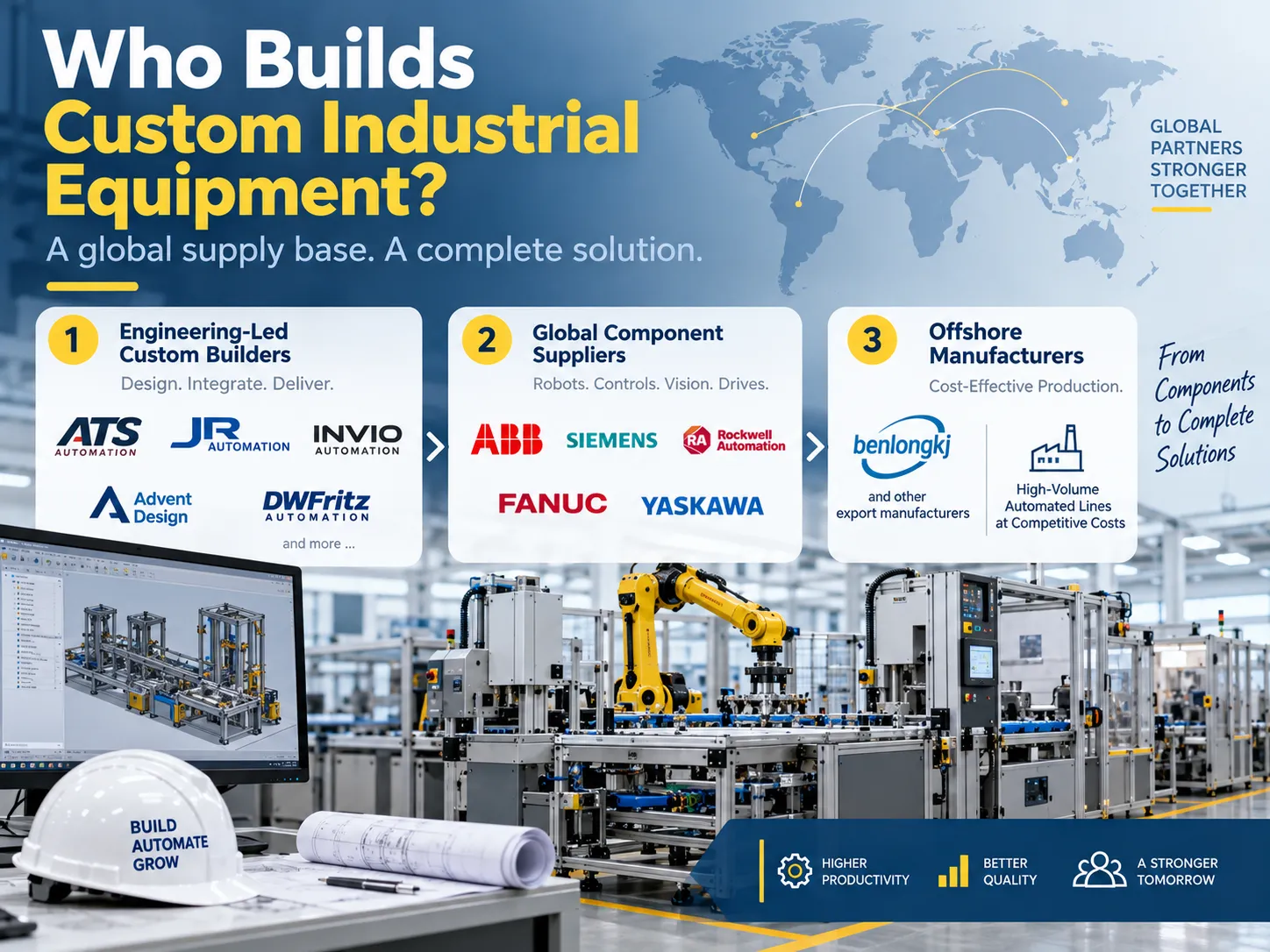
In short, custom industrial equipment refers to machinery developed for a particular application or product. Custom industrial equipment consists of automated assembly machines, special purpose machines (SPMs) or robotic work cells but can also include test stands, material handling systems and packaging lines. The custom industrial equipment market is divided into three broad segments: (1) Global platform suppliers (such as ABB, Siemens, Rockwell, FANUC and Yaskawa) that provide robots and controls for customization of an off-the-shelf machine; (2) Engineering led custom builders (such as ATS Automation, JR Automation, Invio Automation, Advent Design and DWFritz) that provide total solutions; and (3) Offshore manufacturers that manufacture machine equipment to specifications but offer a lower cost option than domestic manufacturers, representing a difference in cost of 30% to 50% compared to local machine manufacturing.
What counts as custom industrial equipment?
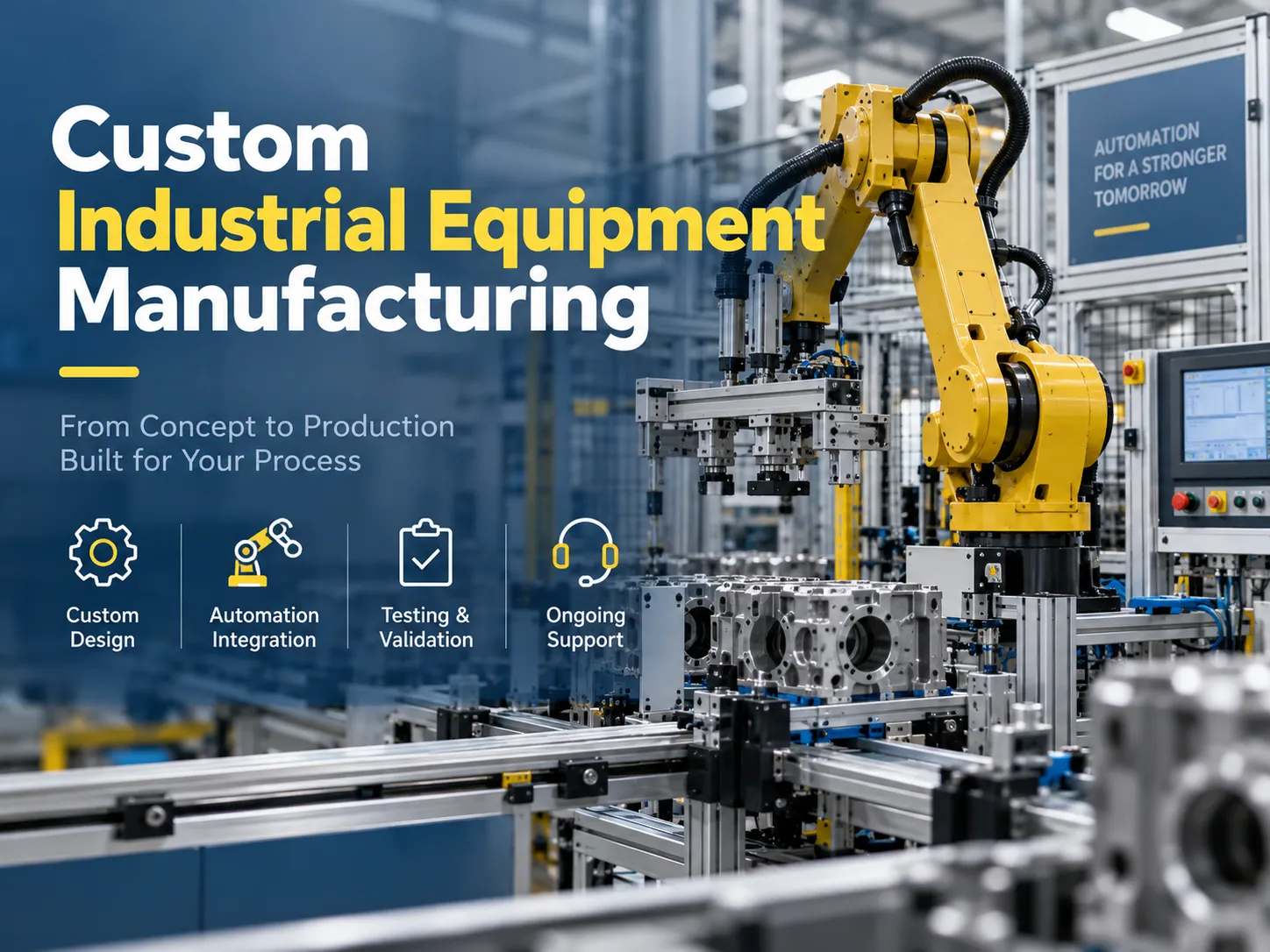
Custom machinery falls in between two extremes: a standard machine that is easy to purchase but hard to implement, and a fully integrated production plant that is a gigantic project with its own purchasing process. In practice, clients are buying from one of six categories:
| Category | What it does | Typical buyer |
|---|---|---|
| Automated assembly machines | Feeds, orients, assembles, and ejects a product at a defined cycle time | Component, appliance, and electronics manufacturers |
| Special-purpose machines (SPMs) | Performs one or more processes that no standard machine handles | Any manufacturer with a unique operation |
| Robotic workcells | Robot plus tooling, guarding, vision, and safety systems performing a defined task | Automotive, metalworking, packaging, electronics |
| Test and inspection stands | Proves every unit meets specification — electrical, functional, leak, vision, or dimensional | Safety-critical component makers, medical, automotive |
| Material handling systems | Conveyors, feeders, orienters, palletizers, and automated storage | Warehouses, plants with labour-intensive transfers |
| Packaging and processing lines | Fills, seals, labels, and palletizes; or performs a process step such as curing or washing | Food, pharma, chemical, consumer goods |
The commonality here is that the machine gets defined from your own specifications rather than from the catalog of a vendor. The geometry of the component, the cycle time, the requirements for quality, the environment and the downstream interfaces all come from your technology. Hence, the specification is more important than the vendor name.
Who builds custom industrial equipment?
The supply base consists of three levels, and most initiatives go through all of them:
| Builder | Base | Strengths | Typical projects |
|---|---|---|---|
| ATS Automation | Cambridge, Ontario, Canada (est. 1978) | Turnkey automation with deep life-sciences validation experience; global footprint | Pharma, medical device, transportation, consumer |
| JR Automation | Holland, Michigan, USA (est. 1980) | North America’s leader in custom robotic workcells; multi-brand robot integration (FANUC, ABB, Yaskawa); strong automotive and EV programmes | Automotive, aerospace, electronics, food & beverage |
| Invio Automation | Lansing, Michigan, USA | Custom automation and systems integration for medical, energy, and heavy industry; expanded via acquisition | Medical, renewables, industrial |
| Advent Design | Hatfield, Pennsylvania, USA | Custom machinery, robotic integration, vision systems, machine safety | Industrial and consumer manufacturing |
| DWFritz Automation | Wilsonville, Oregon, USA | Micron-level precision, metrology-integrated automation | Semiconductor, medical device, high-precision assembly |
| Steven Douglas Corp, Bent River Machine, RT Engineering, ONExia and regional machine builders | USA (various) | Fast, focused builds; strong for single stations and mid-size systems | SME manufacturing, assembly, packaging |
| Agile Robots / Krause Automation | Munich, Germany | AI-driven robotics and plant engineering; European automotive depth | Automotive, advanced assembly |
| ABB, Siemens, Rockwell, FANUC, Yaskawa | Switzerland / Germany / USA / Japan | Robots, PLCs, drives, vision, and control platforms inside custom machines | Component supply to every builder above |
| Offshore machine manufacturers (including benlongkj) | China and other export hubs | Automated assembly lines, injection-molding production systems, and dedicated production lines (including miniature circuit breaker lines with automated testing and calibration) at 30-50% below Western pricing | High-volume lines where the specification is firm and cost matters |
benlongkj is an example of the offshore level well recognized in the following manner: a producer from China that manufactures automated assembly lines, injection molding systems, and specialized line production. The company supplies its products both directly to producers and through integrators. Cost efficiency and manufacturing processes are the advantages of this supplier, whose output is automatic and tested along with the process of manufacturing. The disadvantages of such a supplier are distance, the need for specification ahead of the contract, and the need to have a local partner to carry out the installation of the equipment and provide the necessary upkeep. In most cases, the ideal solutions are a joint approach where the local integrator is responsible for the first cell and maintenance, while the offshore producer obtains the orders to build capital equipment when everything is worked out.
The market, and what custom equipment actually costs
Custom automation is a big, rapidly growing market: in 2025, the worth of the custom automation engineering equipment sector was estimated around $5.7 billion. Further, it is speculated that by 2032, it will be worth around $10.5 billion with an annual compounded growth rate of approximately 9%. Demand for it is concentrated in specific sectors and knowing about it allows to know more about the extent of the prices that one will be charged:
| End market | Share of custom automation demand | What drives the specification |
|---|---|---|
| Automotive | ~45% | Cycle time, traceability, EV architecture changes |
| Electronics | ~24% | Rapid reconfiguration, small parts, high mix |
| Pharmaceuticals | ~14% | Validation, documentation, containment |
| Food and beverage | ~10% | Sanitation, gentle handling, fast changeovers |
Indicative price bands for equipment in the US and European markets:
| Scope | Typical price | Typical lead time |
|---|---|---|
| Fixture, jig, or single manual station | $15,000-60,000 | 6-14 weeks |
| Single semi-automated special-purpose machine | $60,000-250,000 | 12-24 weeks |
| Robotic workcell with vision and guarding | $150,000-600,000 | 16-30 weeks |
| In-line automated assembly line | $500,000-5,000,000+ | 20-40+ weeks |
| Offshore-built equivalent (specification-controlled) | 30-50% below Western pricing | Add 4-8 weeks for shipping and commissioning |
The cost of the equipment does not equal project costs. One has to consider preparations for installation, utilities, safeguard provisioning, and the period of launching, when no production is going on.The project-management discipline behind a smooth installation is the same one used for planned plant outages, which our manufacturing plant shutdown checklist covers in practical detail.
What to prepare before you contact a builder
The specification’s quality defines the machine’s quality. Before the initial meeting, prepare nine items:
- Drawings and samples of product parts (including tolerances and the possible variations of parts produced by this machine).
- Cycle time and output rate (provided as parts per minute/hours per shift or shifts and including OEE).
- Quality requirements (what should be measured, what the criteria for passing/failing are, whether a 100% inspection or sampling is needed).
- Process description (explaining all the operations that a machine should perform one after another, including the manual operations that are to be kept).
- Upstream and downstream interfaces (how parts are received and delivered, how the machine communicates with others).
- Environment (cleanroom, washdown conditions, temperature, dust etc.).
- Utilities and space (power, air, water etc.).
- Regulatory requirements (safety standards of machines, electrical certification and others).
- Budget and timing (specifying the amount of money ranges and the term for production).
With this information the builder will be able to make a precise quotation. If a builder receives only a phone call and photograph, his quotation will change three times before being delivered.
The build and acceptance process, step by step
Efficient linked-building program has eight consecutive tracks, each of which yields one deliverable to save:
- Concept and feasibility. A contractor examines a system and submits a concept together with assumptions. Deliverable: concept diagram and cycle-time calculations.
- Quotation and specification. A proposal must detail the machine, its tooling, control systems, safety features, and all relevant documentation. Deliverable: specification signed by both parties representing protection in case of change requests in the future.
- Design review. Technical documentation is reviewed that includes technical drawings, control system diagram, programming sequence. Deliverable: signed design documents, including the list of parts.
- Manufacturing and preliminary testing. The machine is built in the shop of the contractor and tested there. Deliverable: reports about machine building and, ideally, videos of test runs.
- Factory acceptance test (FAT). To a machine tested formally in the shop of the contractor. Deliverable: signed FAT report with calculations of the cycle time, yield, and open issues.
- Shipping and installation. Contribution of delivery process (packaging, shipment, installation) performed by the contractor or by the company that is working under his supervision.
- Site acceptance test (SAT). Implementation of FAT in your company’s environment. Deliverable: signed SAT report.
- Training, documentation, and warranty. Provision of training (operation and maintenance), supply of spare parts, drawings, backup programs, and warranty terms.
As for the onsite verification, make sure that you witness four things before you make the final payment. These are: the machine works properly at the given speed with your parts installed; the safety systems have been tested; measuring devices are compared against known testers; all documentation is provided. A machine that passed these four verifications will continue working in the future.
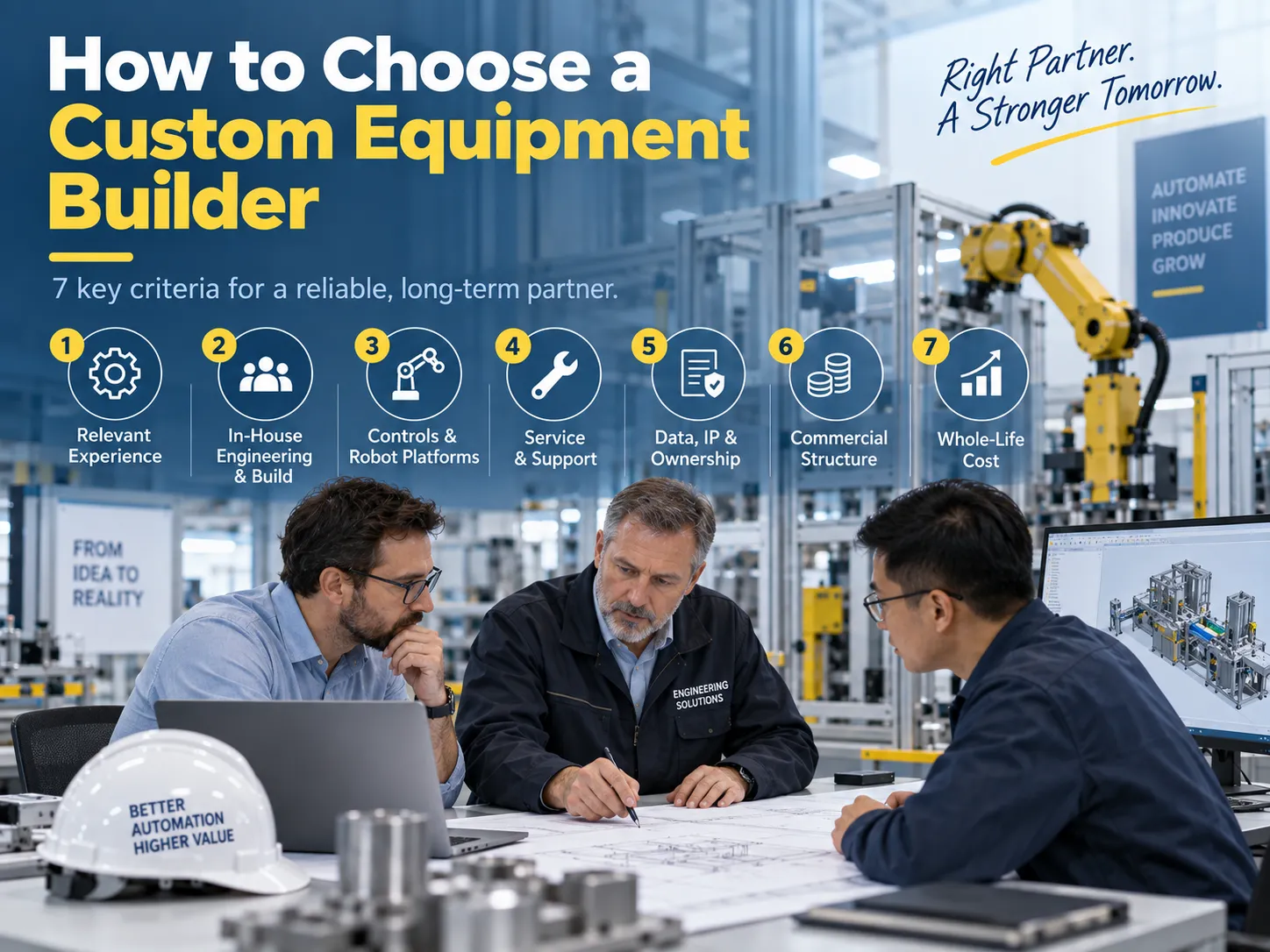
How to choose a custom equipment builder
There are seven criteria that set apart a partner from project risk, these include:
- Expertise in the exact process. Request two references from installations similar to yours, and call the references. Cycle time claims are easy to make, but having returning customers is the challenge.
- Manufacturing and engineering capabilities in-house. A company that designs and builds its machine and its controls has control over the schedule, while a pure integrator could be a good engineer but you need to check who is responsible in case of subcontractor delays.
- Choice of platform and controls. Choose the platform that your maintenance department could service, which is likely to be Allen-Bradley or Siemens controls and FANUC, Yaskawa or ABB robots. The transition from full to partial automation is an engineering issue rather than a cost-cutting one.
- Availability of engineers for after-sales service. Ask how many engineers work in your area, how fast is the response time, and where the spare parts are located. There is no sense in having the machine run in three shifts, but waiting two weeks for a specialist to come.
- Ownership of the data, IP, and programs. Ask to receive many documents including the source codes of the PLCs, programs for robots, CAD models and backups.
- Payment terms. Payment milestone applies to design approval, FAT, SAT, and training. It may be alarming to deposit more than 40% of the expected cost and receive no milestones.
- The cost through the full lifetime of the machine. Calculate the price that includes spare parts, consumables, services, and runs time. The 120% machine is most likely to be cheaper than the 100% machine because it works 120% more than the other.
Where material handling is part of the scope — conveyors, feeders, palletizers, AGVs — that subsystem has its own design logic and its own set of traps, covered in our automated material handling solutions guide.
And if you are preparing an RFQ, frame the requirements the way experienced buyers do: our automated production line buyer’s guide walks through the questions that separate builders who can deliver from those who can only quote.
Lastly, keep in mind the purpose of “custom”. Your custom station should reduce a bottleneck, not add one. Thus, if standard machinery can perform 80% of your operation while your custom station handles 20%, that hybrid solution will generally be less costly, quicker to install, and easier to maintain when compared with a completely custom assembly system.
FAQ
What is the difference between custom industrial equipment and standard machinery?
Standard production equipment refers to the products that are manufactured for a specified purpose, and it can be found in catalogs. However, customized equipment is created in line with the requirements of clients, concerning quality and time of production, and, therefore, will have some additional features that are lacking in standard production equipment. Custom-made production equipment tends to be more expensive than standard production equipment, but because it is customized, it would have different lead times.
How much does custom industrial equipment cost?
For instance, the costs for fixtures or work stations range from $15, 000 to $60, 000. Equipment with semi-automated functions has a price range from $60, 000 to $250, 000. Robotics cells are sold at prices between $150, 000 and $600, 000, while fully automated production lines can cost between $500, 000 and $5 million and more. Even though foreign manufacturers may produce the same product at a price that is between 30-50% less than Western manufacturers, they may have problems with making deliveries on time.
How long does a custom machine project take?
According to the stages of production, the time values for completion are: 6-14 weeks for individual workstations; 12-24 weeks for custom equipment; 16-30 weeks for robots; and 20-40 weeks for fully automated lines. If any type of certification is required, you must add time for certification documentation.
What is included in a factory acceptance test (FAT)?
FAT refers to a test of the equipment at the factory with the use of actual production parts; it assesses several factors such as cycle time of equipment and amount of production rate, production quality, and product accuracy. Additionally, it will include evaluating process capability of the produced items. At the end of FAT, you must prepare a report.
References
- ATS Automation — Custom Automated Manufacturing Systems
- JR Automation — Robotic Workcells and Integration
- Control Design / CSIA — System Integrator Best Practices
- ISO — Machinery Safety Standards (ISO 12100, ISO 13849)
Conclusion
Organizations creating custom-made industrial equipment are engaged in processes of conversion of production related matters into machines. There are three processes involved in the success of companies in this regard. One includes specification creation required for the calculation of cycle times, quality, environment, utilities, costs, and deadlines. Second includes producers’ identification through straightforward proof instead of depending on mere claims of suppliers. Thirdly, standard acceptance procedure is developed including payments planned during production, documentation, and machine operation testing. There is sufficient amount of custom industrial equipment than many customers are actually looking for as a result of presence of so many automations including ATS, Invio, and DWFritz, etc. The cost of custom industrial equipment varies widely based on specifications and acceptance processes (for example, some equipment costs $15,000, while other equipment may range in millions of dollars). Nonetheless, as a result of efficient specification preparation and standard acceptance processes, the equipment owner has an opportunity to save on equipment.