benlong
What Is Mechanical Assembly? Types, Equipment, and Industry Guide
The manufacturing techniques have moved from generating simple products to techniques for assembling various parts into functional devices. When hearing the term mechanical assembly one may get the impression that it is straightforward. However, it is, in fact, one of the most complicated and automated types of manufacturing and one of the least known. In this article, the reader will get acquainted with the concept of mechanical assembly definition, its types, the areas of its application, equipment used in the process and how it is different from manual labor.
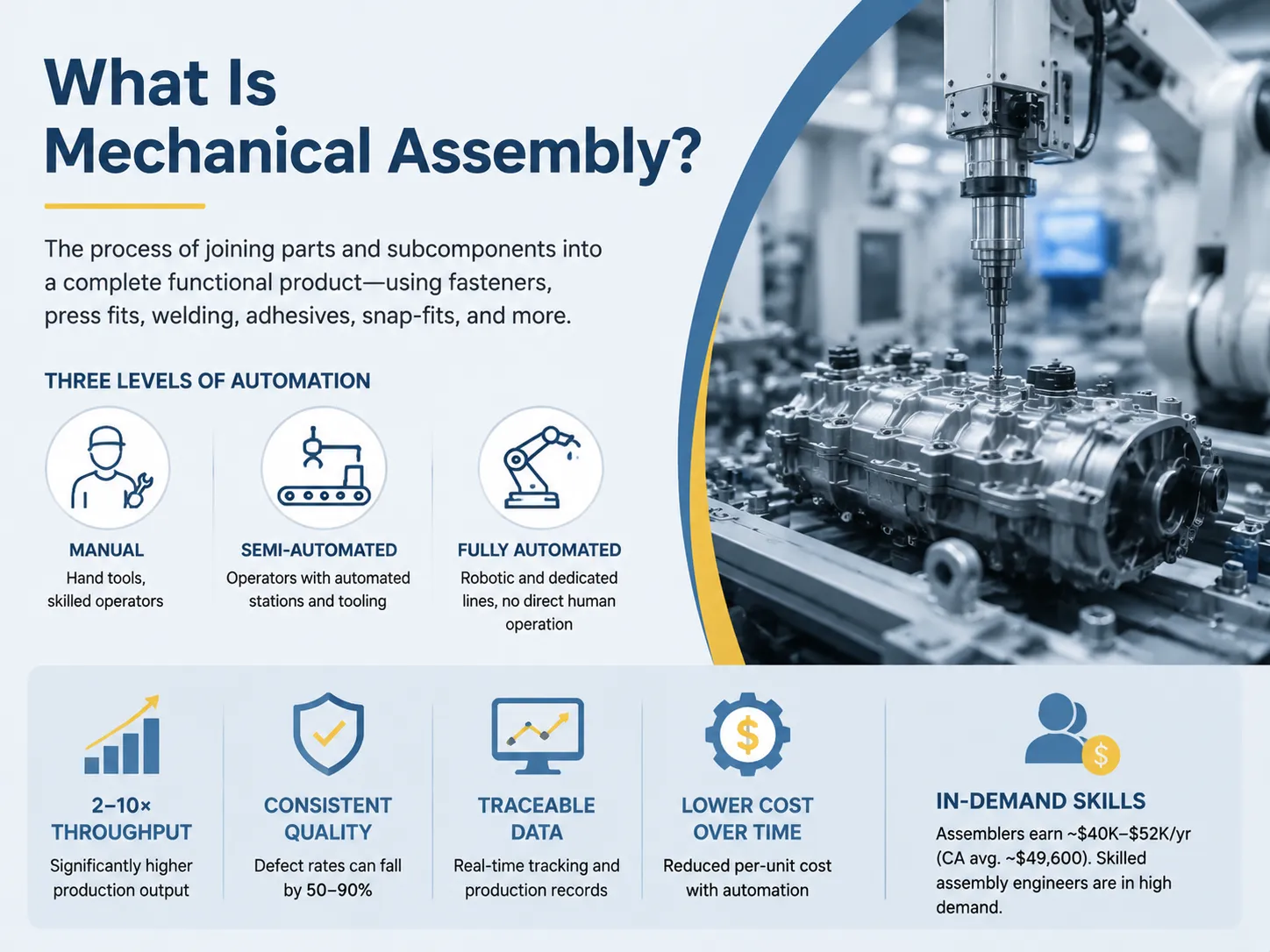
Mechanical assembly refers to connecting various parts and components via tools or devices like bolts, screws, etc. This can be done as per utilized design specifications. There are three types of mechanical assembly. This method is an important part of production, particularly in vehicle, electronic goods manufacture, or appliance industry. Automating mechanical assembly results in increased effectiveness in product manufacturing from 2 to 10 times in comparison with manual process as well as providing reliability of the product, the data on production stages and the necessary cost reduction during successively carried out processes.
What Mechanical Assembly Is
Mechanical assembly is a part of the manufacturing that transforms separate parts into a finished product. The individual parts (being machined, molded, or stamped) are combined to form subassemblies and then the finished product according to technical illustrations and working instructions. People assembling are not supposed to be creative; they just need to put the parts together in the right way and use proper fastening methods.
The important differentiating factor for consumers and engineers: mechanical assembly means joining actual parts together, which is different from electronic assembly (that is, soldering parts to the necessary boards), although nowadays products usually need both types of assembly. For instance, circuit breakers are both mechanically assembled (as they have their details like springs, contacts, levers, etc.) and electrically adjusted for operation. The standards and quality logic behind turning components into certified products are covered in the custom automated assembly machine guide, which walks through how a product’s assembly process gets engineered in the first place.
Types of Mechanical Assembly
There are two types of mechanical assembly: one is classified by level of automation and the other is classified by architecture.
| Classification | Type | Characteristics |
|---|---|---|
| By automation | Manual assembly | Hand tools; flexible; suited to low volume or high variation |
| Semi-automated assembly | Operators feed automated stations; balances flexibility and speed | |
| Fully automated assembly | Robotic or dedicated lines; high volume; consistent cycle times | |
| By structure | Component assembly | Parts joined into a subassembly (e.g., a motor gearbox) |
| Subassembly to final | Subassemblies joined into the finished product | |
| Module-based assembly | Interchangeable modules assembled on common platforms |
In technical terms, choice of automation technology is an economic decision rather than one of prestige. Manual techniques dominate low-volume/high-mix applications while full automation prevails at high volumes when fixed costs can be distributed over millions of units produced.The trade-off logic — and when each level pays back — is laid out in the fully automated vs semi-automated comparison, a decision every factory faces before buying equipment.
Assembly Processes and Techniques
Mechanical assembly is the process of connecting different components through specific techniques. One of the most used methods in mechanical assembly is threaded fastening which is the use of various elements such as screws, bolts, or nuts.Other methods used are:
- Press fitting is when a shaft is pushed into a hole that has smaller diameter, in this way there is no need for fasteners.
- Riveting is simply changes of physical properties of rivets for fastening.
- Snap-fitting is joining plastic elements by just clicking them together.
- Adhesive bonding is the use of glue which holds joints.
- Weld, solder and braze are metallurgical joining processes of providing firm connection between different parts.
Every method has particular characteristics such as torque, required for threaded fastening, pressed force for press method, cycle time for adhesive bonding, which makes it possible for the manufacturers to perform instant tests while assembling items instead of checking their quality already finished.For high-volume electrical products, this process engineering is exactly what goes into an automated line: the assembly, calibration, and testing of a miniature circuit breaker happens on dedicated production machinery, of the kind described in the automated MCB production article.
Equipment and Tooling
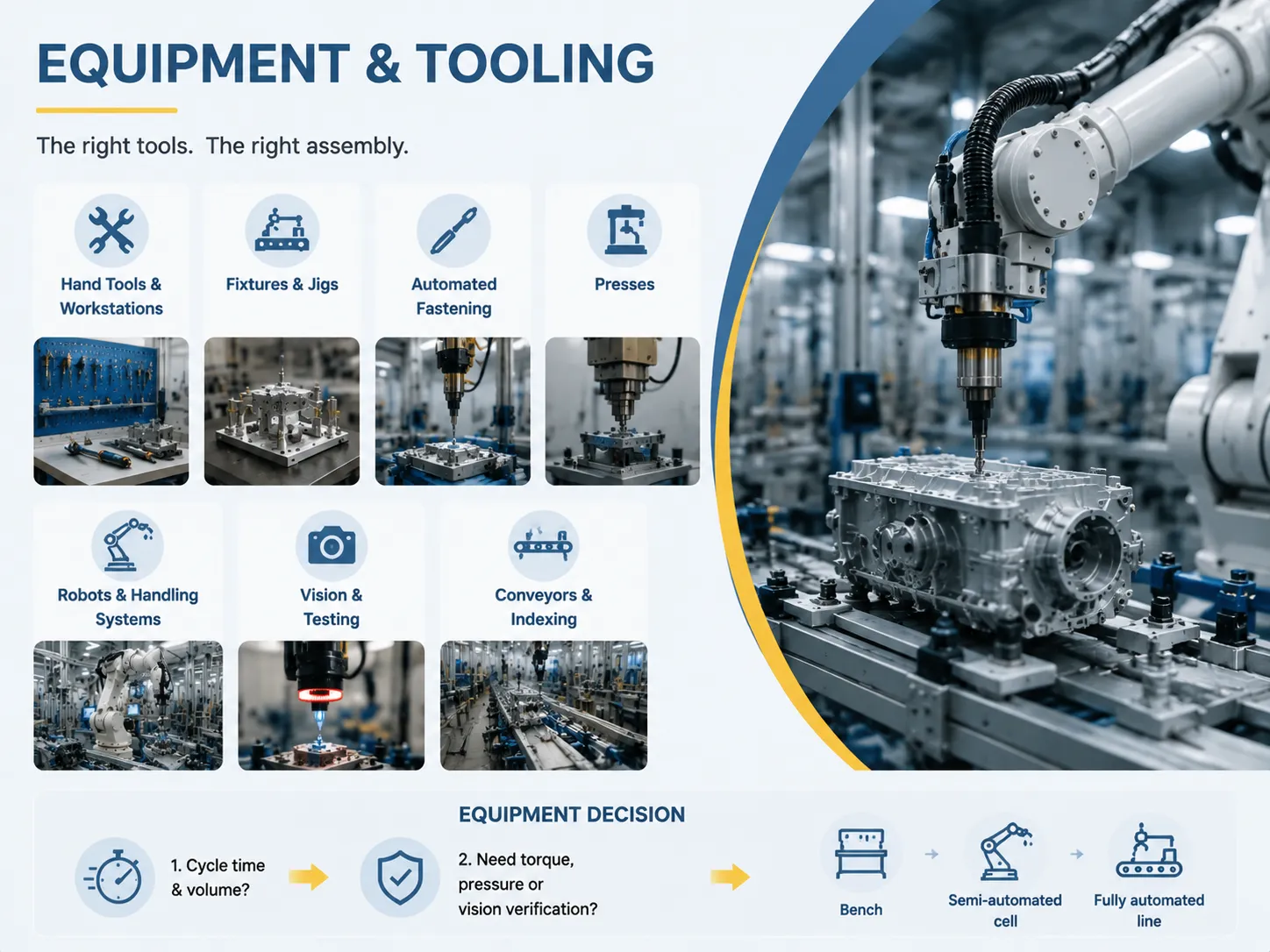
Mechanical assembly devices may include anything from ordinary tools to fully functional robotic workstations.
- Hand tools and working places — tools for assembling and cutting, screwdrivers, etc.
- Jigs — any equipment used to guide the raw materials in the assembly process.
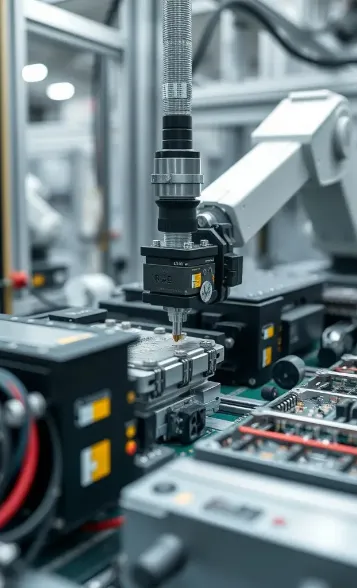
- Automated fastening tool stations — systems that feed and place the tools in position.
- Presses — pneumatic or hydraulic presses designed for assembly operations.
- Robot and material handling system — the robotic devices used for transferring the components.
- Vision and testing devices — the systems for monitoring the assembly process.
- Tesla systems — conveyor devices used to deliver materials.
For buyers, the equipment decision reduces to two questions: what is the required cycle time and volume, and which operations need torque/pressure/vision verification? The answers determine whether a bench, a semi-automated cell, or a fully automated line is the right purchase — and the equipment ecosystem behind a real product family, from assembly to testing, is the subject of the automated production line buyer’s guide.
Industries That Depend on It
Mechanical assembly is the underlying factor for virtually all physical industries.
| Industry | What Gets Assembled | Assembly Style |
|---|---|---|
| Automotive | Engines, transmissions, interiors, final vehicle | High-volume, largely automated |
| Electronics and appliances | Laptops, phones, white goods, power tools | Mixed manual + automated |
| Electrical equipment | Breakers, switchgear, motors, transformers | Automated lines with embedded testing |
| Medical devices | Surgical instruments, implants, diagnostic devices | Controlled manual + semi-automated, cleanroom |
| Aerospace and defense | Airframes, engines, avionics housings | Low-volume, high-skill, documented |
| Industrial machinery | Pumps, compressors, machine tools | Batch assembly, skilled fitters |
In all sectors, the pattern is repeated: mechanical assembly brings together purchased or manufactured parts into the final product of the buyer, while the performance of the assembly line influences the cost of the business. Industries with high volume and stable designs (automotive, electrical equipment, etc.) rely heavily on automation; industries with low volume or big deviation concerning regulations (aircraft, medical equipment) rely on specialized manual assembly with exhaustive documentation.Understanding your product’s place on that spectrum is the first step in choosing how to assemble it — and the manufacturing automation solutions guide frames that choice across industries.
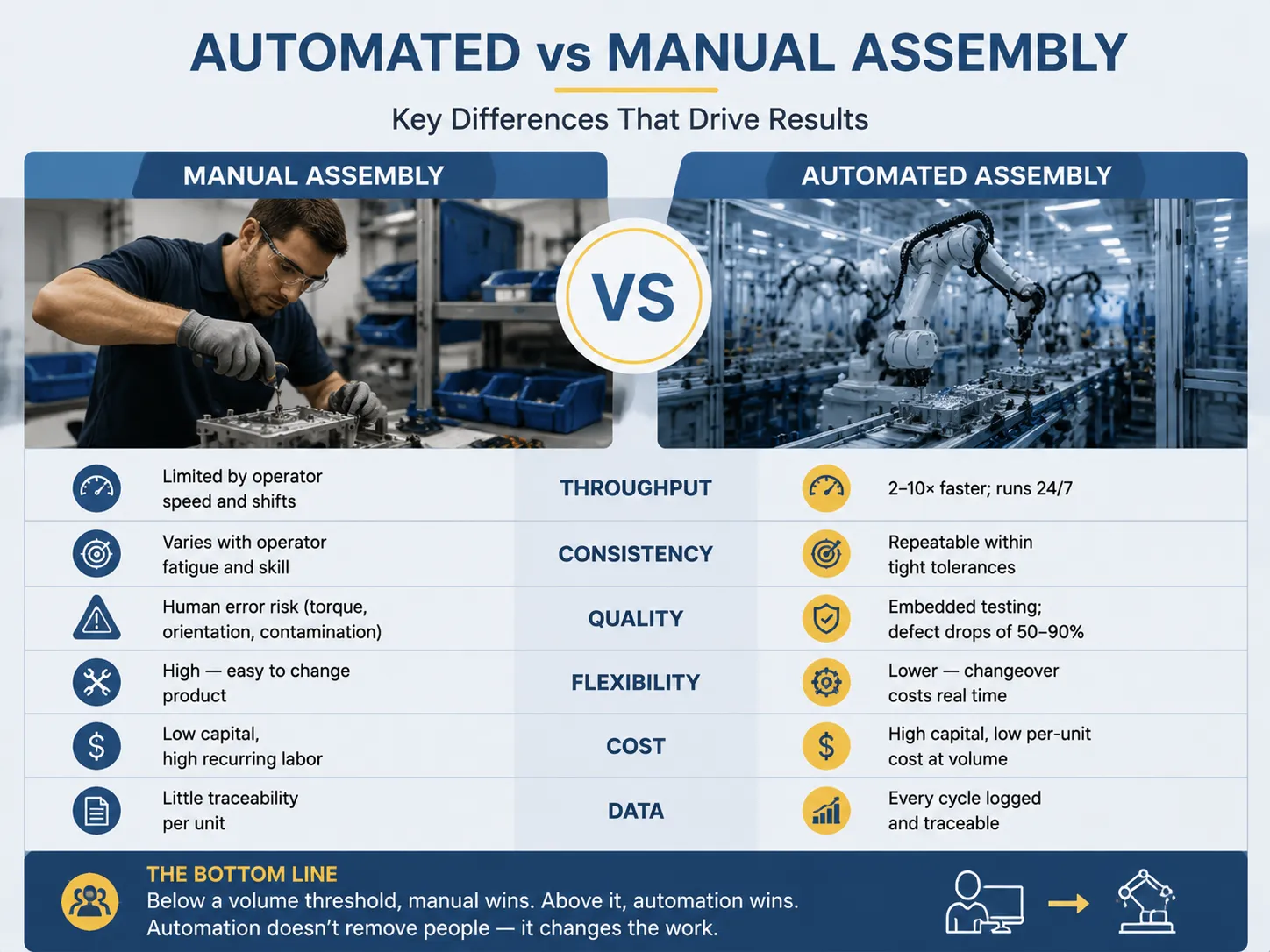
Automated vs Manual Assembly
When comparing manual and automated production, it’s all about realizing the bottom line:
| Factor | Manual Assembly | Automated Assembly |
|---|---|---|
| Throughput | Limited by operator speed and shifts | 2-10× faster; runs 24/7 |
| Consistency | Varies with operator fatigue and skill | Repeatable within tight tolerances |
| Quality | Human error risk (torque, orientation, contamination) | Embedded testing; defect drops of 50-90% |
| Flexibility | High — easy to change product | Lower — changeover costs real time |
| Cost | Low capital, high recurring labor | High capital, low per-unit cost at volume |
| Data | Little traceability per unit | Every cycle logged and traceable |
The number of units produced is paramount: manual production is advantageous when the volume of the respective line is low, whereas automatic production has significant edges when the production volume is higher than the break-even point. What automation can’t eliminate is the human element: lines need set-up, support, as well as engineering, and future assemblers will use robots instead of tools.
Where It’s Heading
There are three main aspects affecting the mechanical assembly area in the latter half of the 2020s.
- Cobots – robots that make it easier to implement automation for logistical processes with lower volume than before because the area allows using of machines without using safety fences.
- AI-powered vision – verification of the assembly process has moved from the methodology based on pre-set norms to the systems that learn themselves, thereby making it possible to detect the problems that cannot be registered by traditional rule-based cameras.
- Digital twins and flexible lines – the software enables engineers to test assembly lines and changes on the assembly line without practical use of machines, thus lowering the traditional barrier that previously existed for the manual assembly process.
The tendency indicates that the area of assembly is still experiencing the shift from manual to automated processes. First of all, the skills become more and more sophisticated, because the capability to program and maintain the machines instead of being only capable of doing repetitive assembly tasks becomes extremely valuable in the industry. In this context, the company benlongkj is occupying its niche, working in manufacturing of automated assembly processes.
FAQ
What do mechanical assemblers do?
The work of mechanical assemblers involves the assembling of products and sub-assembly through reading of assembly blueprints and procedures, arranging components, using fasteners or other joining process with appropriate torque and pressure, and checking whether specifications are met. Depending on the industry, the mechanical assemblers may need to use hand tools, presses, soldering tools, or work with automated workstations and check that the whole assembly is done properly.
Can you give me an example of a mechanical assembly?
Here is a simple example: bringing to life of gearbox housing — placing gears and shafts inside the housing assembly, inserting bearings, sealing the assembly, turning the gears to a specified level of torque, and running an operation test. A consumer example can be a circuit breaker — installation of non-mechanical components into a body of the product. Nearly any product with moving or assembled components is an example of mechanical assembly.
Is a mechanical assembler a hard job?
In certain ways the job can be considered demanding: the job requires physical effort, accuracy and great attention to details. But in fact, it is not challenging from an intellectual perspective, as the employee receives appropriate training and experience while doing the job. On the other hand, repetition of assembly functions can be quite tiresome, which is the reason why manufacturers tend to automate the process in many cases.
How much does a mechanical assembler make in California?
The amounts of money mechanical assemblers get in California is approximately $49600 per year ($24/hour), entry level positions starting at $37000 and those employed in big companies getting even $56000.
References
- SalaryExpert — Mechanical Assembler Salary in California
- PathScorer — Machine Assembler Salary (BLS SOC 51-2031)
- International Federation of Robotics — Robot Demographics
- McKinsey — The Future of Work
- Assembly Magazine — Assembly Technology and Process News
Conclusion
The understanding of mechanical assembly shows the completeness of the operations performed to transform parts in manufactured products with the utilization of all possible types of joining throughout processes of manual and automatic mechanical assembly such as fastening, gluing, riveting, compression, etc. along with their economic aspects since manual assembly is justified in low output production and flexible production management while automation is justified during production when investment in technologies starts recouping and the need for process standardization arises with the application of modern technologies like robots and AI as well as digital twins. The large number of fields has proved effectiveness of mechanical assembly in the process of production, but it requires experimental studies that will result in the solution of the assembly technology; effective mechanical assembly depends on human labor.