benlong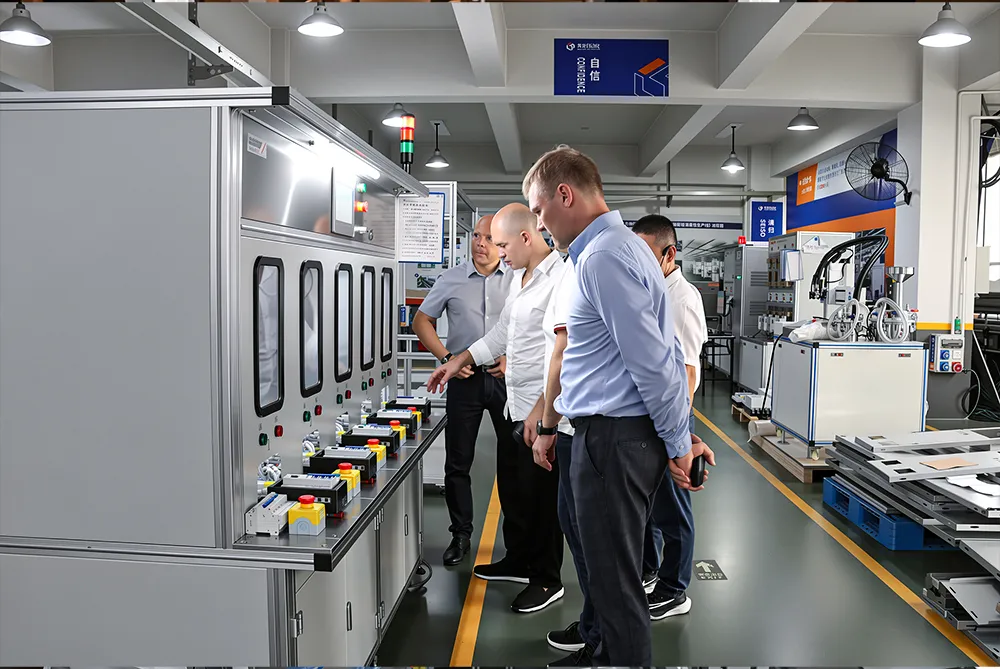
Automated Assembly System Australia Manufacturers
The manufacturing sector in Australia is gradually reinforcing itself with automation. The Advanced Manufacturing Strategy of the country, programs of defense sovereignty, and the labor costs making manual assembly unprofitable led local companies to adopt robotic and automated systems in manufacturing. It is worth noting that a small but significant number of companies appeared on the market to develop and manufacture such equipment. This guide describes the main manufacturers, what kind of products they offer, the cost of products, time frames of the projects, and how to choose either a local integrator or an international supplier.
Short answer: The top manufacturers of automated assembly systems in Australia are Mexx Engineering, Apex Automation and Robotics, Robotic Automation P/L, Bosch Australia Manufacturing Solutions; the price of an automated assembly system usually varies from AUD $100k to AUD $2 million depending on the complexity of the task performed, and it usually takes from 12 to 26 weeks to deliver it. On the contrary, international suppliers (for instance, the Chinese company benlongkj) offer similar systems by 30-50% lower prices, which makes the most qualified customers compare local and international suppliers side by side.
Why Australia Is Building Automation Now
A term like “Automated assembly system Australia manufacturer” signifies an actual turning point rather than just being part of a trend. Factors that lead local companies to purchase and local engineers to manufacture automated assembly equipment include:
- Economics of labor. The manufacturing wages in Australia and a shortage of skilled tradespeople cause the operational costs of manual assembly lines to become extremely high which makes robot cells the logical solution.
- Defence sovereign capability. Programs of the Federal Government require defense-related manufacturing to be done in Australia thus improving the prospects for domestic automation businesses with certification in defense services.
- Reshoring and supply resilience. Nowadays, a great number of Australian manufacturers are returning assembly operations to Australia.
Consequently, the domestic automation industry is something more than the reselling market as it designs, manufactures, and tests complete assembly systems finishing with the long ISO certifications and export orders.
The Leading Australian Manufacturers
Mexx Engineering (Gold Coast, QLD)
Mexx develops custom robotic assembly systems and sophisticated manufacturing lines from its Gold Coast location, holding ISO 9001, ISO 45001, and AS9100 (aerospace) certifications under a unified management system. It is an excellent choice for defence, aerospace, and high-integrity assembly as it has gained ATA accreditation for Trusted Traders from the Australian Border Force and several awards from the industry. Its systems are characterised by low human intervention and recipe-based flexibility in different sectors.
Apex Automation and Robotics (Sydney, NSW)
Founded in 2006, Apex designs and manufactures factory automation from its Seven Hills (Sydney) base, with its engineers boasting of up to 30 years of experience each. The company has delivered more than 200 turnkey automation systems in Australia and worldwide, which includes automatic assembly machines, robotic palletising, press-tending robots, robotic welding cells, and machine-vision systems. Its niche lies particularly in end-to-end packaging and assembly automation for food and beverage, plastics, and consumer products.
Robotic Automation P/L (Melbourne, VIC)
A well-known name in Australia with a long history in the robotics scene, it was founded in 1988. With over 3,500 installations in Australia and New Zealand and a market share of up to 70% in certain markets. It is the exclusive distributor of Motoman Yaskawa robots and MAX AGV making it very experienced in the market in relation to parts and servicing. The company level of expertise includes feasibility studies, real time simulation, complete robotic system building, training, 24 hours breakdown support and project financing.
Bosch Australia Manufacturing Solutions (BAMS)
BOE is also the most vertically integrated player in the market, being a robotics integrator as well as a custom machine builder with operations of Bosch Automation worldwide and its own service team. The company is also able to offer customized assembly lines, manufacturing consultancy and Manufacturing as a Service to its clients.
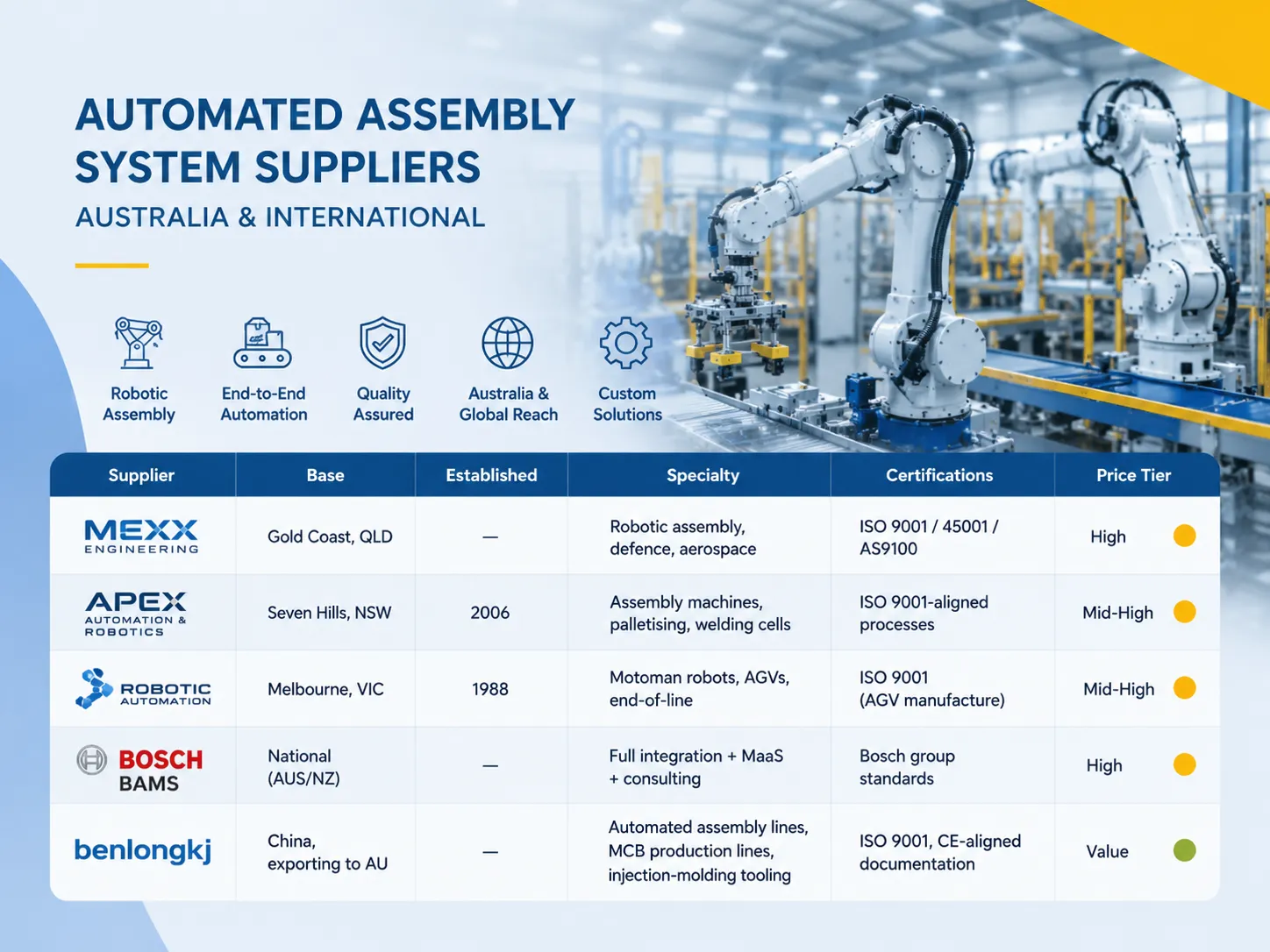
Supplier Comparison Table
| Supplier | Base | Established | Specialty | Certifications | Price Tier |
|---|---|---|---|---|---|
| Mexx Engineering | Gold Coast, QLD | — | Robotic assembly, defence, aerospace | ISO 9001 / 45001 / AS9100 | High |
| Apex Automation and Robotics | Seven Hills, NSW | 2006 | Assembly machines, palletising, welding cells | ISO 9001-aligned processes | Mid-High |
| Robotic Automation P/L | Melbourne, VIC | 1988 | Motoman robots, AGVs, end-of-line | ISO 9001 (AGV manufacture) | Mid-High |
| Bosch BAMS | National (AUS/NZ) | — | Full integration + MaaS + consulting | Bosch group standards | High |
| benlongkj (international) | China, exporting to AU | — | Automated assembly lines, MCB production lines, injection-molding tooling | ISO 9001, CE-aligned documentation | Value |
International Suppliers (Including benlongkj)
Australian procurement increasingly involves two routes whereby local integrators conduct on-site integration, retrofitting, and servicing while international manufacturers are used when specifications and volumes are easier to define. Hence, this is where benlongkj comes in, and it warrants an honest introduction instead of a marketing effort.
Benlongkj is an automated production line, molding tool set, and automated manufacturing solutions maker originating from China. This technological brand provides some advantages, such as costs that are usually around 30% to 50% lower than the cost of similar production lines manufactured in Australia and production processes with traceability., On the downside, Australian customers have to deal with distance, which causes increasing shipping and setup costs, and specifications, which require extra caution before signing the contract as changes tend to cost extra money. For buyers who are new to the decision, the custom automated assembly machine guide explains how to specify a line so that offshore manufacturing works in your favor.
What Services They Provide
Australian companies that supply manufacturing automation solutions deliver a project lifetime rather than a machine. The scope usually includes:
- Feasibility and ROI analysis, i.e. a study that evaluates if the investment pays off, normally quoted for free or charged to the project.
- Design and simulation, i.e. 3D modeling, latency simulation, and off-line programming prior to machine assembly.
- Building mechanics and electronics, i.e. production, assembly, control panels production, and programming.
- Machine vision and testing integration, i.e. system assembly with a machine vision and quality gates for automatic defect rejection.
- Implementation and commissioning, i.e. equipment rigging, wiring, and testing against the criteria for project acceptance.
- Training, documentation, and after-service, i.e. training for machine operators and maintenance personnel, technical manuals, warranty, and after-service agreements.
Ask every candidate which of these steps they do in-house. A supplier that outsources control programming or vision integration adds a coordination risk to your project — and the challenges facing automation machinery manufacturers article explains why this matters more than it used to.
Costs and Timelines
Pricing of automation assembly systems varies. Nevertheless, bands make it easy to predict costs:
| System Type | Typical Cost (AUD) | Typical Lead Time |
|---|---|---|
| Semi-automated work cell (single station) | $80k-250k | 8-16 weeks |
| Full automated assembly line | $250k-1M | 16-26 weeks |
| High-volume turnkey line with vision + testing | $1M-2M+ | 6-12 months |
| Equivalent line built offshore (e.g., benlongkj) | 30-50% below local | 10-20 weeks + 4-6 weeks shipping/commissioning |
There are three cost considerations to deal with. First of all, there is integration engineering costs (which is generally 20-40% of the total, making it commonly forgotten). Then there are the costs related to tooling and end-of-arm tools (the two costs are frequently shown separately). Finally, the commissioning costs (including travelling, installation, and quality-check) raise costs by 10% to 15%.The manufacturing automation solutions guide breaks down where the money goes in a typical automation project.
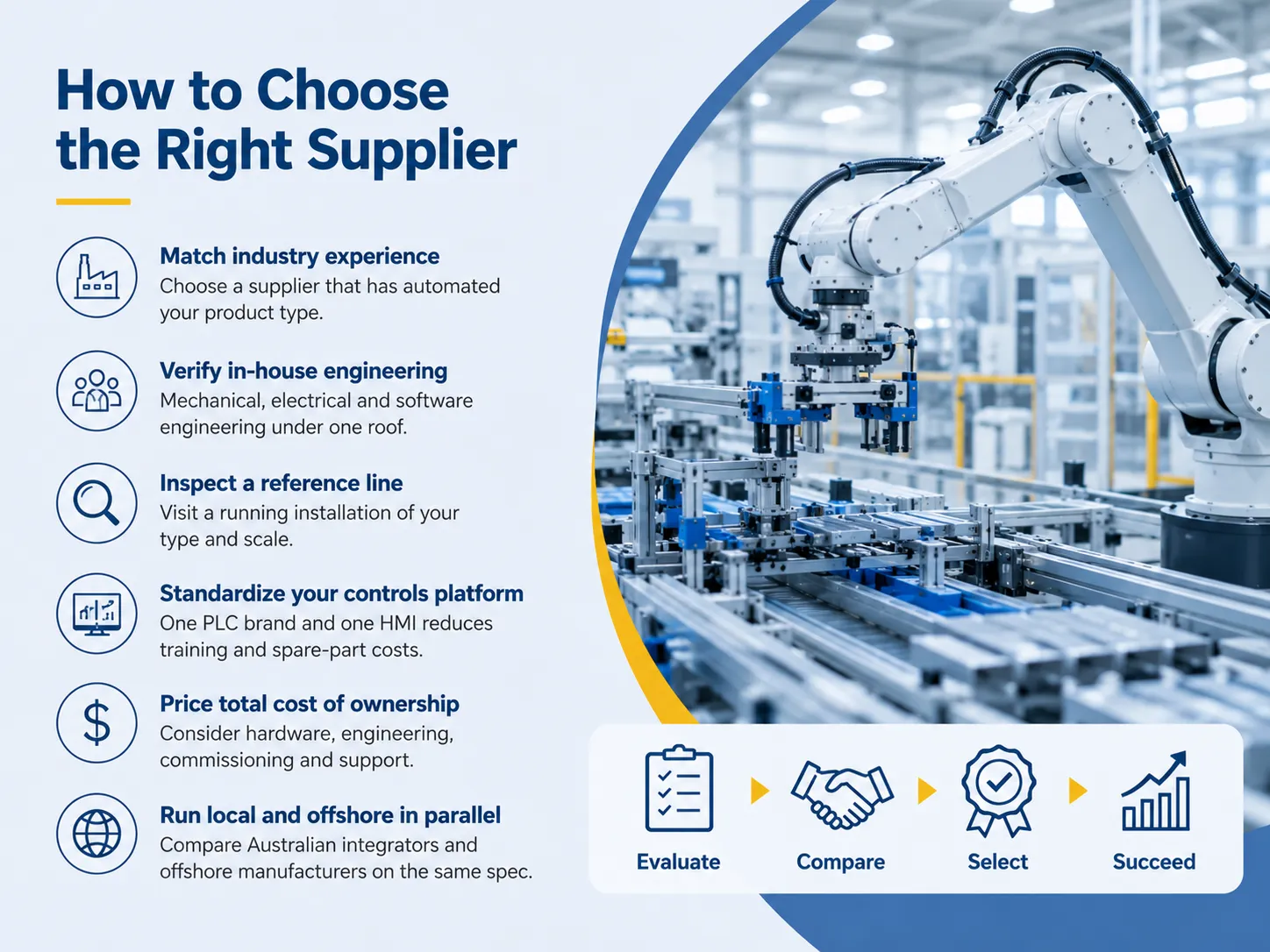
How to Choose the Right Supplier
Evaluation criteria for suppliers regarding Australian customers:
- Focus on industry experience, not on the scale of the company. The vendor that has automated the same type of equipment is aware of all possible defects. Request for examples of installations made for the same company size.
- Check whether the engineering is done in-house. Ensure that mechanical engineering, software engineering, and electrical engineering are done in one company. This is the most important factor for timely execution of orders.
- Check existing production systems. It is preferable to look at the working production system instead of looking at pictures taken for marketing purposes.
- Use the same PLC manufacturer and the same HMI for the whole factory. This will minimize repair costs and training expenses.
- Estimate total cost of ownership. Hardware + engineering + commissioning + years of support = better price than the lowest price for capital goods.
- Run parallel procedures regarding local and offshore equipment. For capital everything, two offers concerning services should be solicited with a local integrator and an offshore company like Benlongkj.products and comparisons should be made based on specifications.
For the specification discipline that makes offshore procurement safe, the industrial automation trends 2026 article is a useful read before you write the RFQ — it covers the technologies (AI vision, digital twins) that are changing what buyers should demand in a 2026 system.
FAQ
What is the typical cost of an automated assembly system in Australia?
The price of an individual automated work cell ranges from Australian dollars (AUD) 80,000 to AUD 250,000; while the complete assembly line is between AUD 250,000 and AUD 1 million. Finally, a complete assembly line with high volume automation and multiple inspections standing at AUD 1 million to AUD 2 million or more. Australian systems are usually about 30 to 50% more expensive than those from abroad leading many buyers to apply the same criteria when qualifying their options.
How long does it take to build an automated assembly system?
On average, integrators in Australia usually finish the project in 12 to 26 weeks with the biggest turnkey lines taking 6 months to 1 year depending on the complexity and many other factors including transportation of the machines to the country. Importantly, there are offshore companies producing similar machines with the possibility to ship with transport included in 10 to 20 weeks, but they also need extra 4 to 6 weeks to get them installed and commissioned.
Which Australian companies build robotic assembly systems?
The major players in the field are Mexx Engineering (Gold Coast), Apex Automation and Robotics (Sydney), Robotic Automation P/L (Melbourne) and Bosch Australia Manufacturing Solutions (Australia).
Why should an Australian manufacturer consider an offshore supplier?
The fact is that the companies having enough specification can implement at least one of their lines offshore and save lots of money while examining the specs from local companies and getting the project done by equipment from abroad though there are still some limits regarding the delivery.
References
- Mexx Engineering — Bespoke Robotic Assembly Systems
- Apex Automation and Robotics — About
- AMTIL — Robotic Automation P/L Profile
- Bosch Australia Manufacturing Solutions — What We Do
- Australian Government — Advanced Manufacturing Strategy
Conclusion
“Automated assembly system Australia producer” can no longer be considered a special search term – it refers to some of the most active sectors in Australian industry characterized by defense facilities, economic conditions of the workforce, and offshore manufacturing being brought back to the territory of Australia. The players in the local market are hardly numerous, but they are reliable at the same time: Mexx being in the aerospace business, Apex for assembly and packaging, Robotic Automation with a long history of almost 35 years, Yaskawa with extensive knowledge of a lot of things, and Bosch BAMI with reliability in providing full integration. The local companies have learned that local enterprises and foreign factories are not competitors, but rather different stages where local companies are used for integration and finalization projects – and that foreign factories can be found for providing their machines with capital equipment if specifications have been developed and it had been checked that the company in question has to earn profits in many ways.