benlong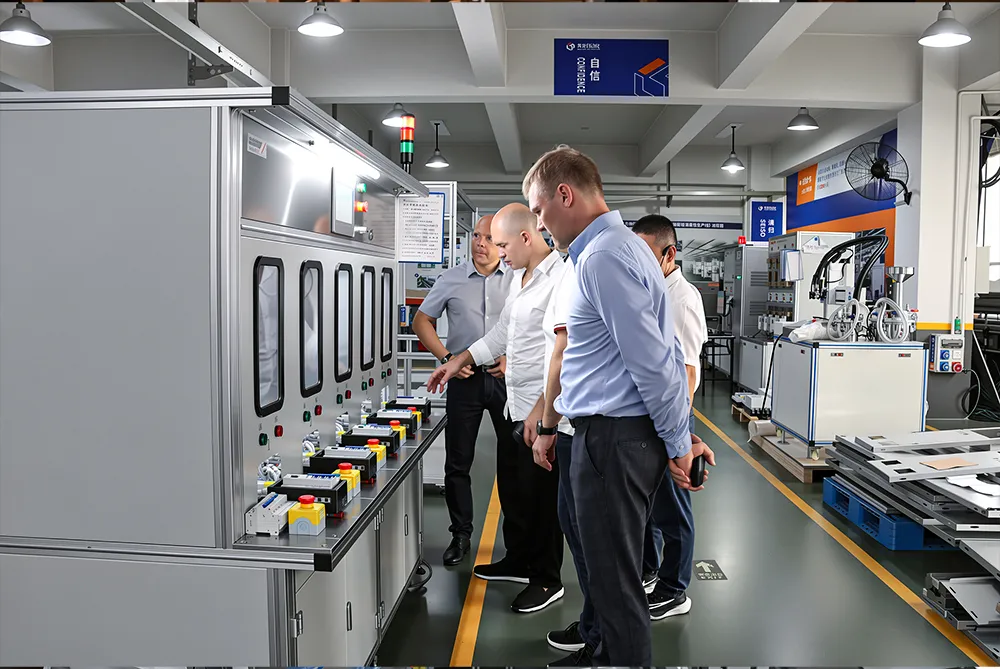

How Intelligent Automation Is Reshaping Electrical Product Manufacturing
For manufacturers of low voltage electrical products such as MCBs, MCCBs, RCCBs, AC contactors, and surge protective devices, competition is no longer just about reducing labor cost. The true challenge is to manufacture thousands of safety-critical devices each day with consistent quality and traceability, while also keeping the flexibility to switch from one model to another frequently. That is precisely the problem intelligent automation is built to solve. Rather than a single machine that performs the same fixed movement over and over again, this system features a combination of mechanical manipulation, real-time monitoring, data gathering and processing, as a result of which an entire assembly line becomes capable of checking itself while it works.
This article outlines the concept of intelligent automation in the context of electrical components’ assembly and testing line. It further elaborates on the difference between intelligent automation and conventional automation and pinpointing the segment where it brings the clearest yield for the producers of MCB and MCCB items. The article contains a special focus on the manufacturers aiming for growth in India and several rapidly blossoming export markets where getting the sequence of investments right is as important as choosing the right technology.
The urgency is tangible – while skilled labor is becoming an issue to find and retain, global customers are tightening the standards set before their suppliers, especially large distributors and panel builders from India, Middle East and Africa. Thus, the assembly lines relying on manual judgement at critical points suffer from both quality degradation due to operator’s fatigue and potential audit failure that may involve all shipment being stopped. Intelligent automation tackles the problem from its source by making quality control and record-keeping automated so that people do not need to depend on their memory and attentiveness.
Intelligent Automation in Low Voltage Electrical Manufacturing
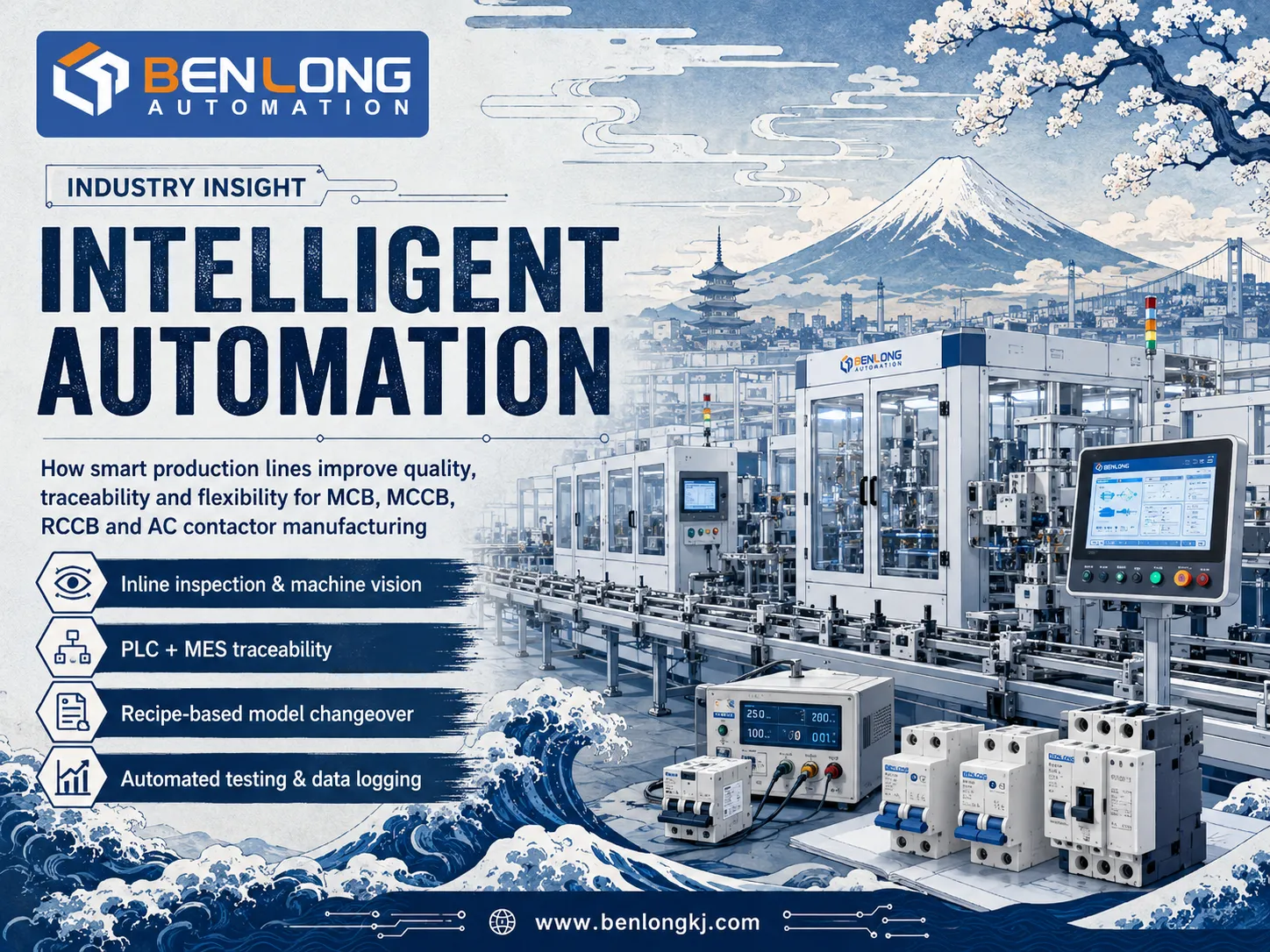
In this industry, intelligent automation refers to manufacturing systems that perform functions way beyond simple transfer of pieces from one location to another. The equipment detects the condition of all components, tests it against set standards, takes relevant actions on it without waiting for assistance to trigger it. For instance, in the calculation of the MCB production line, a specific position may measure the space between contacts, confirm that spring is present, check the performance of trip current, and perform the operations of passing the unit to the subsequent location or moving defective elements – all the operations being melded with the relevant serial number.
The term “intelligent” is indicative of the feedback loop. A regular pneumatic press will manufacture the same part the same way irrespective of the fact whether this part is defective or perfect. As for the intelligent automation system, it processes the information after every run cycle and utilizes it twice: for quality security in real time and for permanent data collection useful for subsequent operations carried out by the quality control and engineering units. It is the dual commitment – manufacturing and confirming – that distinguishes a contemporary production line from a mechanical one.
One of the best examples can illustrate it. In the case of a manual RCCB test bench, the operator introduces a fault current, notes a trip and writes down the result in the document. The recording process can be disrupted by fatigue, distraction or market pressure. In the case when the job is done by an automated test bench, there are no issues with processing the data in a proper way since the process is controlled, the information is collected electronically with immediate comparison to IEC limit standards, and the results are registered in the database connected to the serial number assigned to the product. The product cannot go further if it has not gone through the test successfully.
Traditional Automation Versus Intelligent Automation
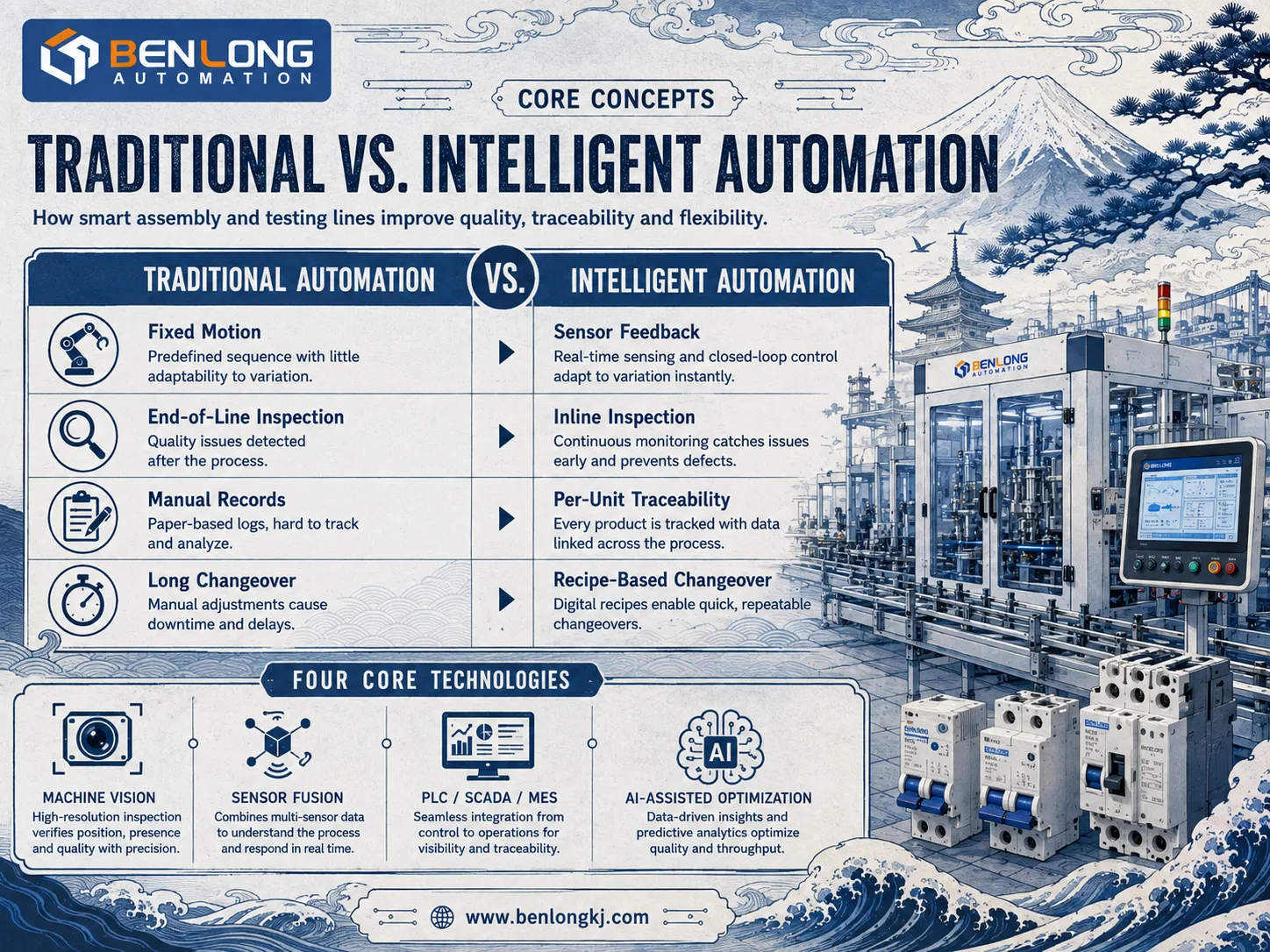
All electrical factories have some form of automation. This can be something as simple as an indexing dial table, a vibratory bowl feeder, or a semi-auto riveting station. While these machines are important, they are mostly open-loop systems. They are able to complete a fixed motion but rely on the operator to detect a problem. Intelligent automation closes this gap and the different between conventional and intelligent systems is very clear across the production process.
Traditional automation solutions work on pre-defined actions. On the other hand, intelligent systems deliver solutions based on information coming from sensors.
A traditional production line only identifies faults during the final inspection while intelligent systems can detect faults at the site of fault creation.
Traditional equipment produces goods but with the help of intelligent automation solutions it is possible to generate data about the fact that the produced goods meet IEC requirements.
Changeover in traditional manufacturing requires a physical change of equipment while intelligent manufacturing relies on using digital design for a quick changeover.
The cultural factor should not be overlooked as well. Traditional automation treats the inspection department as responsible for quality. In the case of intelligent automation, quality becomes the reason to pass from one station to another.
The practical takeaway is that you rarely replace everything at once. Most manufacturers adopt intelligent automation in stages, upgrading the stations where quality risk and labour cost are highest before touching the rest of the line. A structured, phased path is usually the safest way to protect both cash flow and output, and it is the approach we describe in more detail under automation system upgrade services.
The Core Technologies Behind Intelligent Automation
Understanding intelligent automation is easier when you break it into the technologies that make the feedback loop possible. Four building blocks appear on almost every advanced electrical production line.
Machine Vision and Inline Inspection
Vision systems, the eyes of the line. At an MCB or MCCB station, a camera can check that a presence of spring and contact, read and verify the marking on the body, and monitor the position of a flag indicator. Inspection takes place in line rather than on separate control bench, allowing for the identification and removal of defective part within a few seconds of fault occurrence instead of a few hours at the final packing stage.
Sensor Fusion and Real-Time Measurement
Only informed stations avoid using single capture for the operation. Force sensors are employed on riveting or pressing stations in order to determine whether the joint is performed correctly; laser displacement sensors act to give the value of the gap within millimeters; test bench gauges that display current and voltage allow determining electric processes. The mix of several signals of the same unit known as sensor fusion gives a more reliable result than any signal alone.
PLC, SCADA and MES Integration
The aforementioned measurements only become relevant when interconnected. Intelligent automation requires the integration of station controllers (PLCs) with line-level control (SCADA) systems to a manufacturing execution system (MES). The ISA-95 standard defines in detail how these levels must communicate to ensure that each device retains the record of data throughout its production process from the first station to packing. The integration is what turns the disconnected smart devices into a connected line.
AI-Assisted Process Optimisation
Once ample data is collected, machine learning models can notify managers of process drift before scrap is created, forecast when a welding electrode or feeder will need maintenance, and bring attention to the equipment stations that impede throughput. However, we need to be clear about one important limitation in the use of AI: in the case of safety-related electrical products, AI should always assist engineers, but not substitute the hard pass and fail limits as defined by the standards of IEC 60898 and IEC 60947-2. The intelligence can help to optimize the process while the standard still defines what “good” is.
Intelligent Automation Across the MCB, MCCB and RCCB Production Chain
The clearest way to see the value of intelligent automation for low-voltage electrical products is to walk the production chain stage by stage, because each stage benefits in a different way.
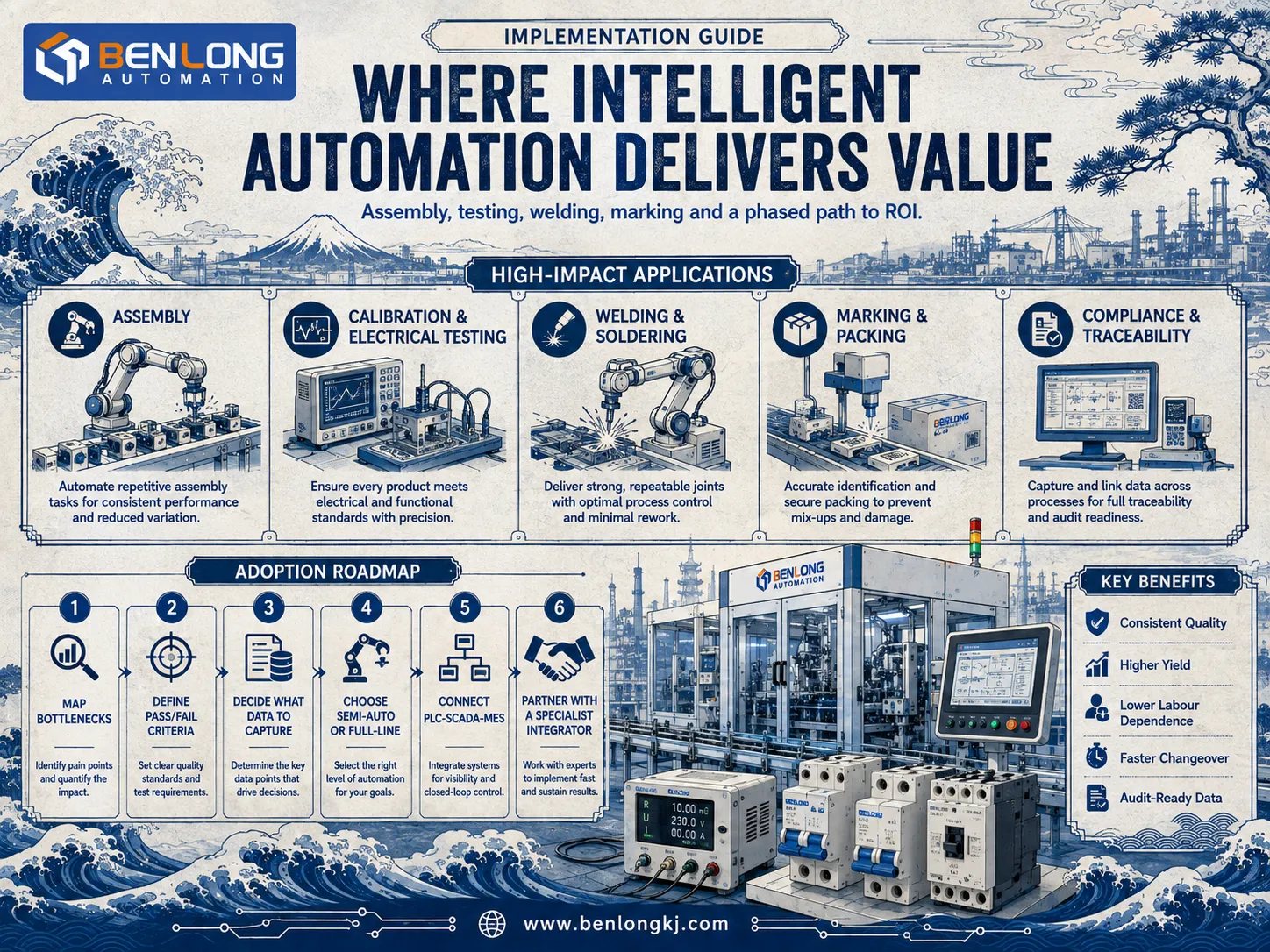
Assembly
Component feeding, riveting, spring insertion and mechanism assembly are all points where a small error becomes a field failure. Force monitoring on each press confirms the joint, vision confirms component presence and orientation, and the line rejects any unit that falls outside tolerance. Our assembly project solutions are built around exactly this closed-loop principle.
Calibration and Electrical Testing
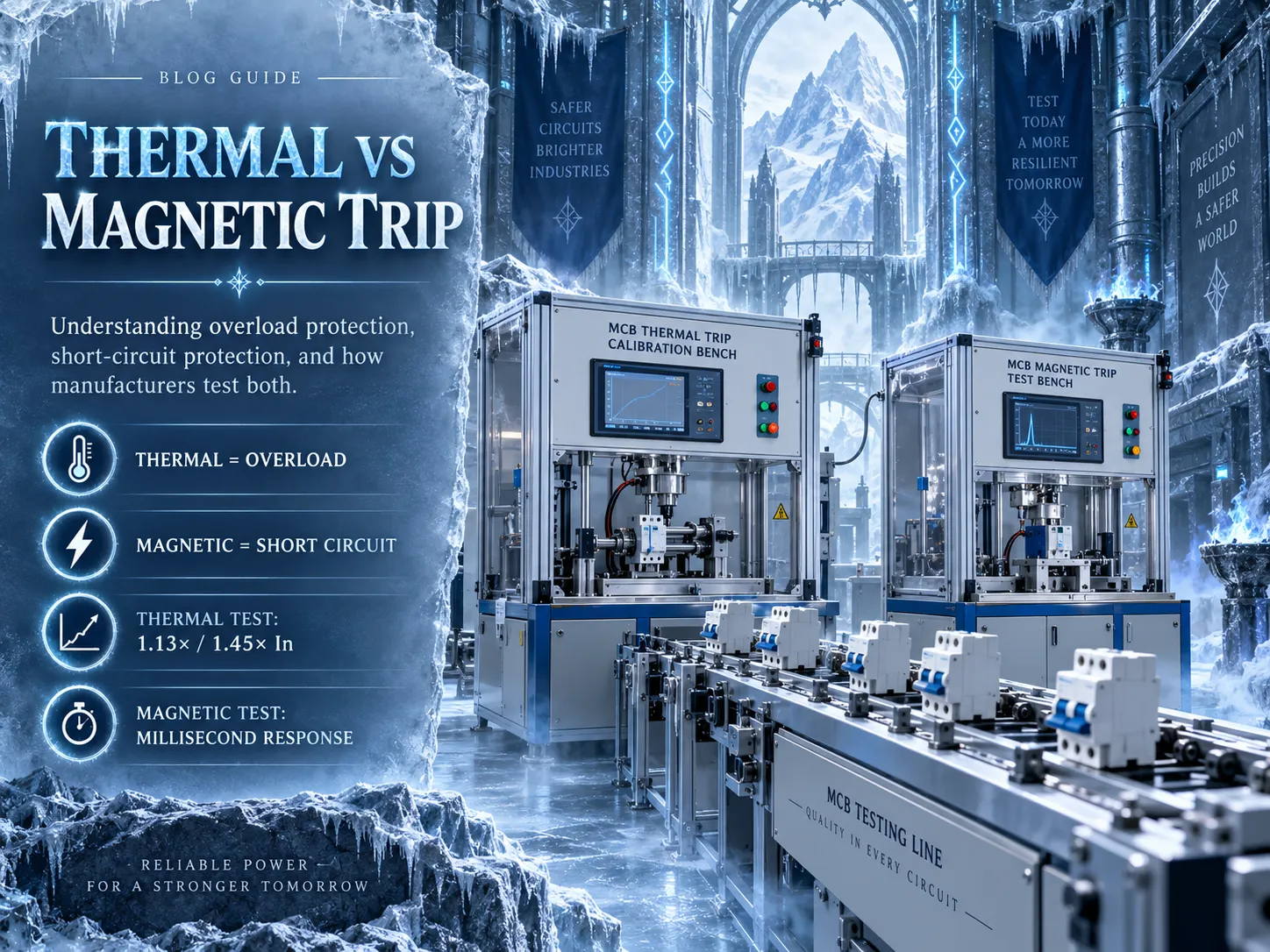
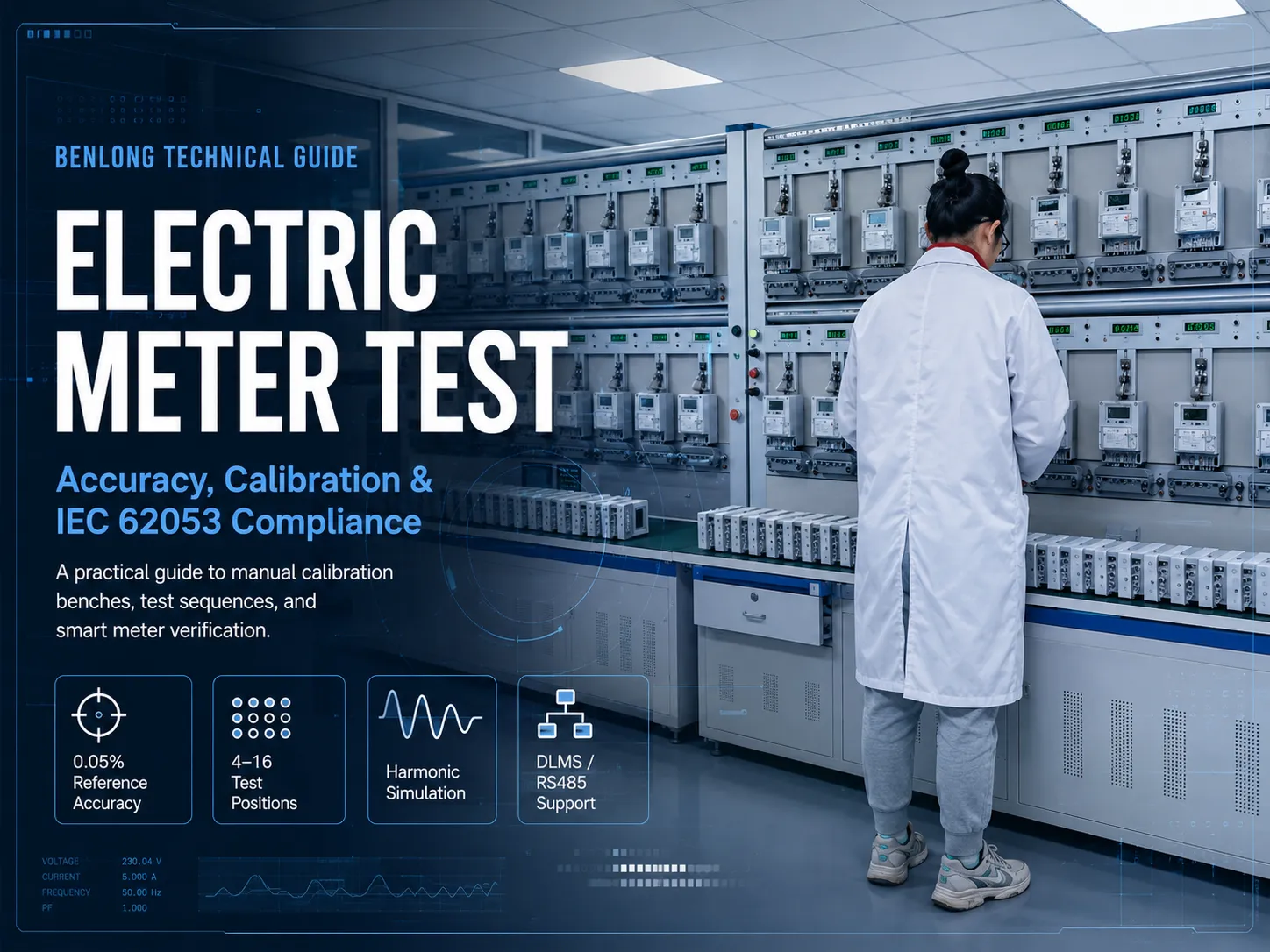
This is where intelligent automation usually pays back fastest, because manual testing is slow, repetitive and prone to human error. Automated benches perform tripping tests, dielectric and high-voltage tests, and mechanical endurance checks, capturing the result of every test against the unit’s serial number. You can explore the range under our test bench project equipment, which is designed so that test evidence is generated automatically rather than transcribed by hand.
Welding and Soldering
Silver contact welding is a critical, quality-defining process for MCBs and contactors. Resistance and laser welding stations with inline weld-quality monitoring ensure each joint meets specification, and units with a suspect weld are flagged immediately. See our welding and soldering project equipment for how monitoring is built into the process itself.
Marking, Printing and Packing
Printing and safety labels should be clear and correct; hence the forgoing pad printing and laser marking stations should ensure that the prints are correct. The check indicator should be verified to ensure that it has the right color and details. Then comes the automation of packing which checks that the product and quantity are approved before cartoning.
There is clear consistency in the pattern as there is regular verification at the various stages of the process not to mention that the end-to-end factor of performance is seen at all levels of production. This means that you can always trace the history of a ready-made MCB or MCCB backward through the cartoning procedure.
Why Intelligent Automation Matters for Electrical Product Manufacturers
When the technologies above work together, the benefits compound. The gains most often reported by MCB and MCCB producers moving to intelligent automation are:
- There is guaranteed quality with all products being evaluated according to the same standard at a single location. The system can give data for all products so it can be audited by both IEC and clients.
The system enables to decrease the reliance from highly qualified specialists and lets them work on more complicated engineering problems.
With in-process detection of faults, the lines will have higher yield as they will catch the faults before the final inspection.
The automation system will also allow for shorter leads time to switch production modes.
The data will serve as a basis for constant improvements.
It is important not to give into temptation to reduce these achievements to one figure only; it is the efficiency of automation that makes it successful instead of separate figures like slight improvement in yield, decrease in warranty cases, faster transition to another production mode. Also it should be said that blind comparison of automated and manual methods of production can lead to wrong assessment as the manual technique cannot give such information.
Intelligent Automation and IEC Compliance
Compliance is no longer a document you produce at the end; increasingly, buyers ask for test evidence per batch or even per unit. MCBs are governed by IEC 60898 (and IS 8828 in India), MCCBs by IEC 60947-2, RCCBs by IEC 61008 and IEC 61009, and solid state relays by IEC 62314. Because intelligent automation systems capture test data as a natural part of production, compliance becomes a by-product of making the product rather than a separate paperwork exercise. Traceability should be designed into the line from the start, never bolted on afterwards when a customer audit is already scheduled.
Common Barriers to Adoption and How to Overcome Them
If the case for intelligent automation is so clear, why do many electrical factories hesitate? In practice the barriers are predictable, and each has a well-established solution.
- Cost considerations: the undertaking should be seen as involving a staged approach to funding, where implementation begins with the sites which present the greatest risk in terms of quality or cost of the workforce, and not as a single major expense.
Concerns about loss of production during installation: a modular commissioning approach allows the latest smart station to operate alongside existing production until it is established as fully functional, thus avoiding any disruption to operations.
Skills shortages: modern human-machine interfaces and recipe management systems reduce the amount of training needed for personnel and a qualified integrator takes care of installation and training work.
Risks of being locked-in: the use of PLC, SCADA and MES systems based on internationally recognized standards allows clients to prevent changing their supplier due to integration into a proprietary system.
Fears of model changeover: recipe management systems provide for the storage of parameters of every product model and switching from one to another takes just a few clicks of the mouse.However, these issues should not become an obstacle to a firm’s going forward. The actual cost of inaction — lost tenders, failed audits, continuously rising labor costs — is usually much higher than the cost of executing the first step. The companies that find it difficult to keep up are rarely those that acted too early; rather, they are those who postponed the decision until a lost deal made it necessary.
Considerations for Manufacturers in India and Emerging Markets
The wage structure and fast demand growth make a gradual approach a good option for manufacturers looking to expand in India. Implementing semi-automated intelligent stations at your high-value activities such as testing or welding may provide a better return than starting with a completely automated workshop. Ultimately, what is best for manufacturers depends on their production volume, product portfolio, and access to capital.
This is why practical intelligent automation solutions should be matched to the factory rather than sold as a one-size-fits-all package. A producer shipping a narrow, high-volume MCB range has very different needs from one running dozens of MCCB and contactor variants in smaller batches. Benlong designs both semi-automated stations and full-line systems so the investment fits the stage the business is actually at.
The export dimension matters too. Many Indian and regional producers are not only serving their domestic market but bidding for contracts where the customer specifies IEC test evidence as a condition of purchase. In that context, intelligent automation is not merely an efficiency play; for many tenders it has become a market-access requirement. A line that can hand over per-unit test data with every shipment can compete for business that a purely manual operation cannot realistically win.
How to Begin Your Intelligent Automation Journey
A sensible path into intelligent automation in manufacturing follows a clear sequence rather than a single large purchase:
1. It is necessary to map the process and detect the stations that require a highest quality savings or labor costs.
2. You should set up criteria for successful completion of each process station based on the relevant IEC standard.
3. The next is to define the information that needs to be collected for each unit produced (serial number, testing parameters, operator name, time).
4. Once you know the data to be collected, you can decide whether to automate station or the entire line taking into consideration the volume produced, combinations of the line and your financial capabilities.
5. It is also important to plan the PLC, SCADA and MES integration in advance, so that the data can meet be stored in one place and not on each and every machine.
6. Finally, make sure to find the company, which specializes in manufacturing low-voltage products and not only assembly technologies.
Conclusion
Intelligent automation is not a single machine you buy off a shelf; it is a capability you build station by station, closing the loop between making a product and proving it. For MCB, MCCB and RCCB producers, the manufacturers who lead over the next decade will be those whose lines can guarantee quality, adapt quickly to new models, and generate the traceable data their customers now demand. If you are ready to plan that path, explore our production line project capabilities or talk to our engineers about a solution matched to your products and volume.
Huang Xiaolei | Benlong Automation