benlong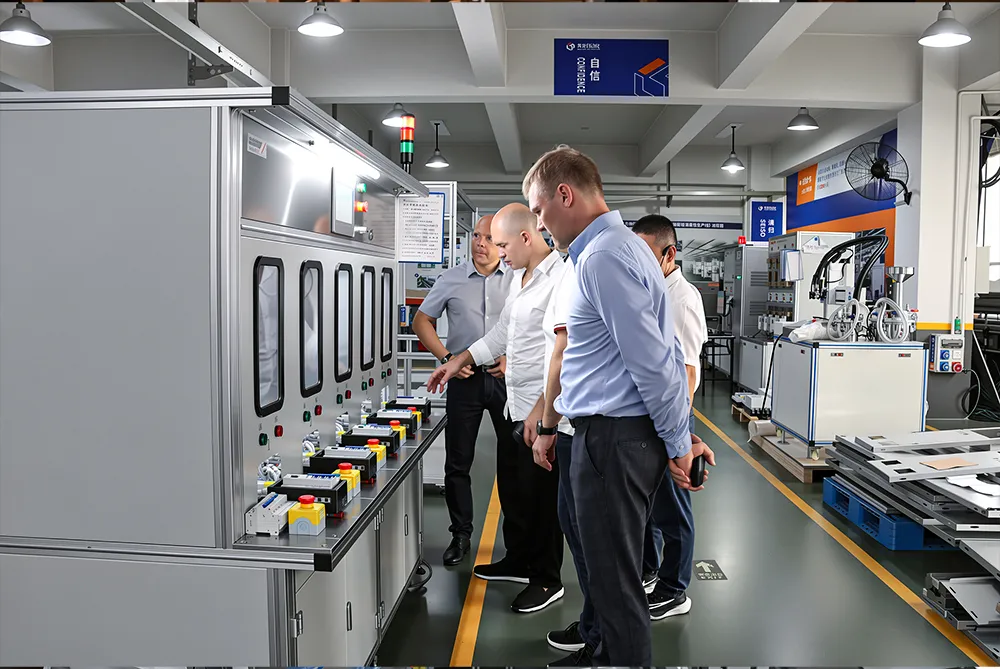


What Is the MCB Line?
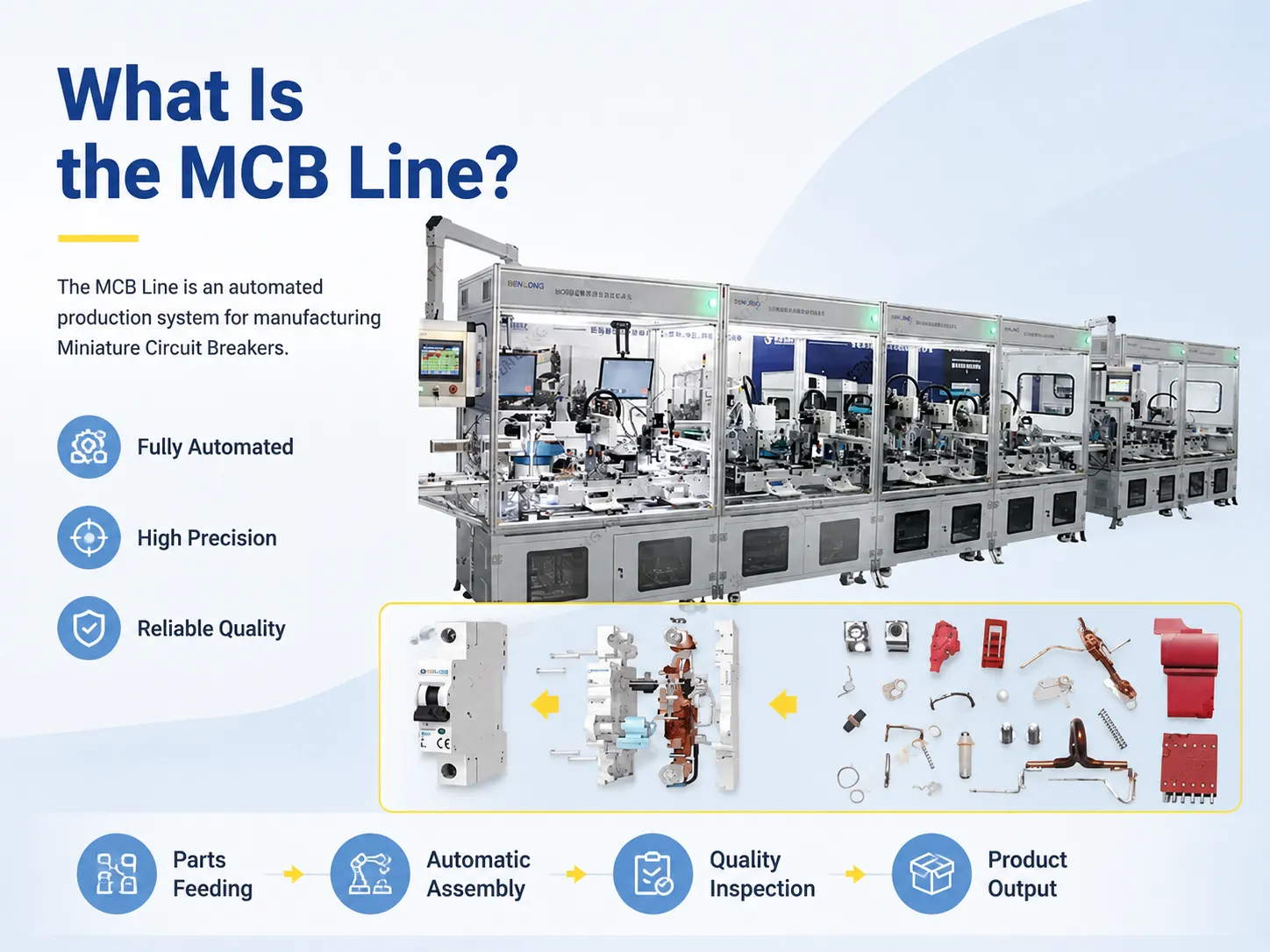
You’ve entered a switchgear factory located in China, and you keep hearing the sales manager say phrases like “we have three MCB lines producing 24 hours and 7 days” and “our latest MCB line produces 14,000 units per day.” You look behind and see a huge machine that starts its journey at one end with all the parts coming into it while equipped with a testing mechanism and continued process until circuit breakers come out of it at the other side. It can be safely said that this machine is an MCB line — the main manufacturing tool for constructing miniature circuit breakers.
This guide will tell you more about the MCB line including its definition, the way it operates, the machines and projects used, its price and usage in the manufacturing industry.
Short answer: MCB line (MCB line) is an automated (or semi-automated) assembly process to manufacture miniature circuit breakers from components to finished tested products. Classic line incorporates assembly units, riveting, testing (mechanical, thermal, magnetic trip calibration and dielectric/hi-pot), laser marking or pad printing, and packing – managed by PLCs, including data storage for traceability.
What Is an MCB Line?
An MCB line is known as an assembly and test system for miniature circuit breakers. Many electronic components like MCB bodies, contacts, bimetal strips, trip coils, arc chambers, handles, springs, and terminals are used in this manufacturing system to generate fully prepared, tested, and packed MCB devices. This method is an automated version of the manual assembling of circuit breakers, and therefore the manufacturing process is performed on a large scale rather than producing a few hundred devices per day.
The assembly line incorporates various machine groups. It combines assembler machines, riveting machines, testing machines, marking machines, and package devices. The whole process is performed through a human-machine interface connected to the PLC control system.
Why the MCB Line Matters to Buyers
When buying MCBs (whether as a distributor, panel builder, or OEM), the quality of the manufacturing process determines what you’ll be receiving:
- Regularity: Automatic lines have the ability to adjust each circuit breaker according to the desired trip mechanics (B/C/D) in a way that cannot be replicated with a manual sales route.
- Traceability: Nowadays, automated lines record data for every product by unique serial numbers that can be linked to MES/ERP — if an MCB batch breaks down on-site, the producer can find its way back to the line, time, and parameters of its production.
- Certification possibility: High-quality manufacture with proper records makes it possible to get IEC 60898 / UL 1077 certified.
- Capacities and lead times: A manufacturer of MCBs that utilizes machines in the production process can guarantee shorter deadlines and greater orders than someone assembling the MCBs manually.
Thus, asking “which MCB lines to you use?” is a benefit-seeking question that gives you valuable insights into the manufacturer.
The Machines Inside an MCB Line
| Station / Equipment | Function | Notes |
|---|---|---|
| Component feeders & loading | Feed housings, covers, contacts, springs, coils into the line | Vibratory bowls, robots, or AGV loading; QR/serial printing at entry |
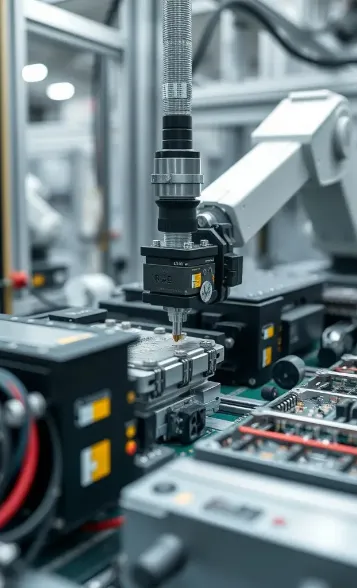
| Assembly units | Place arc-chamber plates, magnetic guides, handle springs, trip coils, iron cores, terminals, adjustment screws | 10–25+ assembly processes per pole; CCD vision checks after key steps |
| Riveting presses | Rivet contacts and internal joints for solid electrical connections | Pneumatic or servo presses with force monitoring |
| Mechanical test | Verify on/off function, handle movement, contact operation | Automated actuation + sensors |
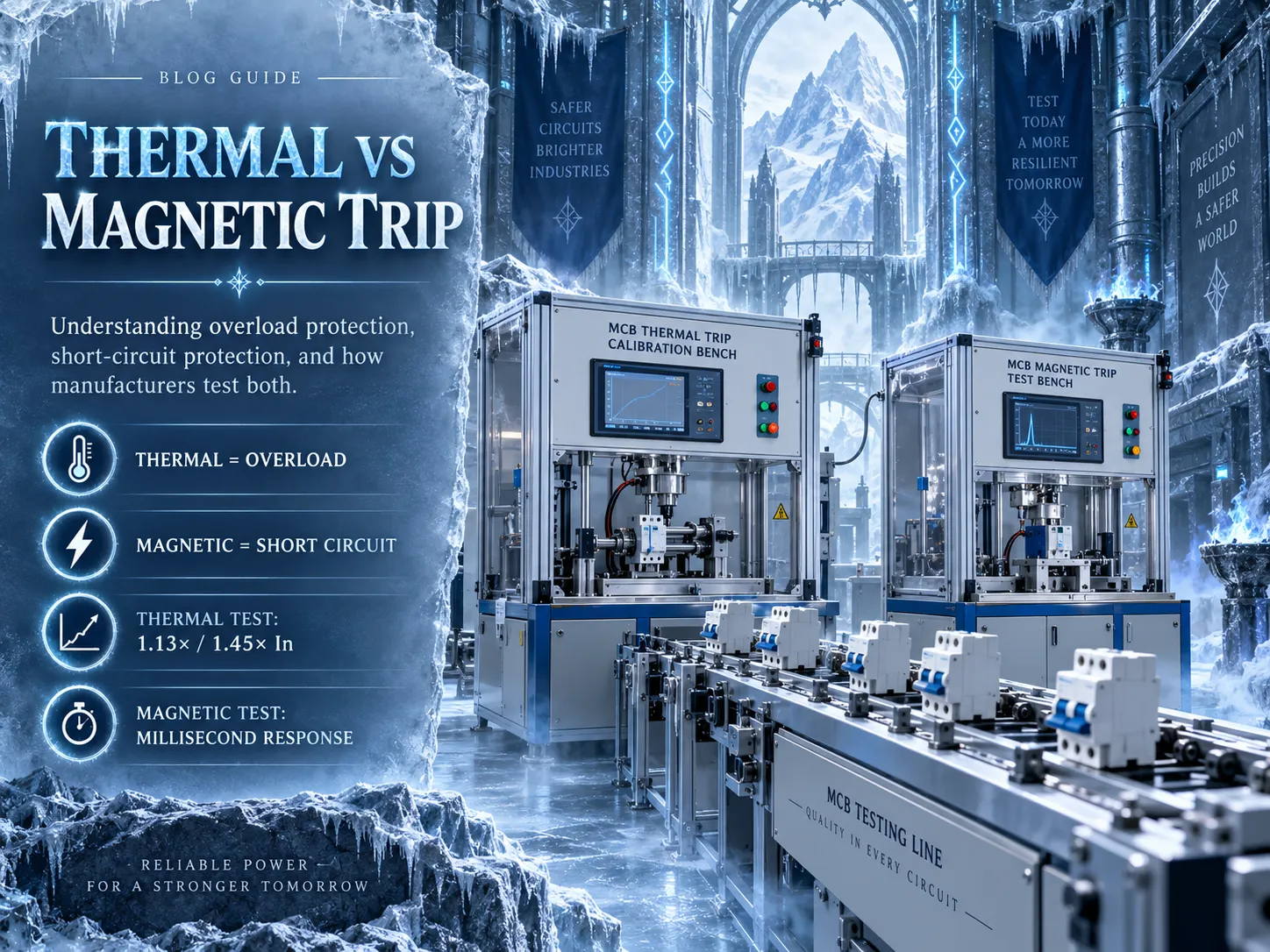
| Thermal (long-delay) trip test | Calibrate bimetal strip: verify tripping at overload current within time spec | Constant-current supply (e.g., up to 230A test capability) |
| Magnetic (short-circuit) trip test | Verify instantaneous magnetic trip at high current (e.g., up to 990A) | Validates B/C/D curve behavior |
| Hi-pot / dielectric test | Apply high voltage between live parts and housing to check insulation | Dielectric withstand verification |
| Marking / laser / pad printing | Print rating, curve, logo, and QR code | Laser for permanence; QR for traceability |
| Sorting / reject system | Divert failed units to a reject bin; pass units continue | Automatic classification |
| Packaging | Bag/carton packaging, labeling | Often integrated or semi-integrated |
Add-ons that are optional include several stations such as the cooling station, screw tightening station, multi-pole linking stations (2P-4P), as well as the entire MES/ERP networking that possesses a data storage capacity. (Certain systems have the ability to store the traceability data for a few years).
How the MCB Line Works: Step by Step
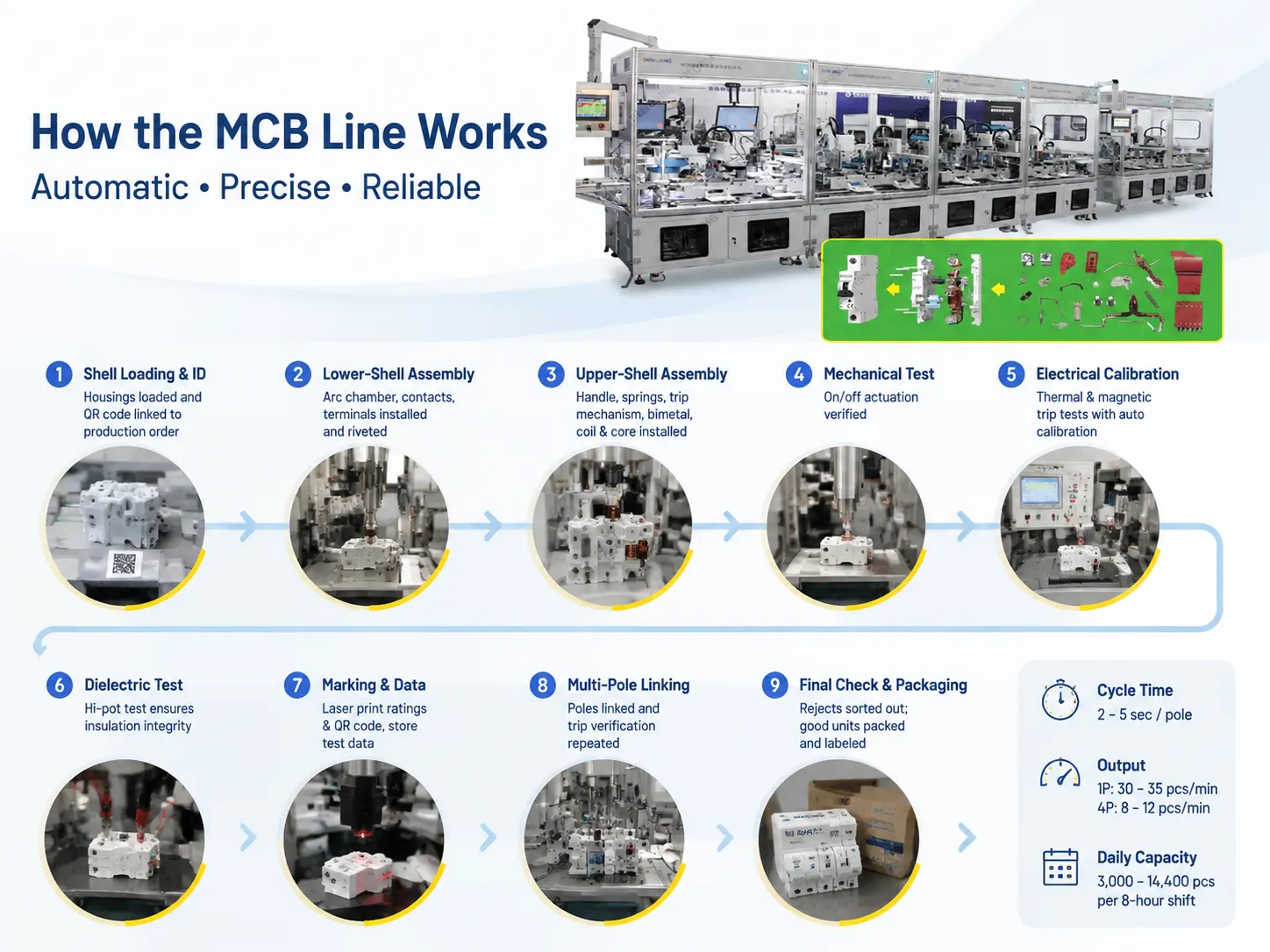
Here is a standard automatic MCB production:
- Shell loading and identification: The loading of upper and lower shells can be carried out either automatically or through the AGV, with the unique QR code assigned to the each item.
- Lower shell assembly: The process of loading the arc chamber plates, magnetic guides, and contacts begins, with every step followed by a quality check and rivet fastening.
- Upper shell assembly: At this stage, the handle, springs, trip mechanism, bimetal, coil and the iron core are assembled, after which both parts are put together.
- Mechanical test: The actuator is checked to ensure operation; adjustment of the regulators is done if required.
- Electrical adjustment: The thermal and the magnetic trip tests are performed, which usually include the automatic adjustment of the calibration screw to allow changing of the trip thresholds.
- Dielectric test: At this stage the insulation is tested for integrity.
- Marking and data: The necessary ratings and QR codes are printed on the products; the data is saved and assigned to each serial number.
- Poles linking (2P-4P): Here the linking of the poles is performed; in some cases additional delay/trip test is conducted to check for stability of the product.
- Final check and packaging: Manufacturing rejects are isolated; good products are packed and labelled.
Cycle time for automatic manufacturing is approximately 2-5 seconds per pole2 (the larger the amount of the poles in the device, the longer the cycle time); 1P can be produced in a high-speed plant up to 30-35 pcs/min, while production of 4P requires up to 8-12 pcs/min. The total productivity during an 8-hour shift in a middle-speed plant can be in the range of 3,000-8,000 poles; for a high-speed plant it equals approximately 14,400 units/day.
Automation Levels: Manual, Semi-Auto, Fully Automatic
| Level | Description | Throughput | Cost Range |
|---|---|---|---|
| Manual bench | Workers assemble by hand with jigs and separate test stations | ~100–300 pcs/shift/worker | Minimal equipment cost; high labor |
| Semi-automatic | Some automated stations (riveting, testing) with manual loading/transfer | ~500–2,000 pcs/shift | $30k–$150k |
| Fully automatic | Integrated line: auto feed, assembly, test, mark, sort, pack | 3,000–14,000+ pcs/day | $200k–$600k+ |
The right level depends on volume, labor costs, quality requirements, and product stability. Many factories start semi-automatic and upgrade as volume grows — this is exactly the manual vs automated trade-off we cover in our guide to fully automated vs semi-automated production.
What an MCB Line Improves
- Dependability and quality: Each breaker is put together and adjusted the same way—its trip characteristics are not affected by the person working with it.
- Efficiency: One automated line is capable of replacing dozens of workers and producing at 10–50 times the normal speed.
- Traceability: Our MES and ERP systems allows us to maintain a record of production at the serial number level proving the full product history and allowing for certification and repairs in case of defects that occurred in the field.
- Decrease of manufacturing cost: The larger the production volume, the smaller the share of fixed costs in the price of production; it also brings lower volume of rework and rejects.
- Reduced human mistake factor: The system is designed so that all wrong assembly defects are removed by means of vision systems of automatic inspection.
- Safety: Thus, the number of accidents associated with spring and rivets handling is substantially reduced.
- Competitive edge: The certified, steady and traceable product makes it possible to win orders from distributors and OEMs.
How Much Does an MCB Line Cost?
Pricing varies widely by automation level, capacity, and brand. Realistic ranges from manufacturers’ listings:
| Line Type | Typical Price | Capacity |
|---|---|---|
| Basic semi-automatic line | $30,000–$80,000 | ~500–1,500 pcs/shift |
| Mid-range assembly + testing line | $80,000–$150,000 | ~1,500–3,000 pcs/shift |
| Full automatic line (1P–4P) | $200,000–$460,000 | 30–35 pcs/min (1P), 8–12 pcs/min (4P) |
| High-end integrated line (MES-linked) | $460,000–$600,000+ | Up to ~14,400 pcs/day |
Additional costs include tools and fixtures, calibrators, MES software integration, installation and training, as well as spare parts. A complete high-speed production line with full IT integration may cost anywhere between $600k and $1M. Payback period depends on the volume of products being produced; e.g. in factories with production capacity in excess of 10,000 products per day, automatic production lines have payback periods of between 1 and 3 years compared to manual production costs.
MCB Line Manufacturers & Brands
The market for MCB line equipment is dominated by Chinese companies (which produce equipment for MCCBs, ACBs, and contactors):
- Hongxin Automation (Wuhu, Anhui): Fully-automated MCB assembly and testing lines; costs between $30,000 and $300,000 and above depending on the project size; good integration with MES/ERP systems, and processing capabilities of around 14,400 units a day.
- KESU Automatic Equipment (Hangzhou): Automatic MCB assembly and testing machines (~$460,000 to $600,000); servo mechanics, camera controls, and capability for 1P-4P production at 30-35 units per minute (1P).
- Zhejiang Huiju Automation (Yueqing): Performs custom automation for MCB productions; rotary station system with around 2s/pcs efficiency; OMRON PLCs, touchscreen MCGS systems, SMC cylinders, EPSON or FANUC robotic systems available.
- Shanghai NoFuel: Automatic assembly and inspection systems, the price starts at $50,000; There is the use of PLCs and SPC and OEE monitoring systems.
- Other entrepreneurs from the area: Many companies around Wenzhou/Yueqing (the capital of the Chinese low-voltage industry) are ready to produce semi-automatic or completely automatic machines according to customers’ specifications.
When choosing a supplier make sure to ask for: guarantees regarding the productivity, transition time between 1P (1-pole) and 4P (4-pole) systems and their B/C/D curves, testing capacities, MES/ERP integration, levels for rejected units, and warranties.
Buying an MCB Line: Key Considerations
- Identify your range of products: 1P–4P? Which current ratings (1–63 A)? B/C/D curves? Toggle switch requirements?
- Set goals for throughput: Daily production will affect automation levels and cost.
- Verify testing capacity: Current range for thermal test (e.g. up to 230 A), magnetic test (e.g. up to 990 A), hi-pot voltages.
- Determine the requirements for traceability: Serial-level data, network MES/ERP, period of storage.
- Check current quality systems: Vision inspection, reject handling, OEE and SPC reports.
- Negotiate a complete package: Tooling, installation, training, commissioning, spare parts, warranty, and after-sales service.
- Request reference lines: Visit or video call operating factory producing the same range of products.
Frequently Asked Questions
Which wire is MCB connected to?
When set up in an ordinary way, the MCB will connect to the live wire, meaning that the live current from electricity enters into the line terminal of the MCB which is usually identified either with the number “1” or the line symbol and the outgoing current leaving the load wire will enter into the load terminal, indicated by the number “2”. The neutral wire is connected to the neutral outside the MCB (this is more relevant for single pole MCB). While using the 2-pole MCB, both the line and neutral current will pass through this unit with both line and load terminals present at both poles.
Is MCB the same as circuit breaker?
Yes—a MCB (Miniature Circuit Breaker) is a kind of circuit breaker. “Circuit breaker” is the blanket term used to identify any apparatus that shuts off current in the event of a short circuit or overload; MCB is a particular type of small-size low-current (up to 63-125A) thermal-magnetic breaker primarily used for home and light commercial installations. Other types of breakers include MCCB (molded case and used for higher current), ACB (air circuit breakers), VCB (vacuum), and many more used in industrial/high-voltage applications. Thus, while every MCB is a circuit breaker, not all circuit breakers are a type of MCB.
Can I use MCB as main breaker?
Certainly. An MCB can be utilized as the main breaker (the main disconnect or switch) for home or light commercial installations if the rating of the MCB suits the service – a 63A or 100A MCB can function as the main breaker in typical residential settings. It is also important to note that codes and standards must be upheld: the main breaker has to be rated for the service, breaking capacity of sufficient level (IEC60898-1 / 60947-2), and requirements of the panel itself. In case of large services (200 A and higher), manufacturers of MCCBs and other types of breakers usually operate. Always check with your electrical contractor or the code in the local area.
How to connect MCB in a circuit?
To install an MCB, the following steps should be followed: (1) turn off the power supply; (2) Place the MCB on the din rail in the distribution box; (3) connect the incoming live wire to the line terminal, which is at the top and is number 1; (4) connect the outgoing live wire to the load terminal, which is located at the bottom and is number 2 wire that goes to the circuit being protected; (5) connect the neutral wire to the neutral busbar (for single pole switch) or connect it via the second pole (for two-pole switch); (6) connect the earth/grounding wire according to the installation wiring; (7) fasten all terminals, check polarity and tightness. Some manufacturers provide torque specifications for terminals, which should be followed together with your local electrical standards. If you are not sure about the installation process, you can use the services of a licensed electrician to do wiring.
References
- IEC 60898-1 — Miniature circuit breakers: standard and test requirements
- IEC 60947-2 — Circuit breakers for industrial application
- MESA International — MES standards and manufacturing execution systems
- ISA-95 — Enterprise-control system integration for production lines
- KESU — automatic MCB assembly and testing line specifications
- Hongxin Automation — MCB automatic assembly line product data
Conclusion
The MCB manufacturing line represents the essence of the automatic miniature circuit breaker manufacturing process comprised of sequences of assembly, riveting, testing, marking, and packaging processes to convert components into certified miniature circuit breakers. The line operates at speeds ranging from 2 to 5 seconds for every pole, accommodates miniature circuit breakers with B/C/D curves operating on 1P to 4P circuits, and has the cost range that starts from $30,000 for semi-automatic installations and reaches over $600,000 for full automation requiring MES and ERP systems for tracing.
For the clients, it delivers the certainty that they can rely on the quality of products provided by their suppliers as automatic, tested, and traceable production processes create the conditions for getting mini circuit breakers with stable trip curves. For factory owners, it is a classical return on investment calculation involving production volumes, the stability of products, and labor costs to determine whether it is worth investing in manual, semi-automatic, or fully automatic production lines.