benlong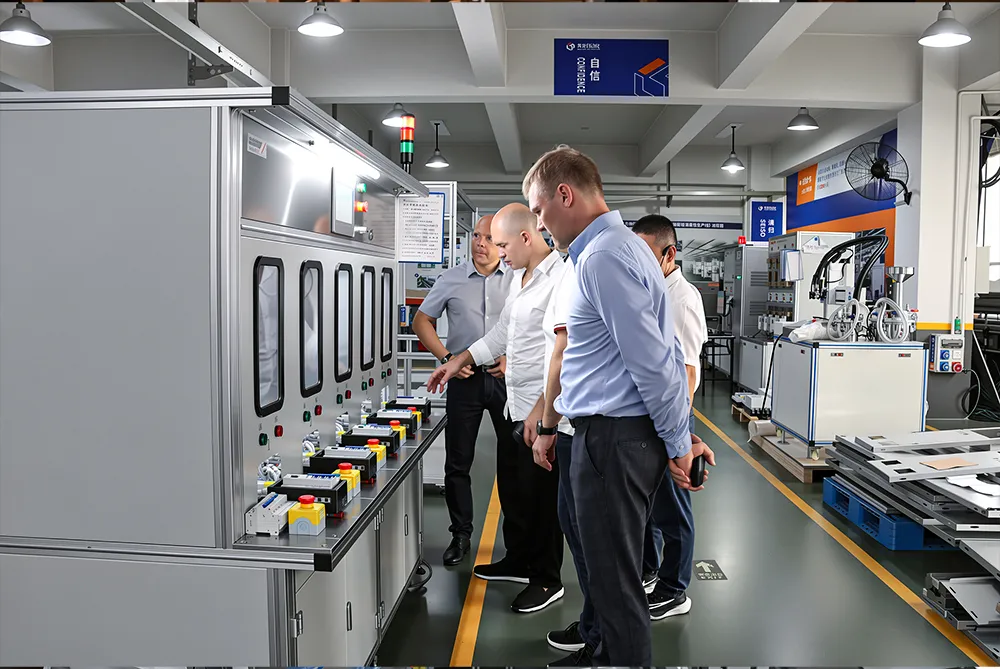

Pin Insertion Machine Market
When an industrial connector supplier in Stuttgart won a contract to supply high-density PCB connectors to a major player in the automotive field, just one factor mattered, and that was ensuring that there were no lost pin and that there are also no bent contacts. The manufacturer relied on semi-automatic pin insertion system that involved the placement of pins into the fixture and the use of a pneumatic press to press them in. Unfortunately, this manufacturing process could not satisfy the conditions of having 100% inspection and traceability. A new automatic pin insertion mechanism was installed that worked by spinning the pins in a bowl feeder, positioning them, inserting them into the connector with the speed of 60 bodies per second, and ensuring the necessary conditions for quality checking of each pin using a vision control system. While the equipment cost a lot, it helped the manufacturer gain the contract. Pin insertion machine market is driven by the same factors: the process of enhancing pin technology, raising quality of the process, cost reduction and the emergence of electric vehicles.
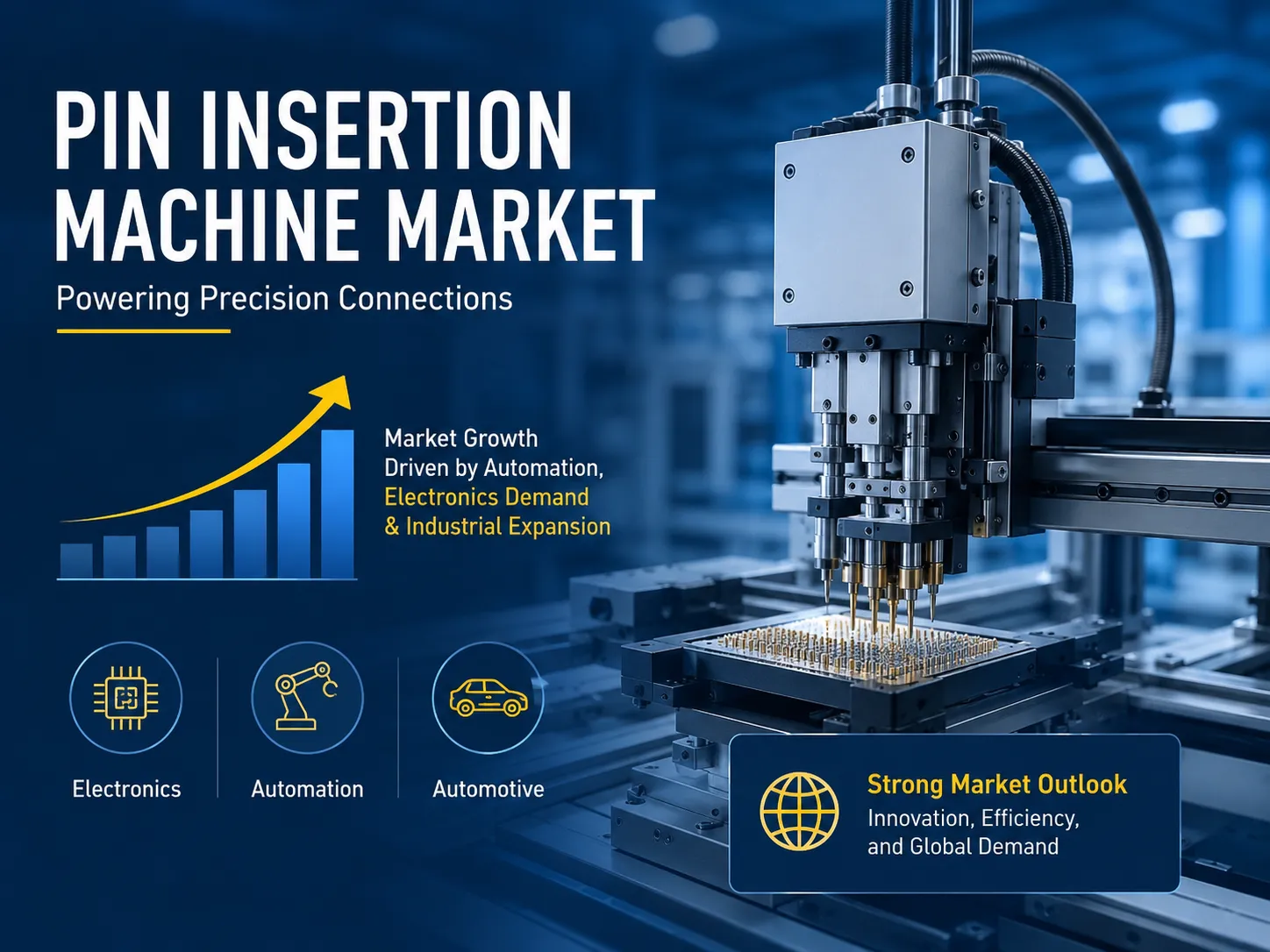
Market Summary: The market for global pin insertion machines is anticipated to rise with a CAGR of around 6%–8% mainly due to the automotive industry electrification trend, new data centre and telecommunications infrastructure development, as well as automation increase in electronics assembly in Asia, Europe, and North America. Among the segments developing at the highest CAGR are fully automated vision-guided insertion systems for assembly of dense connectors and PCBs, although the largest base of installation still belongs to the semiautomatic or manual machines working for low- and medium-volume manufacturers. On the basis of production and consumption, Asia-Pacific leaves all the continents behind owing to strong electronics industry in China and rapid growth of production of EV batteries and connectors. The companies which address the market include major global automation integrators, connector machinery manufacturers and engineering firms designing and building custom insertion machines for specific connectors and production volumes.
The Demand Drivers: Why the Pin Insertion Machine Market Is Growing
Automated feeding, orientation and insertion of metal terminals, contacts or pins into a plastic or ceramic casing is the role performed by the pin insertion machine, which belongs to the category of equipment that is specific yet very important in the manufacturing process for the electrical connectors, PCB assembling operations as well as electric terminals manufacturing industry. The demand for this kind of equipment is based not on a single trend of an industry but on a combination of different forces which push the manufacturers to become more automated, precise and efficient. The most significant driving force here is the automotive electrical system advancement, since the vehicle with internal combustion engine utilizes around 1,500 electric connectors while the electric vehicle has around 3,000 up to 5,000 connectors. Each of these connectors has to be fitted with pins which requires such precision and consistency that cannot be achieved manually or semi-manually. According to the data from the International Energy Agency (IEA), the increase of production of electric vehicles corresponds directly to the requirements to the automated equipment for pin insertion.
The development of data centers and 5G telecommunications infrastructure can be considered as the second driver. Fast data connectors, backplane connectors, and fiber-optic transceivers require pin insertion on a micron level and the amount is in millions of units. In a hyperscale data center, tens of thousands of high-density connectors exist. The global cloud computing and AI network build out documented within the data center industry leads to the permanent needs for connector producers who apply automation to fulfill their production targets. The last driver is lasting labor shortages in manufacturing. The availability of skilled assembly labor in the electronics manufacturing countries like China, Japan, Germany, and the USA is getting less and the costs go up as well. Automation of pin insertion changes the monotonous manual process of performing a task with a machine capable of executing it faster and more consistently without getting tired and returns on the investment are normally predictable within 12-24 months.
Regional Demand: Where the Pin Insertion Machine Market Is Growing Fastest
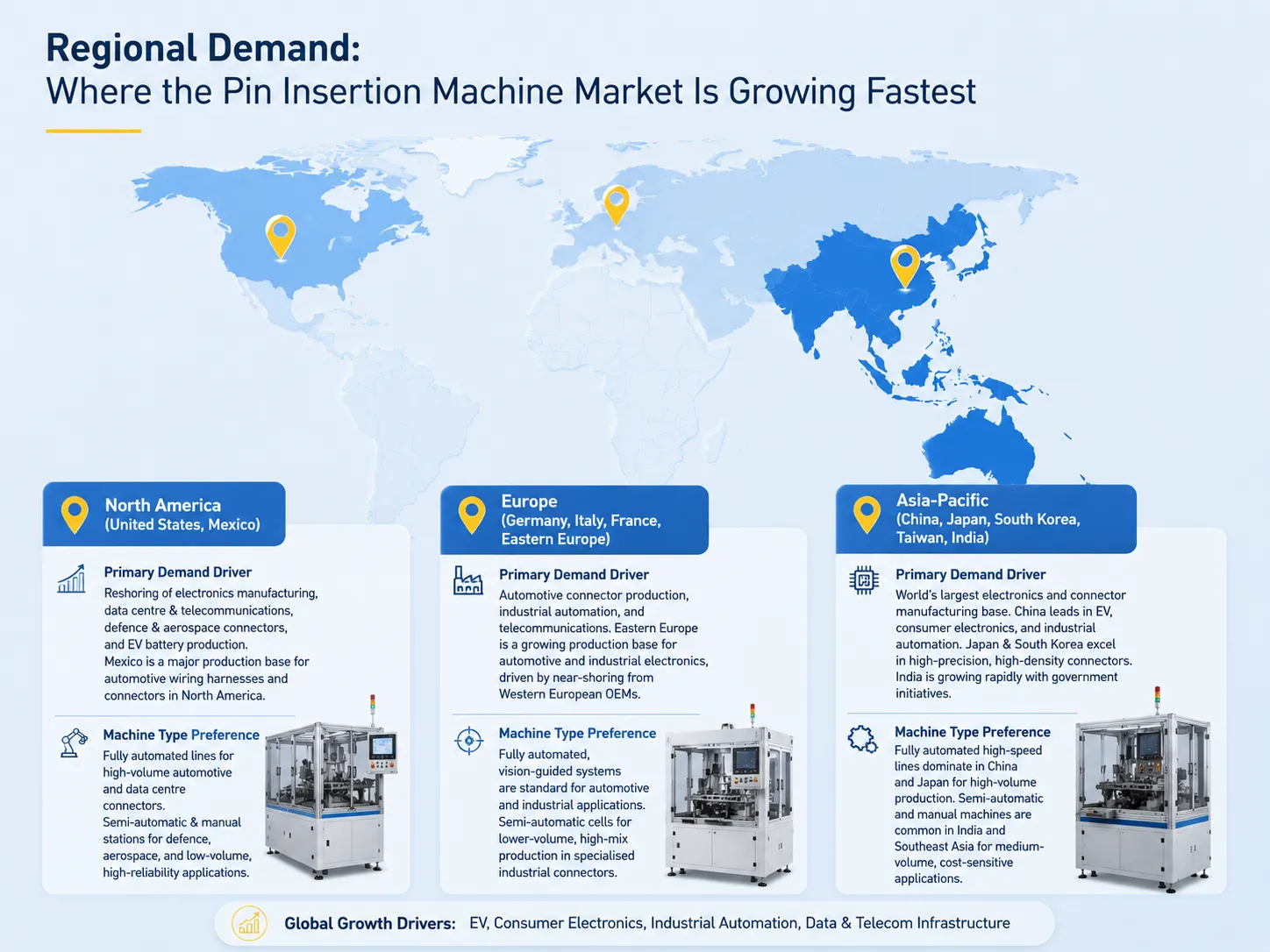
The global pin insertion machine market is not evenly distributed. It follows the geography of electronics and connector manufacturing, and the growth is concentrated in a few key regions, each with a distinct demand profile. The table below summarises the regional dynamics.
| Region | Primary Demand Driver | Machine Type Preference |
|---|---|---|
| Asia‑Pacific (China, Japan, South Korea, Taiwan, India) | The world’s largest electronics and connector manufacturing base. China alone accounts for a substantial share of global connector production, driven by EV, consumer electronics, and industrial automation. Japan and South Korea are leaders in high‑precision, high‑density connectors for automotive and data applications. India’s market is growing rapidly as domestic electronics manufacturing expands under government initiatives. | Fully automated high‑speed lines dominate in China and Japan for high‑volume production. Semi‑automatic and manual machines remain common in India and Southeast Asia for medium‑volume, cost‑sensitive applications. |
| Europe (Germany, Italy, France, Eastern Europe) | Automotive connector production, industrial automation, and telecommunications. Germany’s automotive supply chain is a major consumer of automated pin insertion for EV connectors and sensor assemblies. Eastern Europe is a growing production base for automotive and industrial electronics, driven by near‑shoring from Western European OEMs. | Fully automated, vision‑guided systems are standard for automotive and industrial applications. Semi‑automatic cells are used for lower‑volume, high‑mix production in specialised industrial connectors. |
| North America (United States, Mexico) | Reshoring of electronics manufacturing, data centre and telecommunications infrastructure, defence and aerospace connectors, and the growth of EV battery production. Mexico is a major production base for automotive wiring harnesses and connectors serving the North American market. | Fully automated lines for high‑volume automotive and data centre connectors. Semi‑automatic and manual stations for defence, aerospace, and low‑volume, high‑reliability applications. |
Industry Applications: Who Buys Pin Insertion Machines and Why
The pin insertion machine sector stretches over several unique sectors, with each of them having their own connector types which dictates the needs of every for its operation as well as the standards of quality. The big-church automakers are particularly the most important in the sector since they need the pin insertion machines which can insert the pins into the sealed and the unsealed connector housings with very high precision in terms of speed and with 100% verification of pin presence, position and height; with the increase of the trend of the electric cars, the demand is for the new types of the pin ladies to be produced since they deal with connector of the batteries, chargers and other electric machines. Large companies producing industrial connectors and terminal blocks have been producing highly durable circular connectors and DIN rail terminal blocks used in manufacturing, automating and controlling processes at factories; such connectors are definitely bigger and stronger then those being used in the automotive industry. PCB assembly and EMS companies use pin insertion machines to place the press fit pins, compliant pins and other connectors; the requirements for the insertion force and positional accuracy are rather strict for making process and many machines can be combined with other SMT. The telecommunication and data center sector has been producing the company-producing facilities providing a huge range of backplane connectors that require a lot of precision and cleanroom compatible devices. The last category in this industry includes the manufacturers of electrical devices, for example, production of terminals and connectors. the insertion is often one station within a larger automated assembly and testing line that includes welding, calibration, testing, and marking, as seen in Benlong’s MCB automatic assembly lines and automatic assembly machines for AC contactor contacts.
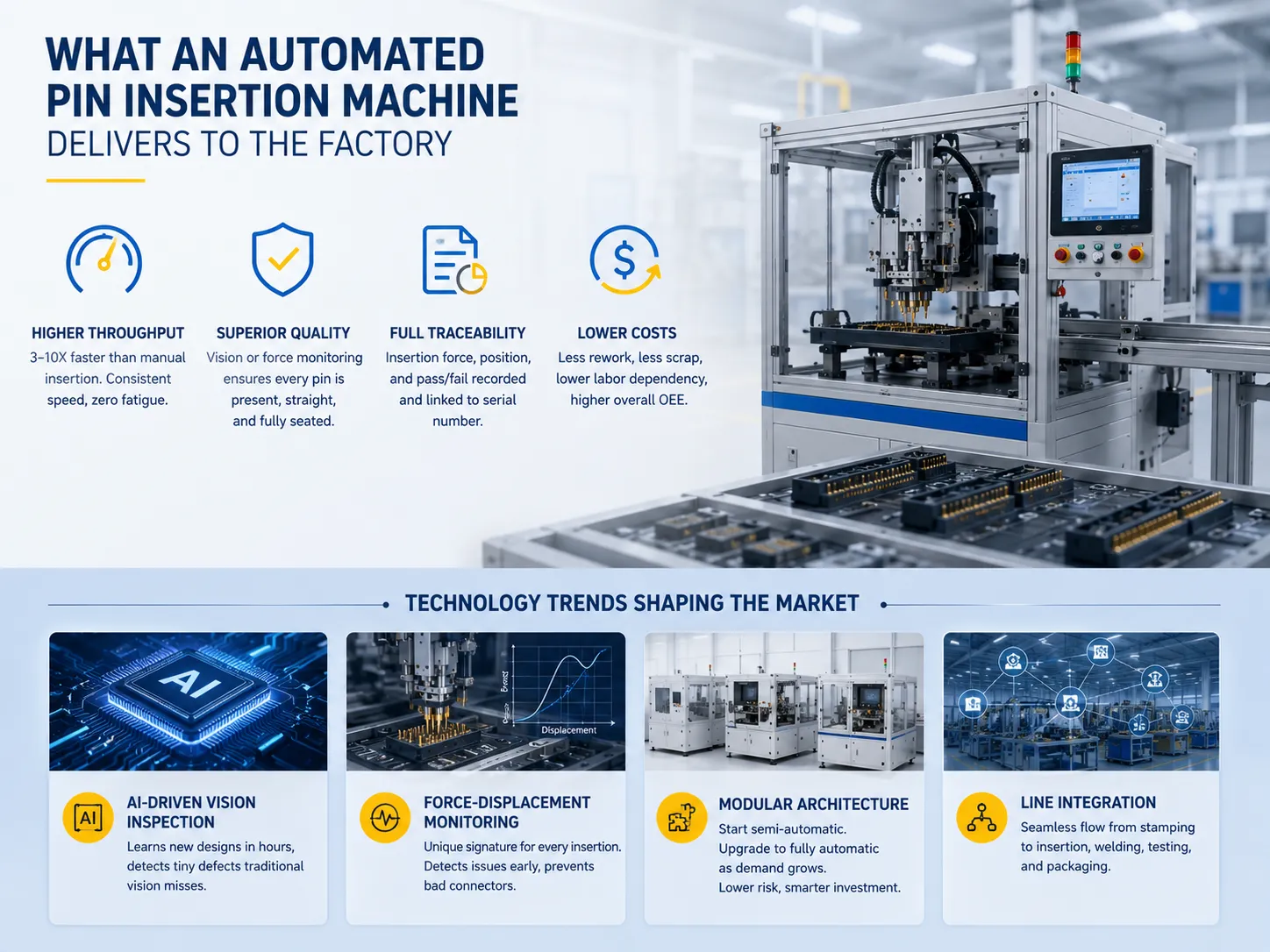
What an Automated Pin Insertion Machine Delivers to the Factory
Automated pin insertion machines yield measurable benefits compared to both manual and semi‑manual processes across all industries employing such machines. Specifically, throughput may increase between three and ten times depending on the type of connector as well as on the automation level — whereas a human operator may insert between 10 and 20 pins per minute, fully automated vision-guided devices can insert anywhere between 60 and dozens of pins per minute at no fatigue and with constant quality. Moreover, quality of connections will also be improved significantly since every pin is verified by a vision system or a force-displacement sensor prior to leaving the station; hence, the most common issues with manual insertion – missing, bent, and incorrectly inserted pins – are eliminated completely. In addition, the process includes constant traceability since all insertion parameters, such as force, position, and pass/fail status are recorded and linked to the serial number for further analysis and reporting.
Technology Trends Shaping the Pin Insertion Machine Market
There are some technological advancements impacting the effectiveness and design of pin insertion machines in 2025 and beyond. AI-driven vision inspection is taking the position of rules-based vision, which allows training of the machine on a new connector design to be done within hours instead of weeks, and allows spotting tiny defects: if a pin is seated 0.1mm below the height it should have or there is a micro-crack in the plastic casing, all these defects will be evident while traditional vision algorithms miss them. Moreover, force-displacement monitoring at every cycle of insertion is becoming a typical feature, which gives a unique signature of the entire insertion process; thereby, detecting a dislocated pin or a worn-out contact before any of these defects leads to damaged connectors. Modular architecture enables producers to use a semi-automated pin insertion cell and later upgrade to fully automated version as the demand increases, which reduces the amount of initial investments and minimization of risks. Finally, the connection to an entire production line enables a smooth process from the stamping machine that produces the actual pins to the insertion machinery, welding station, testing machinery, as well as packing cell, which transforms this process into an interconnected journey.
Frequently Asked Questions
What is a pin insertion machine used for?
The machine for inserting pins helps to insert various forms of metallic pins, connections, pins, and terminals into plastic or ceramic materials automatically — this usually means that it is used in conjunction with electric device cases, printed circuit boards, connectors, etc. The machines are specialised for use in the production of electric appliances, electronics, and any automotive items, among the others.
How fast can an automated pin insertion machine run?
An automated pin insertion machine has the capability to insert a range of 30 to 120 pins every single minute, depending on various factors including the type of connector and the size of the pin as well as the level of automation being employed. A fully automated machine with vision-guided technology is capable of inserting around 60 to 120 pins.
Is pin insertion machine demand growing?
Yes, the market for the pin insertion machine is developing at a rate of around six to eight percent each year, with the progress being facilitated by the electrification in the automobile sector, the advancement in 5G and data centre development, as well as the trend of reshoring electronics technologies manufacturing. An increase in the fastest-growing segment can be observed in the relatively large deployment of fully automated and vision-guided technologies associated with inserting connectors with high density.
What industries use pin insertion machines the most?
The automotive element industry, the cable and terminal industry, PCB manufacture and electronics service industry, the telephone and data centre industry, and the electrical equipment industry, including circuit breakers, contactors, and switches, are the largest consumers of pin insertion machines.
References
- International Energy Agency (IEA) — Global EV Outlook. Annual data on electric vehicle production and the associated demand for connectors, wiring harnesses, and automated assembly equipment.
- Data Centre Industry — Global Data Centre Build‑Out Trends. Information on the expansion of hyperscale data centres and the associated demand for high‑density connectors and automated assembly.
- McKinsey & Company — The Future of Manufacturing and Automation. Research on the labour shortage in manufacturing and the productivity and quality impact of automated assembly solutions.
- International Federation of Robotics (IFR) — World Robotics Report. Annual data on robot installations and automation density by country and industry sector, including the electronics and automotive industries that drive pin insertion machine demand.
The pin insertion machine market is a specialised segment of the broader industrial automation industry, but it is a segment that sits at the intersection of several powerful, structural trends: the electrification of vehicles, the digitisation of global infrastructure, and the long‑term shift from manual assembly to automated, verified, and traceable production. A manufacturer who invests in automated pin insertion — whether a fully integrated line for high‑volume automotive connectors or a semi‑automatic cell for industrial terminal blocks — is buying the capacity, the quality, and the data that will define competitive manufacturing in the decade ahead. Benlong Automation contributes to that market from its specific expertise in the electrical manufacturing sector, designing and building automated assembly and insertion stations that are integrated into the complete production lines that produce calibrated, tested, and certified protective devices for global markets.