benlong
Automated Material Handling Solutions
At a manufacturer of electrical protection devices located in Wenzhou, MCBs were moved approximately 50 meters from the end of the testing line to the packing station. As a result, an operator used to push a cart between those two positions on an average of forty times per shift. In addition, although the cart was located close to where needed, it was not there exactly at all times when required. Consequently, the packing station would periodically have too many MCBs, and at other times, too few MCBs, leading to an excessive amount of time lost for both production and packing. This situation was corrected by utilizing an automated guided vehicle (AGV) to transport the MCBs along a magnetically guided path that was synchronized with the testing line’s output. The AGV will arrive exactly at the time needed, have the correct quantity of MCB’s, and will return to the test line to pick up the next load within an average of under 18 months. The use of one AGV allowed the whole downstream process to be stabilized. Automate Material Handling Systems (ADHMS) now provide a way to connect the various automation islands of manufacturing together to create one seamless, continual, predictable flow of materials, parts and finished goods within modern manufacturing systems.
The State of Automated Material Handling in 2025–2026
Automated Material Handling Equipment Market The automated material handling equipment marketplace includes a substantial and expanding market with noteworthy growth potential throughout the next decade (2024). According to the Material Handling Institute (MHI), global market value of material-handling equipment will exceed $220 billion by 2024 and is anticipated to expand at a compound annual growth rate (CAGR) of approximately 7%–11% from 2024 to 2030 due to three leading business drivers: increased throughput associated with limited labor availability; increased demand for faster and more accurate fulfillment of e-commerce orders; and a transition toward dark/light-out manufacturing in regions with high labor costs.
A number of trends are driving the development of automated material handling solutions that will be implemented by factories and warehouses from 2025 and will continue to accelerate as we move into 2026:
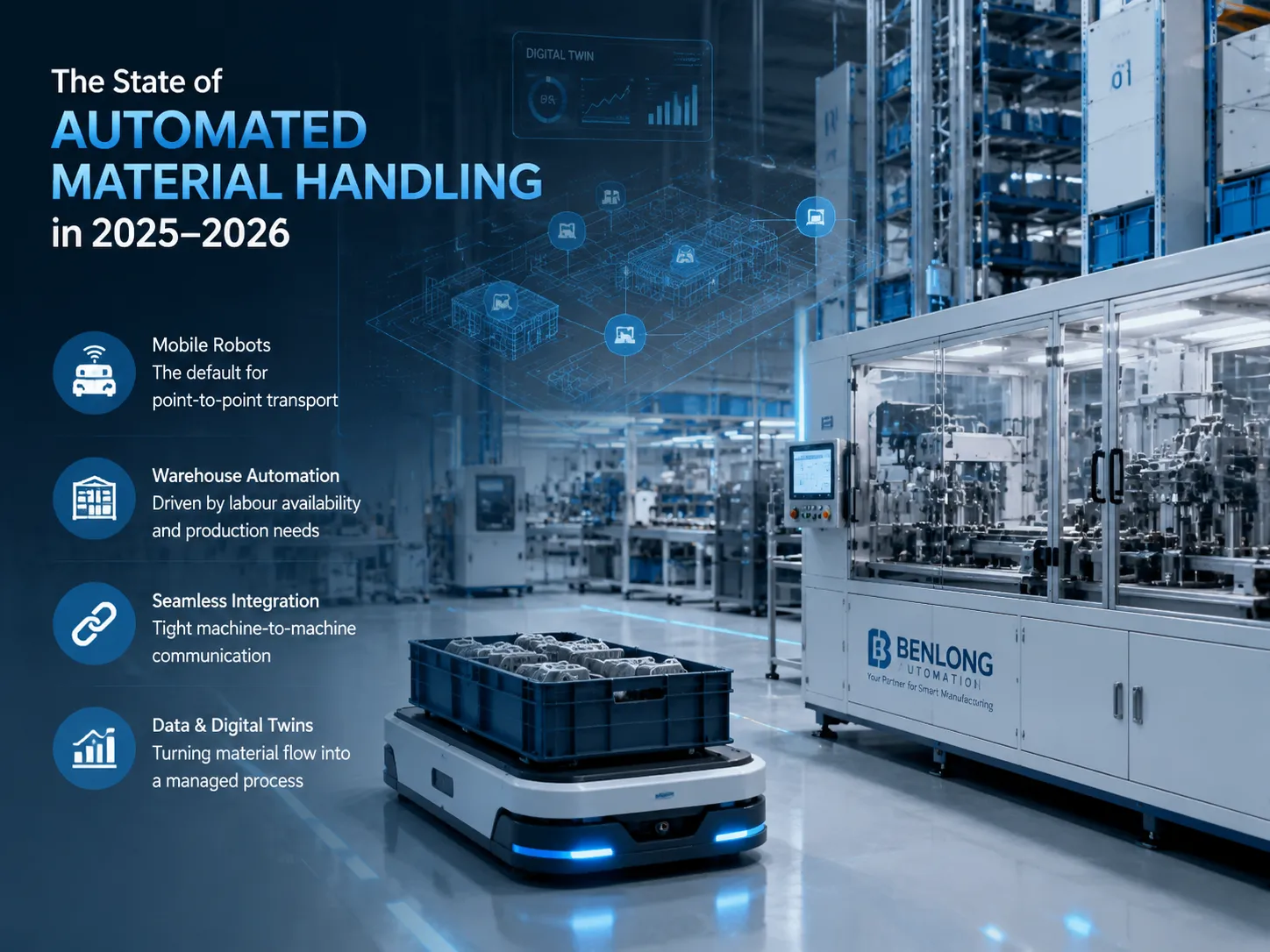
- Mobile robots are becoming the default for point‑to‑point transport. In the past decade, autonomous mobile robots (AMRs) and automated guided vehicles (AGVs) have transitioned from pilot projects to standard part of warehouses and factories. Modern AMRs navigate dynamically with simultaneous localisation and mapping (SLAM) technology and onboard cameras to avoid static and dynamic obstacles and re‑route in real time while operating on a shared factory floor with forklifts and pedestrians (no dedicated path required). The economics of AMRs have also changed — today’s entry level AMRs can be bought and deployed for less than $30,000, accessible to midsized manufacturers as opposed to just the major automotive manufacturers.
- Warehouse automation is being driven by labour availability, not just volume. The e‑commerce fulfilment sector, documented extensively by McKinsey & Company, has been the proving ground for high‑density automated storage and retrieval systems (AS/RS), goods‑to‑person picking stations, and autonomous case‑handling robots. In 2026, the same technologies are moving into manufacturing warehouses and distribution centres that serve production lines, not just online customers. A manufacturer that stores raw materials, components, and finished goods in an AS/RS can feed a production line with the exact part at the exact time, reducing line‑side inventory and the floor space it consumes.
- Integration with production machinery is becoming tighter. An AMR that brings a tray of moulded breaker housings to an assembly cell no longer just “arrives.” It communicates with the cell controller via an industrial IoT protocol (such as OPC UA or MQTT), confirms that the cell is ready, and triggers the robot to unload the tray. This machine‑to‑machine communication closes the loop between material handling and production, eliminating the human decision that used to sit between “the parts are here” and “the cell can start.” For the electrical manufacturing sector, this integration is where material handling connects directly to the automated assembly and testing lines that Benlong Automation builds. An MCB automatic assembly line that is fed by an AMR delivering contact assemblies and housings on demand is a line that never waits for parts and never accumulates excess work‑in‑progress.
- Data and digital twins are turning material flow into a managed process. A conveyor, a fleet of autonomous mobile robots, or an automated storage/ retrieval systems will collect positional data, speed of travel, information on the weights of payloads and utilization. The data generated by all of these systems can be sent to a manufacturing execution system (MES) or a warehouse management system (WMS), where it can be used to create a real-time representation of every object and every machine located in the Factory. A virtual model (known as a digital twin) of the material handling systems allows us to project into the future, foresee potential production bottlenecks, and make layout decisions without ever moving a real piece of equipment.
How Automated Material Handling Differs Across Industries
The same technologies – conveyors (automated guide vehicles (AGV) automated mobile robots (AMR) and robotic arms). All these technologies are applied/processed in different industries, however, they use different levels of processing. The materials used, volume of materials, and regulatory environments therefore affect their application.
Electrical and Electronics Manufacturing
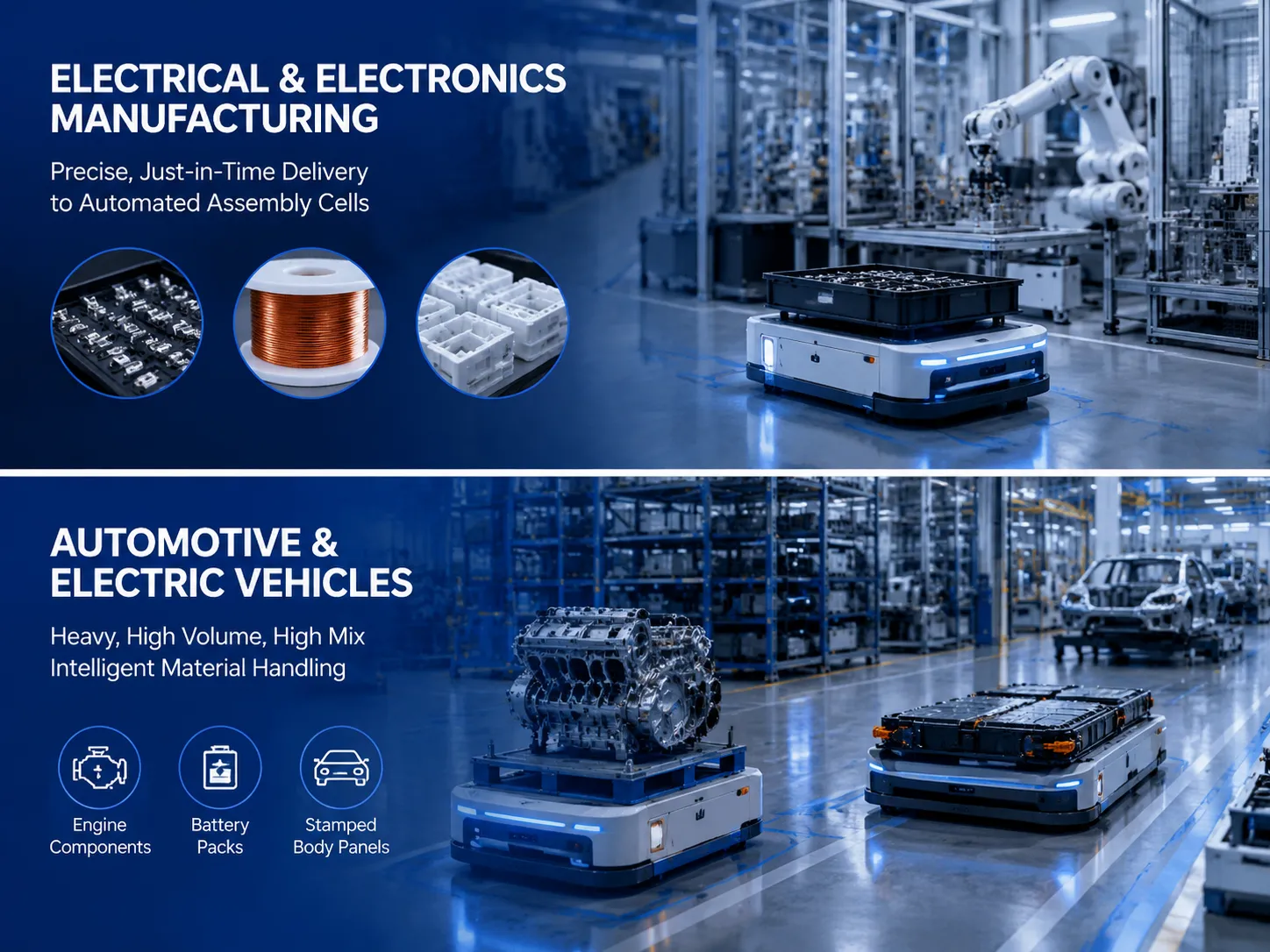
Small parts, in quantity, and often, similar-looking, For example, a tray of silver contacts, a roll of coil wire, and a stack of molded housings are common examples. Here material handling is almost entirely about precise, just-in-time delivery of materials to automated assembly cells. AMRs with small part carriers or drawers will bring kits of components directly to the robot in the assembly cell, where the robot will pick them up directly from the AMR. Because of this, there is no requirement for line side shelving, and there is less manual kitting, which can have a significant impact on labour costs and error generation. In a manufacturing environment where MCBs, MCCBs and contactors are manufactured, the material handling system acts as the circulatory system of the overall production process and connects stamping, welding, assembly, calibration and packing functions. Benlong Automation designs these entire production lines, including material handling functions at the beginning of each project, resulting in a production line where the flow of parts through the material handling system matches the way the various processes convert parts into final product.
Automotive and Electric Vehicles
Automotive materials handling involves weighty, high volume high mix processes. Material Handling Equipment such as Automated Guided Vehicles transport heavy loads (engine components, battery packs and stamped body panels) between manufacturing work cells. Automated Storage and Retrieval Systems (AS/RS) hold thousands of unique part numbers for Just In Sequence Deliveries to the Assembly Process. The design trend of manufacturing electric vehicles has developed new handling challenges in automotive part handling – battery modules are heavy objects to handle, require careful electrostatic discharge protection due to their sensitivity and more cases are emerging which drive the investment in specialisation in handling automation.
Food and Beverage Processing
Material handling requires cleaning and can generally be stainless or washdown proof. This means that conveyors must be made of sanitary belt materials, along with automated palletisers to move bagged ingredient product around plants, and AGVs to transport large containers through the cooking, filling, and packing areas of the facility. As it relates to cold-storage facilities, the trend for 2026 is increased automation due to the difficulty in human labor at a high cost.
E‑Commerce and Logistics
Automated Material Handling (AMH) is known for its most recognizable forms of operation, e.g. long stretches of conveyor systems, large fleets of mobile robots delivering shelving pods to pick stations, and fast sortation systems providing packets to the appropriate dock doors. The companies that build this infrastructure — Dematic, Vanderlande, Honeywell Intelligrated — are now adapting their warehouse‑scale solutions to the smaller footprints of manufacturing logistics.
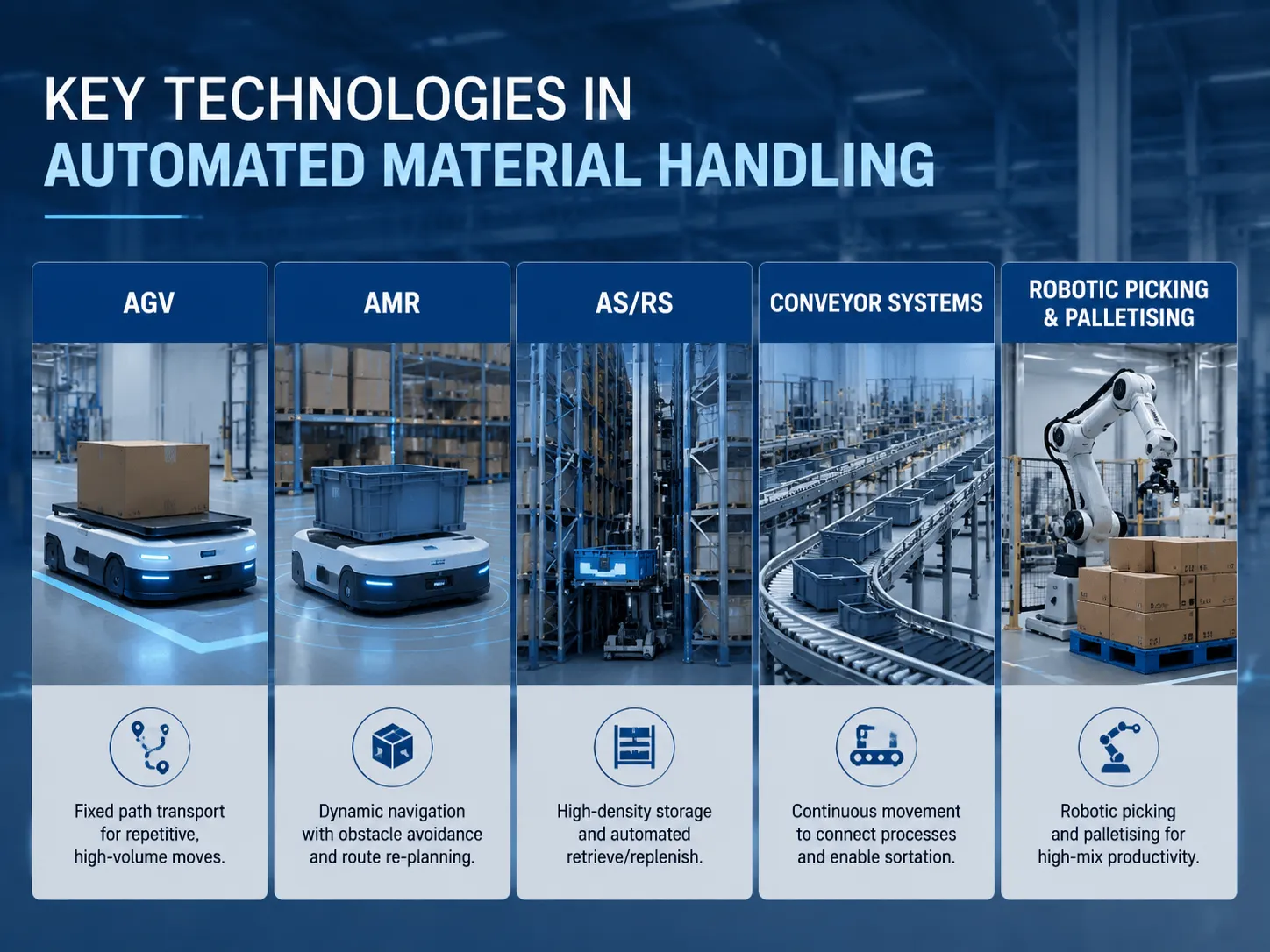
Key Technologies in Automated Material Handling
The acronyms are dense, but the machines are practical. The table below summarises the most common types of automated material handling equipment and where they fit in a manufacturing environment.
| Technology | What It Does | Best For |
|---|---|---|
| AGV (Automated Guided Vehicle) | Follows a fixed path (magnetic tape, wire, or laser‑guided) to move loads between defined points. | Repetitive, high‑volume point‑to‑point transport in stable layouts. |
| AMR (Autonomous Mobile Robot) | Navigates dynamically using cameras, lidar, and SLAM; avoids obstacles and replans routes. | Dynamic environments where the layout changes or where people and vehicles share the floor. |
| AS/RS (Automated Storage and Retrieval System) | Stores and retrieves items from high‑density racking using computer‑controlled cranes or shuttles. | High‑density storage of raw materials, components, or finished goods in a manufacturing or distribution setting. |
| Conveyor Systems | Moves materials continuously along a fixed route; can be belt, roller, or overhead. | Connecting sequential process steps within a production line; sortation in distribution. |
| Robotic Picking and Palletising | Uses articulated robots or cobots to pick individual items or to stack finished product onto pallets. | End‑of‑line packing, order fulfilment, and any application where the product mix is high and manual picking is slow. |
What Automated Material Handling Delivers to a Factory
Automated material handling systems have many worthwhile benefits that have been recorded. There is no need to theorize about these advantages; they can be confirmed by looking back at all of the factories that have converted their manual carts to an AMR and their static shelf to an AS/RS.
- Higher throughput with the same footprint. Parts arrive at the proper station at precisely the right time which removes the idle time created by the manual handling of parts. The throughput improvements of 20 to 40% on lines that were previously manually fed can typically be seen.
- Reduced work‑in‑progress inventory. Continuous flow of material from one station to the next eliminates the need to maintain buffer stocks between operations, thereby reducing WIP and allowing for cash and floor space to become available for other uses.
- Lower product damage and handling errors. Each time a component is lifted, placed down onto a surface, and moved, you risk scratching or contaminating it. Automated components reduce that risk because they’re handled automatically.
- Improved safety. The most prevalent types of workplace incidences include: forklift accidents, repetitive strain injuries from manual lifting, trips and falls caused by crowding in aisle ways or passageways. AGVs (Automated Guided Vehicles) and AMRs (Autonomous Mobile Robots) that can take the place of manual fork lift trucks, as well as robotic palletizers that can take the place of manual stackers, reduce these risks directly.
Frequently Asked Questions
What are the 4 types of automation?
There are four standardized varieties of industrial automation. There are rigid (or fixed) automations, these are used to produce one item in mass amounts; Programmable automations, these are used to produce items that are manufactured in batches; Flexible (or Soft) automations, these are used to manufacture products that are produced in mixed increments on a continuous flowing assembly line;-and finally there is Integrated Automation where basically the whole plant is under computer control and connected through data. Through any of the four automation types there will be a category referred to as Automated Material Handling Equipment in commercial application, whether it be a fixed conveyor being used on an assembly line that is dedicated to one product or the use of an Autonomous Mobile Robot (AMR) fleet in a flexible data-integrated facility.
What is an example of automated material handling?
A common example of an autonomous mobile robot (AMR) would be a unit that autonomously navigates from a testing line to a packing station, carrying trays full of assembled circuit breakers. The AMR will autonomously navigate avoiding obstacles and communicate with the production control system so that it arrives just in time to perform its function.
What is AGV in a warehouse?
In a warehouse, the company’s version of an automatic guided vehicle (AGV) is a vehicle that runs without a steering wheel, on a fixed course that is typically set up by either magnetic tape, wire guides, or laser targets, on which it will move pallet loads, bins, and containers from storage, to the picking area, and ultimately to the shipping area, making it a primary method of moving materials throughout a facility in situations where there is significant volume, and where tasks are completed with a repetitive nature.
What are common examples of MHE?
Material handling equipment (MHE) Covers all operating mechanisms of moving materials by humans & machines; including but not limited to: Hand Pallet Trucks, Forklifts, Pallet Jacks, Conveyor Systems, AGVs, AMRs, Automatic Storage & Retrieval Systems (AS/RS), Robotic Palletising Systems, Overhead Crane Systems. It includes the full range from a manually operated pallet truck to an autonomously moving fleet of mobile robots communicating via data networks. Each type of material handling mechanism has unique characteristics & utilizes different Operating Mechanisms.
References
- Material Handling Institute (MHI) — Annual Industry Report — Market sizing, growth projections, and adoption trends for material handling equipment.
- McKinsey & Company — Automation in Logistics and Manufacturing — Research on the impact of automation on warehouse and factory productivity.
- Dematic — Automated Material Handling and Logistics Solutions — Major integrator of conveyors, AGVs, and warehouse automation.
- Vanderlande — Warehouse and Parcel Automation — Global supplier of automated handling systems for warehousing and airports.
Automated material handling solutions close the loop between a machine that makes a product and the machine that packs it, stores it, or ships it. They are not the most visible part of a factory — the assembly robots and the testing stations get the attention — but they are the part that determines whether the factory flows or stumbles. A well‑designed material handling system, integrated with the production equipment it serves, delivers higher throughput, lower inventory, and better consistency than any manual cart or forklift ever could. Benlong Automation builds automated production lines for the electrical industry with the material handling designed in from the start, because a line that makes a breaker perfectly but waits for the next tray of contacts is a line that is not running.