benlong


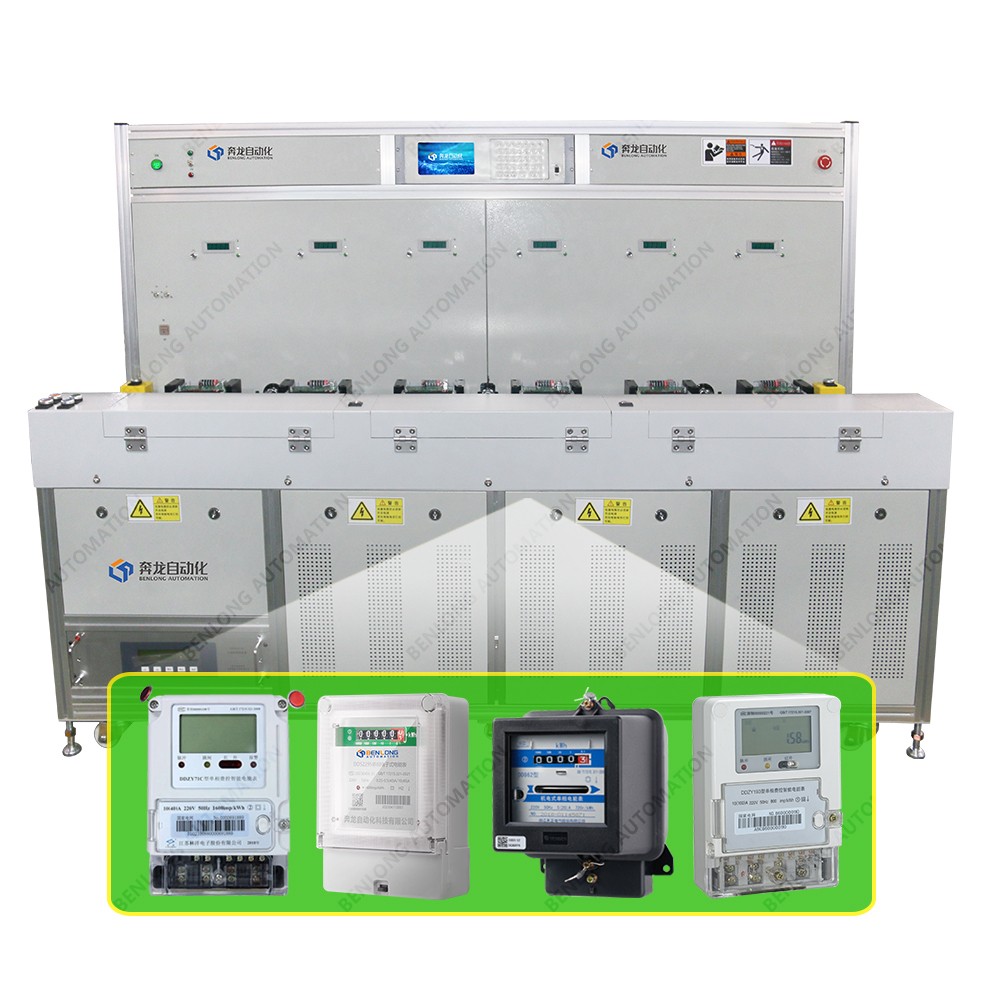
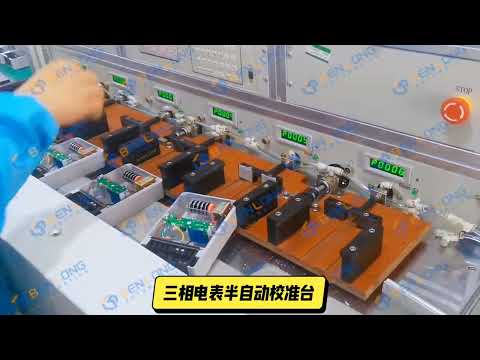
Electric meter manual calibration bench
Custom three‑phase energy meter manual calibration bench. Automated basic error, creeping, start, harmonic simulation (2‑21), influence quantity tests. Multi‑position (4‑16), 0.05% accuracy, DLMS/COSEM/Modbus. Non‑standard design tailored to your meter form factor.
Custom Three‑Phase Energy Meter Manual Calibration Workstation
This Electric Meter Manual Calibration Bench is a high-precision test setup for extensive testing of three-phase energy meters (both active and reactive). Manual meter loading and unloading are performed manually; using these benches, high-accuracy automated test protocols are used for basic meter testing (by using basic errors, creeping, starting, and harmonic simulation, as well as reading test samples). Utility metering labs, meter manufacturers, and calibration services need to provide flexible testing capabilities that comply with IEC 62053-11/22/23.
This system gives you good, ample voltage (0-480 volts) and current (0-120 amps) that has little distortion.
Standard delivery: 45-60 days | Non‑standard custom: 90-120 days | 0.05% accuracy class

What is an Electric Meter Manual Calibration Bench?
An Electric Meter Manual Calibration Bench provides a means of verifying the accuracy and performance of energy meters (for both active and reactive applications) on a manual basis. The bench is a semi-automated manual testing apparatus providing for the following tests: Basic Error (active/reactive power measurements); Creeping Test (load); Starting Test (minimum load); Harmonic Simulation; Influence Quantity Tests (voltage, frequency, temperature variation).
The Electric Meter Manual Calibration Bench has stable, programmable voltage and current sources, high precision reference standards (0.05%) and multi-position capability (4 – 16 positions). The bench may be used in quality control of energy meters during manufacture; for incoming inspection of energy meters purchased by utilities; or in electric meter calibration laboratories. Since the Electric Meter Manual Calibration Bench is a custom non-standard solution, the configuration of the bench may be modified to meet the requirements of the user (e.g. socket type vs terminal block, voltage/current ranges e.g. 3 X 220/380 volt, 0-120 Amps, Communication protocols optical port vs RS485 vs Wireless and the number of test positions).
Flexible for batch testing of different meter models; no dedicated robot needed.
Basic error, creeping, start, harmonics, influence quantity, maximum demand, timing error.
Up to 16 meters tested simultaneously, drastically reducing per‑unit test time.
Tailored to your meter dimensions, voltage/current rating, and communication requirements.
Key Test Features & Calibration Process




Technical Specifications
| Meter type compatibility | Three‑phase or single‑phase, active/reactive, Class 0.2/0.5/1/2, direct or CT connection |
|---|---|
| Test positions | 4 / 8 / 12 / 16 positions (customizable) |
| Voltage output range | 0 – 480V (three‑phase, adjustable), accuracy ±0.05% |
| Current output range | 0 – 120A (per phase), accuracy ±0.05%, THD <0.5% |
| Frequency range | 45 – 65Hz, accuracy ±0.01Hz |
| Harmonic simulation | |
| Influence quantity tests | Voltage variation (±20%), frequency change (±5%), temperature (optional chamber) |
| Measured parameters | Active/reactive power, power factor, phase angle, basic error (%), creep, start current |
| Communication support | Optical port, RS485 (Modbus, DLMS/COSEM), pulse output, optional wireless |
| Power supply | 380V ±10% 50Hz | 3‑phase 4‑wire |
Core Technical Advantages (Custom Non‑Standard Design)
Flexible meter adapters
We design custom meter mounting fixtures and electrical contacts to match your meter’s terminal spacing, form factor (socket or terminal block), and connection type (direct or CT).
Multi‑protocol communication
The bench supports automated reading of meter registers via optical port, RS485 (Modbus, DLMS/COSEM), or pulse outputs. Test software compares reference values with meter readings.
Harmonic & influence quantity testing
Essential for smart meter certification (IEC 62053‑22). Programmable harmonic orders (2‑21) and influence tests (voltage/frequency/temperature) ensure meters perform correctly under grid disturbances.
Scalable test positions
From 4 to 16 positions, the bench grows with your production volume. Each position is independent, allowing mixed‑model testing (different meter types in the same batch).
















Customer Success Story (Custom Non‑Standard Design)
One European utility required calibration of eight different smart meter designs (three and one-phase), either CT or direct wired and using multiple communication standards. Because of this broad range of types, an off-the-shelf calibration bench could not be used to accommodate this variety. Benlong developed a 12-position manual meter calibration system to address this requirement which included:
The time required for testing was decreased by 60% per meter on the test bench allowing customers to meet the IEC 62053‑22 certification. The modular adapter allows for easy addition of new types of meters by simply changing test leads and software profiles.
Applications and Lab Integration
Standard Delivery and Commissioning (Custom Engineering)
Request a Custom Electric Meter Calibration Bench Quote
If you send us your specifications (phase, class, voltage/current ranges, communications protocols) and targeted calibration positions, our engineers will design an appropriate manual calibration bench that meets accepted IEC 62053 criteria.
WhatsApp: +86 150 5837 0007 | Email: xsb@benlongkj.cn | English & Chinese support
Why Choose Benlong for Meter Calibration Benches?
- 15+ years designing energy meter test equipment for utilities and manufacturers
- In‑house software development (test sequences, data logging, report generation)
- 0.05% reference accuracy, traceable to national standards
- Custom adapter design for any meter form factor (socket, terminal, rail)
- Multi‑protocol support: optical, RS485, pulse, wireless
Typical Custom Bench Includes
This equipment includes the following: · Reliable voltage and/or current power source (0 to 480 VAC and 0 to 120 A DC) · 0.05% Accuracy (Reference Meter) · Multi-Position Test Rack (4 to 16 test positions) · Harmonic Generator (2nd Harmonic to 21st Harmonic) · Influence Quantity Test Module (voltage and/or frequency) · Communication Interface (Optical and/or RS485) · Computer Software that Supports Automated Testing · Calibration Certificate · Warranty Period (1 year)
Frequently Asked Questions
Sure, there are wiring adapters that can be switched to provide the ability to test either single-phase meters or three-phase meters in the bench configuration. In addition, you have the option of mixed position configurations, with some positions configured for single-phase and some positions configured for three-phase.
The integrated reference standard is a Class 0.05% (0.05S) for active energy, showing the accurate measurement taken by the reference unit in metrology, Traceable to all national metrology institutes’ metrology laboratories. This Class 0.05% (0.05S) active energy reference standard can be used to test Class 0.2, 0.5, 1, and 2 meters.
For testing the harmonic influence of harmonics on devices, the harmonic simulation module is capable of generating harmonics from 2nd to 21st order and has programmable amplitude and phase angle properties (given that the amplitude can be at a maximum of 40% of the fundamental). This capability will allow you to complete your IEC 62053-22 testing.
I can confirm that we include an optical head that has the capability of adjusting to varying positions of the optical port on the meter and has communications via the following protocols: DLMS or COSEM and IEC 62056‑21 (IEC 1107). Our Software will perform a test cycle where the program will check to see if the meter registers match the reference value.
That’s right; the bench can be customized to your need. You can start with 8 positions and then later on add a modular 4-position extension. The software will automatically recognize your additional positions.
Related Products

MCB semi-automatic thermal trip calibration bench Type-B
View Details
MCB mechanism life test bench
View Details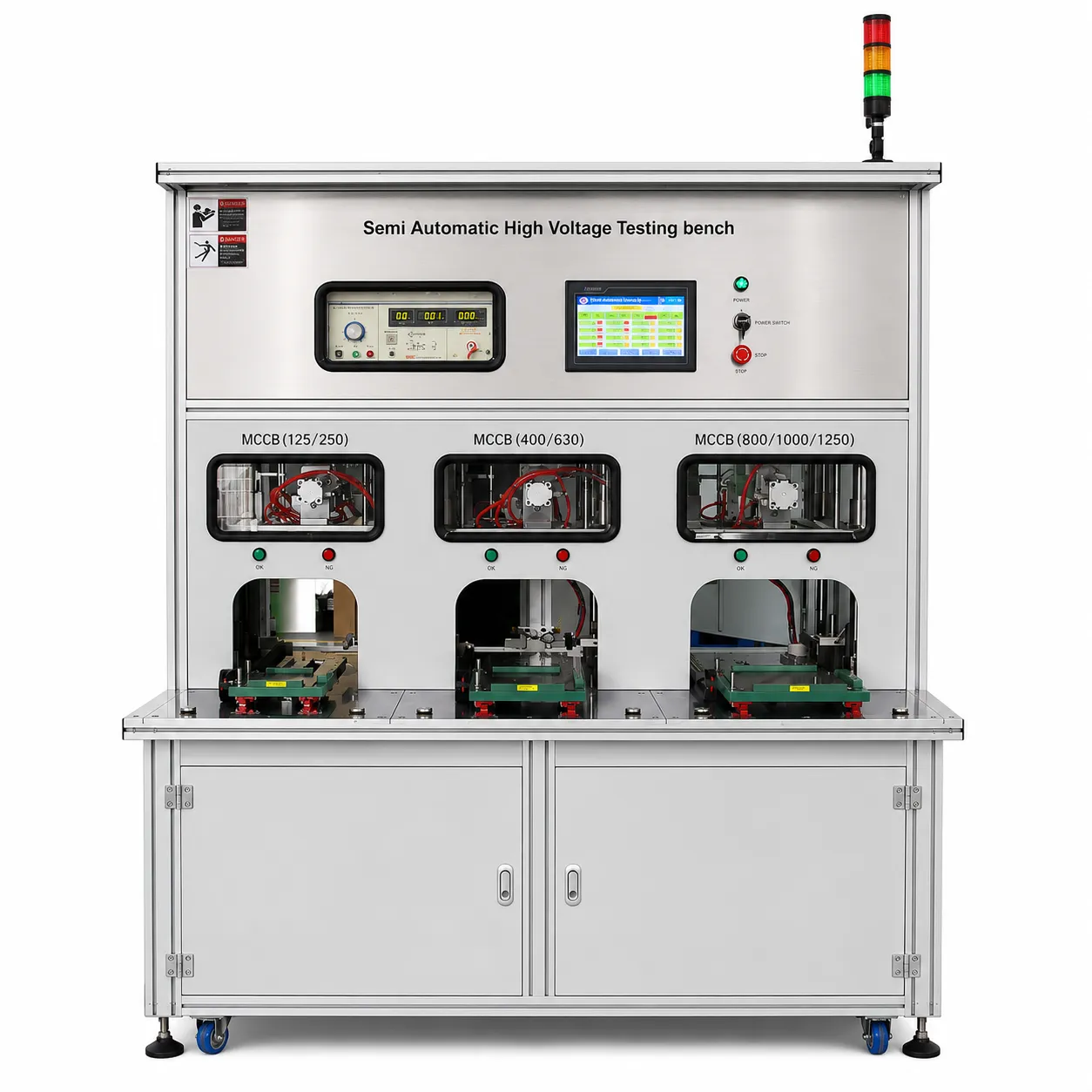
MCCB Semi Automatic High voltage test bench
View Details
Magnetic ring current test bench
View Details
MCB Electrical Endurance Test Bench
View Details