benlong


RCCB Tester: Instruments, Test Benches
A residual current device is created for only one purpose, which doesn’t really show the signs of malfunctioning. The appearance of the device doesn’t change, and there’s no sign of something being wrong, which indicates that it is on the mark when it comes to performing its primary function.
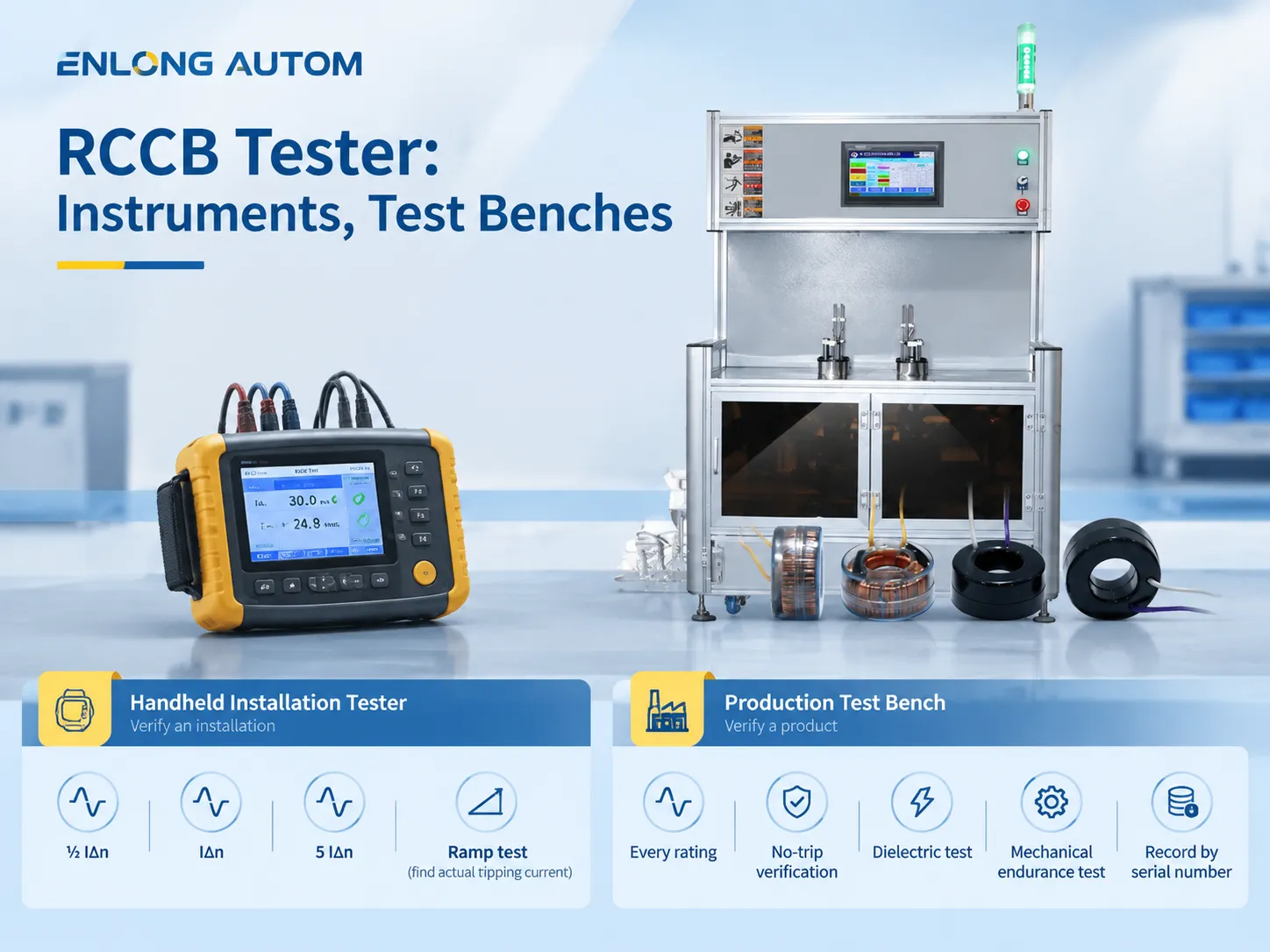
This is the work of an RCCB tester, the devices include simple handheld tools found in electricians’ bags to complex testing stations that test numerous RCCBs in the factory.
Brief response: RCCB testers are devices which inject residual current of known value and measure how long it takes for an RCCB to trip. Handheld testers measure the tripping time at all three standard residual current values ( ½ IΔn, IΔn and 5 IΔn) and conduct a ramp test. Production test benches can perform all tests as handheld testers but add no-trip verification, dielectric and mechanical endurance tests and save information against serial numbers of devices. Handheld testers carry out installation tests while test benches conduct product tests.
What an RCCB Test Actually Measures
Five measurements define whether a device is good, and each one catches a different failure.
| Test | What is applied | What it proves |
|---|---|---|
| No-trip test | ½ IΔn for a defined period | The device is not over-sensitive and will not nuisance trip |
| Trip time at IΔn | Rated residual current | The sensing and the mechanism both work at the threshold |
| Fast trip at 5 IΔn | Five times rated residual current | The device clears quickly on a serious fault |
| Ramp test | Current raised gradually | The actual tripping point, compared with the nameplate |
| DC test (Type B) | Smooth DC residual current | The device sees DC at all, which Type A cannot |
The significance of the phase angle is equal to that of the current. A device that passes the test carried out solely at 0° will fail the test carried out at 180°, indicating the occurrence of a half-wave rectification fault. A professional test will take both into account, however.
The thresholds used for Type AC or Type A devices are provided by standards IEC 61008-1 for RCCBs and by IEC 61009-1 for RCBOs, with the method of the relevant installation test provided in IEC 61557-6. When it comes to Type B devices, IEC 62423 is used, which presents a challenge to the testers, as the need to generate a smooth DC implies that the output stage is not the same as that required for producing the AC.
The Instruments
There are three different instrument categories and their purposes are different.
Multi-testers. These test loop impedance, insulation resistance, continuity of electrical circuit, time taken by an RCD to trip and ramp in the same device. In particular, it is Fluke 1664 FC model that is used here because it does tests on all types of RCDs AC, A, B, and S, provides 1/2, x1, and x5 multipliers, is able to conduct smooth DC tests carried out with 6, 60, and 200 mA currents in accordance with IEC 62955, and is able of performing ramp from 30% to 110% of rated current. This is an instrument that electricians must take with them.
RCD Testers. It is a simpler instrument which is usually cheaper and thus is more preferable for everyone. Typically, its specs include reliable currents of 10, 20, and 30, 200, 300, and 500 mA, one can take half of the unit, x1 and x5 multiplier, and trip time of approximately ±0.6%. Thus, commissioning teams that apply the device on a daily basis prefer this instrument.
Bench systems. Not handheld. It is a fixture comprising a connection to a device, source, timing device, and data logger, which is operated according to the instruction. This type is mainly interesting to the manufacturer.
Do not pay attention to the devices’ brand. You have to pay attention to the three specifications: possibility to inject smooth DC, possibility to record results against connected device, and possibility to calibrate the device traceably. Our guide to testing a circuit breaker covers the overcurrent side of the same bench, because a residual device is usually tested alongside an overcurrent device instead of on its own.
What a Handheld Tester Cannot Do
A portable testing device indicates that one piece of equipment, on a single occasion and under specific circumstances, has tripped. While this is good information, it is also quite limited.
It is unable to quantify the current level that caused the tripping accurately enough for factory approval purposes. It cannot conduct several hundred operations to observe deterioration of the device. It cannot carry out a dielectric test at a voltage of 2000 volts because this is not the purpose of this instrument, and it would be destructive in electrical installation environment. It cannot establish a unique identification number that will satisfy the expectations of a quality auditor.
These four shortcomings justify the presence of production test systems and point out the difference between the measurements made by the manufacturer using handheld instrument and the measurements that should be taken using a stationary measuring system.
What a Production Bench Tests
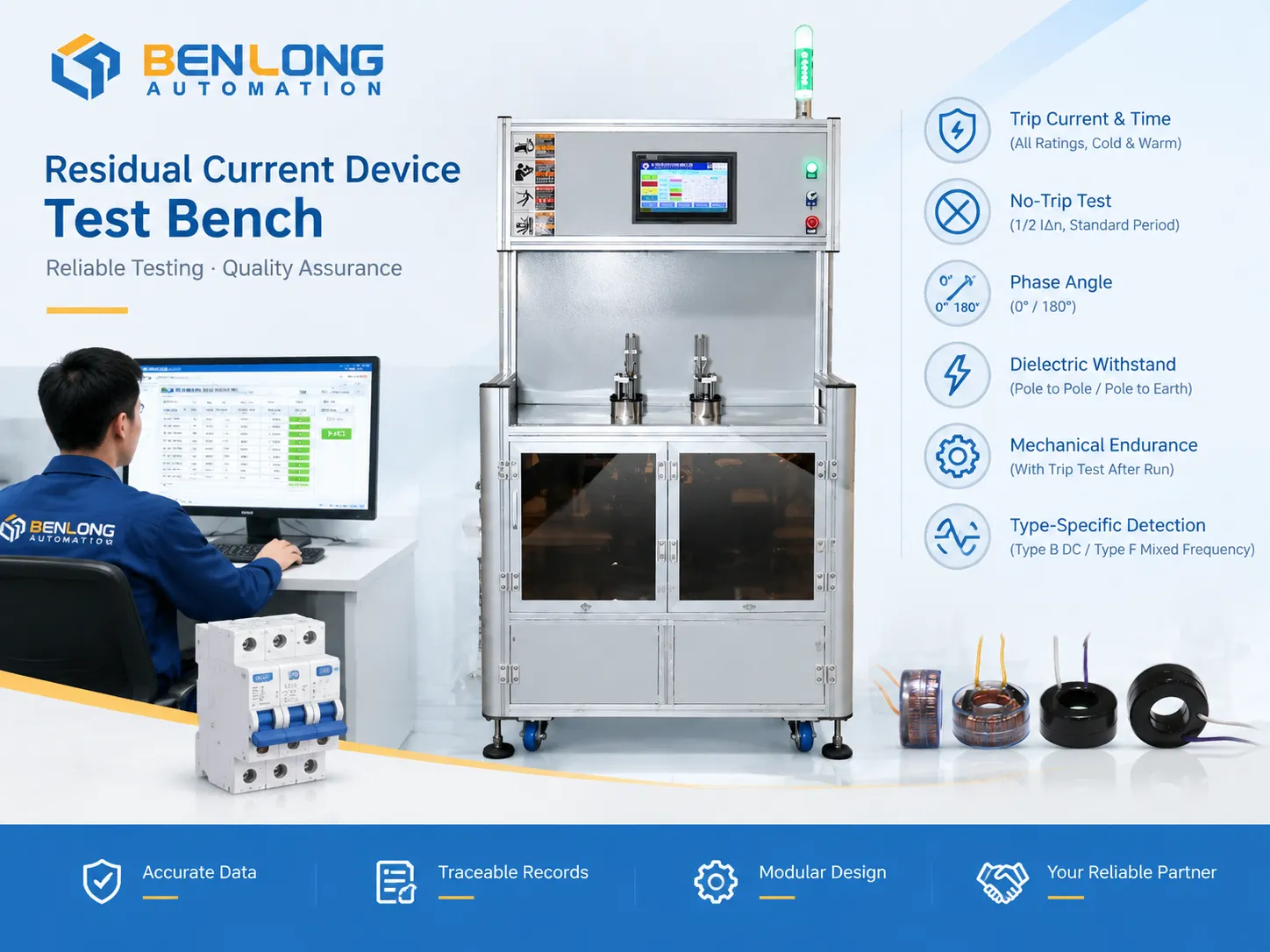
The test bed enables the sequence of tests to be performed, not just one single test.
- It measures the trip current and time at all appliances ratings, where cold and warm-up tests are taken into account.
- In the no-trip scenario at ½ IΔn, the device can detect the trip premises through the safety period.
- The angle in its active and passive states, captured in recordings.
- Dielectric parameters between electrodes with insulation integrity maintained at certain voltage levels.
- The appliance goes through mechanical endurance tests, where a large number of operation cycles are performed along with the tripping test.
- The appliance must detect magnetic waves of different kinds.
Information that matters commercially is the record, including serial number, date, operator, measured values, but also “pass” or “fail.” The information is what makes the equipment batch traceable, and the first thing the customer is looking for when the appliance breakdown occurs is that record.
The second part of the job lies in calibrating the tripping point of the device, an entirely different job requiring not just acknowledging test results but calibrating meant for working in the mid zone of the effective range. How that works on an overcurrent device is described in this look at the MCB calibration machine, and the same logic applies to the residual element.
The Benlong Bench Range
We do not construct measuring instruments, but rather testing equipment. Our system is modular, which means that we have a standard base for our equipment such as fixtures, a controlled power supply and a data system, while only the measurement segment depends on the specific device being tested.
For breakers, the ACB comprehensive test bench covers the timing, contact resistance and travel measurements that an air circuit breaker needs.The auxiliary and signal contact bench carries out functions on the small-signal side of the piece of equipment described above. The ATS ageing bench operates in a variety of transfer switches in operation till malfunction takes place or until a defined point number is achieved.
Where residual devices are involved, the testing procedure involves injecting the residual current, and the tests discussed above are incorporated into the cycle as well. The question here is not whether a bench can inject 30 mA, but whether it can meet the set calibrating tolerance for all angles and ratings and save the reading to the serial number without operators entering it manually.
What we don’t do is sell benches as black boxes. The test process is defined in cooperation with the client’s quality engineer; no matter how good the bench is, it is only as good as the process outlined. In practice, most projects begin with one measurement the bench should achieve; this measurement is the one the design is based on.
What to Specify When Buying
Five defining elements determine how a test bench operates efficiently.
- Throughput needed. Required number of units to be processed per hour fully—the effective measurement is not for the duration of completing a single test.
- Measuring range. The extent of the equipment being tested from the lowest to the highest levels, since a bench covering a range of 25 A to 100 A may miss the accuracy level of a six-amp-device test.
- Calibrating procedures. The uncertainty level that the measurement process will work under and the frequency of calibrating the devices.
- Data results. How serial numbers are recorded, whether there is a pass/fail function, and how the data are stored and transported.
- Changeover time. How many minutes does it take to change from one level to another which will determine whether or not a bench can be used under production pressure.
The fifth point is the point that usually kills projects. If it takes forty minutes to re-configure the bench for a different level, it will be used for one successful rating and never work again afterwards leaving a gap in records that nobody will notice until the audit takes place.
The last point is that the small signal work requires a separate line in the specification since the residual equipment can switch the extra contact instead of the load. A bench built for that, such as this auxiliary and signal contact test bench, measures the contact, not the mechanism, and the two are rarely tested to the same procedure.
Five Mistakes in RCCB Testing
- Testing at a single phase angle. 50% of defects in a badly designed appliance will manifest only at an angle of 180 degrees.
- Testing only at IΔn. A device may trip at the designed rating and fail the 5 IΔn fast trip test which is the important one for shock situations.
- Using AC testing on a type B device. The unit’s AC sensing will trip the instrument on which it will report done the test while the unit’s direct current paths have never been used.
- Omitting the no trip test. A device passing the 15 mA trip passes the rest of trip tests and nuisance trips at every boot.
- No endurance testing. One trip shows the device works today. Five hundred operations prove the mechanism will still work in year ten, which is what the ageing bench is for.
FAQ
How does an RCCB tester work?
It forms a connection between supply and load, allowing a specific amount of current to flow through the sensing unit of the device, through the line and back to ground instead of through neutral. The device detects an imbalance, trips and the device measures the time between the switch-on and the trip.
How to check RCCB testing?
First press the test button of the apparatus, confirming the operation of the device. Now, use the apparatus at ½ IΔn, IΔn and 5 IΔn at an angle. Take note of the time. A ramp test shows the real tripping current of the device.
How to do RCCB testing?
If the test process necessitates the isolation of the circuit, disconnect the circuit from the mains, connect the tester down the stream of the sample device, choose the specified residual current rating and use the multiplier. Then carry out the test for each angle of a phase, resetting the unit after every trip. Don’t forget to make a note of all the results as a pass with no record does not mean anything.
What is the name of the RCCB testing meter?
It is commonly referred to as an RCD tester, a residual current device tester, or an RCCB/ELCB tester. If the same instrument also measures loop impedance and insulation resistance, it will be marketed as an installation tester or multifunction tester.
References
- Fluke — Installation Testers and Type B RCD Testing
- Metrel — RCD and Installation Testing Instruments
- BEAMA — RCD Types, Testing and Application
- UL Solutions — Residual Current Devices and Certification
- Siemens — Residual Current Protective Devices and Test Requirements
Conclusion
An RCCB tester induces an imbalance and measures how long it takes to set off the device. A good tester will do this at every phase and at every voltage specified in the standard. It will also measure it on a device that is old enough to guarantee that the readings still comply with the standard next year.
Provide your auditor with your device range, throughput, and necessary records to receive your quote.