benlong

What Is Injection Molding?
Look around any room and you’re surrounded by injection-molded parts: the housing of your phone charger, the casing of your laptop, the coffee machine’s water tank, the dashboard of your car, thousands of cable ties, and the body of every circuit breaker in your panel. Injection molding is the most common manufacturing process for plastic parts in the world — and yet most people couldn’t explain what actually happens inside the machine. If you’re an engineer, a buyer sourcing plastic parts, or just curious how the plastic objects around you are made, understanding injection molding is the foundation of modern manufacturing.
This technical guide covers injection molding in depth: what it is, the principle and physics behind it, the full process cycle, materials, design rules, machine types, defects and their fixes, surface finishes, and quality control.
Injection molding can be defined as a process used to manufacture plastic parts by melting polymer beads and injecting it into a sealed metal mold, before cooling and solidifying to form the desired shape. The entire process can be broken down into five major stages, which are originated from clamping, injection, holding or packing, cooling, and ejection. Some of the advantages of the injection molding process include a high rate of production and low cost, while its disadvantages is the high tooling costs and lead times for production and making pieces of 1000 or less.
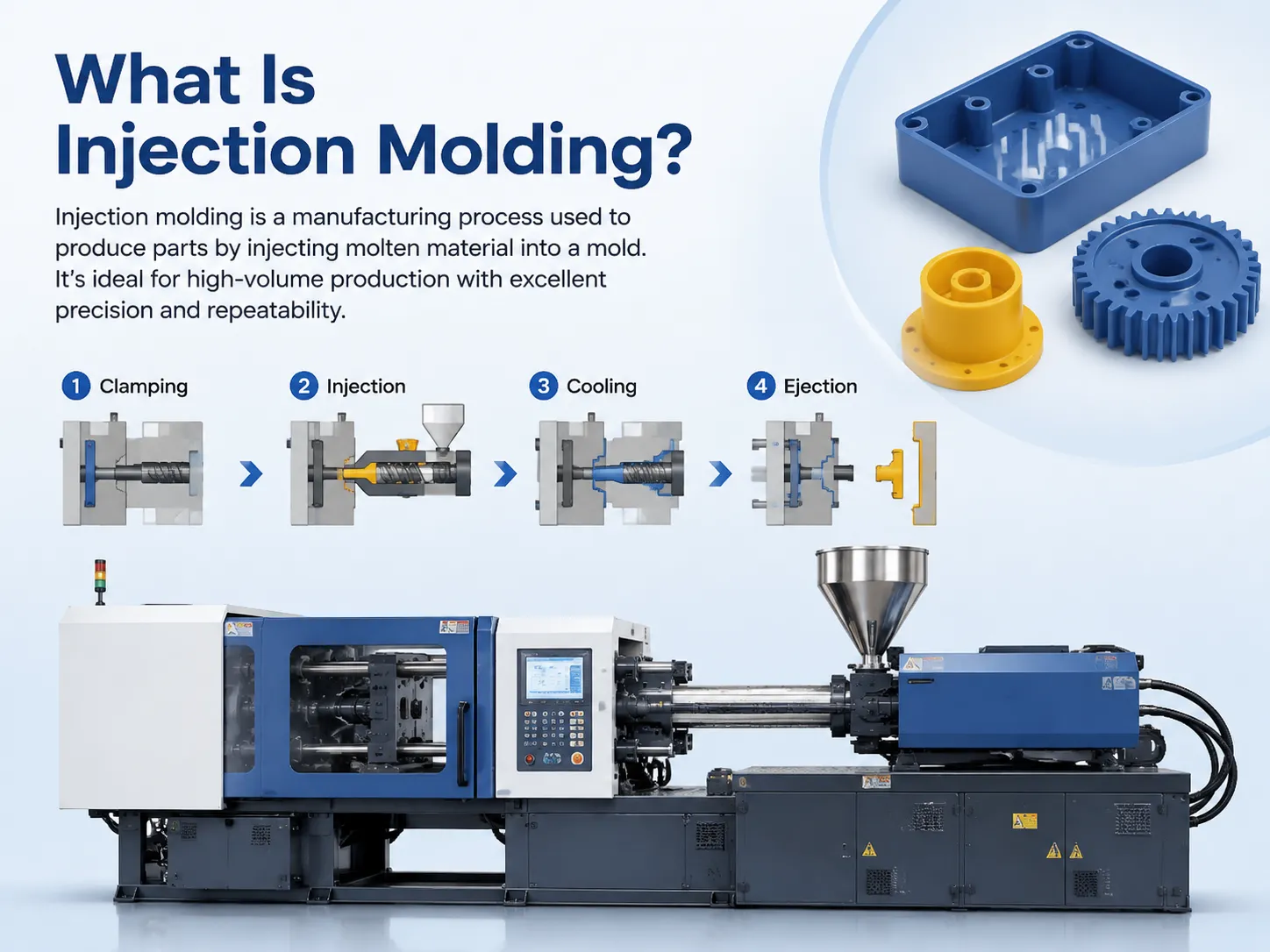
What Is Injection Molding in Simple Terms?
To put it simply, injection molding is essentially an accurate cookie-cutter machine that employs pressurized heat rather than a cutting edge. Plastic beads are melted into a thicker liquid form and injected into a hollow mold made of steel at high pressure. When the plastic cools and solidifies, the machine opens to extract the finished part and starts the process again, repeating this many times in a short period of time.
It is the process commonly used for producing plastic parts in bulk as it is speedy, replicable, and able to create complex forms at a low per-part cost without restrictions on manufacturing.
The Principle: How It Works
The principle of physics is simple. That is why polymers soften when they are heated and harden when cooled. Injection molding consists of three important parts.
- Melting: plastic pellets are heated above their melting temperature or glass transition temperature and get fluid-like properties.
- Flow and Pressure: the melt is pushed into a closed cavity at high pressure (70-180 MPa), and it fills all the tiny details of the mold.
- Solidification: the melt cools down inside the mold and takes the shape of the cavity.
The mold is probably the most important part of the machine: it is made of steel (or aluminum), and it has the negative shape of the part cut into it. Everything that concerns the part — surface finish, draft, and geometry — is defined by the mold.
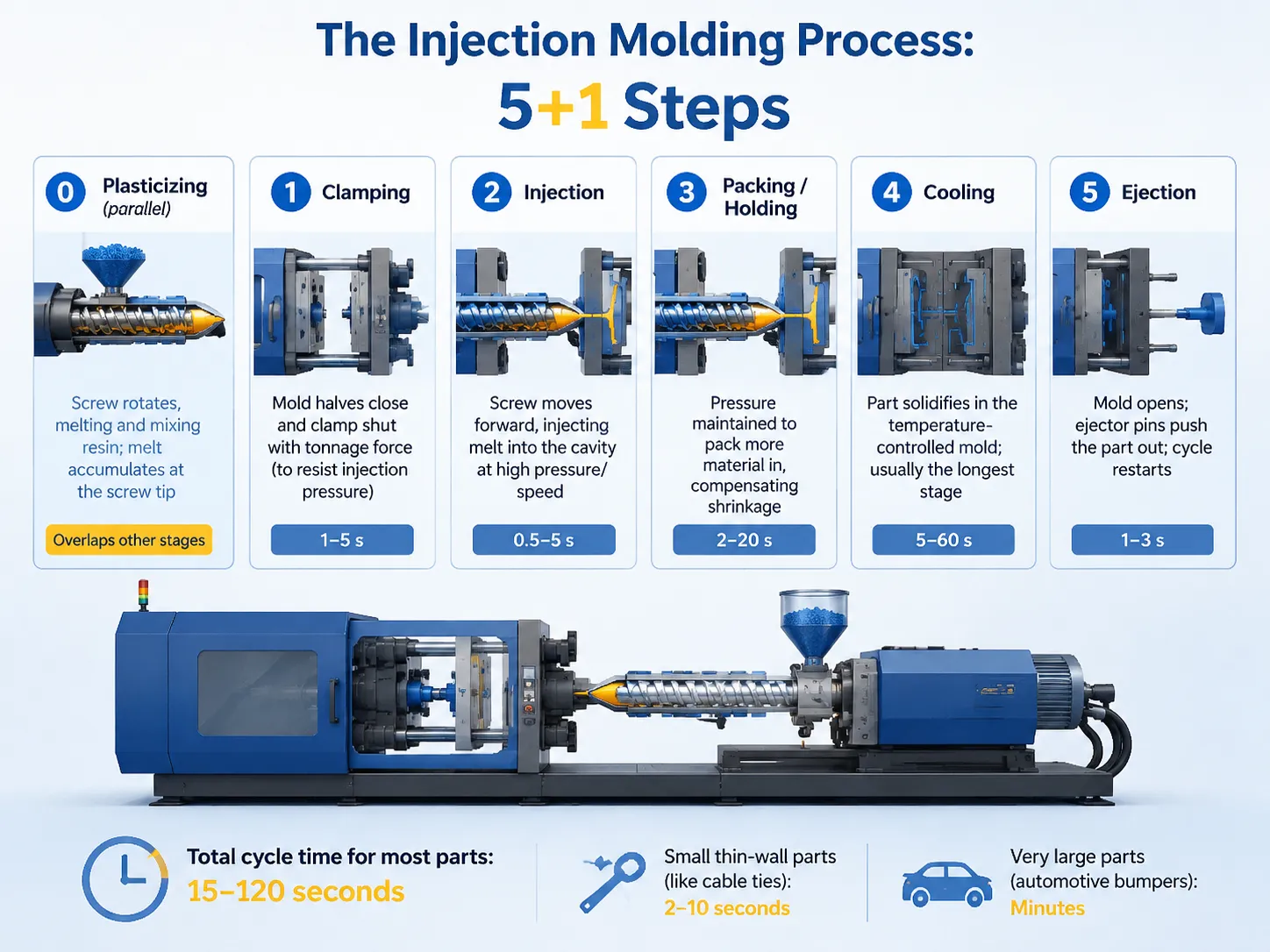
The Injection Molding Process: 5+1 Steps
The production cycle keeps on repeating continuously with 5 stages in total as well as the process of plasticizing:
| # | Stage | What Happens | Typical Time |
|---|---|---|---|
| 0 | Plasticizing (parallel) | Screw rotates, melting and mixing resin; melt accumulates at the screw tip | Overlaps other stages |
| 1 | Clamping | Mold halves close and clamp shut with tonnage force (to resist injection pressure) | 1–5 s |
| 2 | Injection | Screw moves forward, injecting melt into the cavity at high pressure/speed | 0.5–5 s |
| 3 | Packing / holding | Pressure maintained to pack more material in, compensating shrinkage | 2–20 s |
| 4 | Cooling | Part solidifies in the temperature-controlled mold; usually the longest stage | 5–60 s |
| 5 | Ejection | Mold opens; ejector pins push the part out; cycle restarts | 1–3 s |
Cycle time for different parts: 15-120 seconds; small, thin wall parts (such as cable ties) may have cycle time of 2-10 seconds; while larger parts such as automotive bumpers may take minutes.
The Injection Molding Machine & Its Parts
The main components of an injection molding machinery are:
- Injection section (injection and heating of plastic): the feeder (materials in, the heated cylinder with rotary screw (melting, mixing, and injecting), and the nozzle (carries the material into the mold).
- The clamping section is a fixed and moving plate which contains the mold, clamping tool (hydraulic or electric), and ejector system.
Major characteristics of the machinery: clamping force – tonnage – 30-4,000+ tons depending on size of the workpiece; shot size – volume of the melted material per cycle; diameter of screw – length and diameter ratio – which influences the quality of obtained melted product. Additional equipment: temperature control devices, driers (for hygroscopic resins such as nylon), transport devices and robots.
Materials: What Can Be Injection Molded
Injection molding can be used for nearly every thermoplastic type. Here are the most common resins and their applications:
| Material | Key Properties | Typical Applications |
|---|---|---|
| PP (Polypropylene) | Cheap, tough, chemical resistant, fatigue resistant (living hinges) | Containers, caps, cable ties, auto interior |
| PE (Polyethylene) | Cheap, flexible, good chemical resistance | Housings, bottles, lids, toys |
| ABS | Tough, good surface finish, paintable | Electronics housings, appliances, auto trim |
| PS (Polystyrene) | Rigid, cheap, transparent (GPPS) | Disposable products, casings, optical parts |
| PA (Nylon 6/66) | Strong, wear-resistant, heat resistant; absorbs moisture | Gears, bearings, cable ties, automotive parts |
| PC (Polycarbonate) | Impact-resistant, transparent, heat resistant | Lenses, safety gear, electronic enclosures |
| POM (Acetal) | Low friction, high stiffness, dimensional stability | Gears, bushings, precision parts |
| PMMA (Acrylic) | Transparent, scratch-resistant | Lenses, displays, light guides |
| PBT / PET | Stiff, chemical resistant, good electricals | Connectors, auto electronics |
| TPE/TPU | Elastomeric, flexible | Soft-touch grips, gaskets, overmolds |
Engineering thermoplastics (including PA, PC, POM, and PBT), glass-filled types (like PA66-GF30), flame-retardant types (UL 94V-0), and bio-based plastic resins. For a deeper dive on one of the most molded materials, our HDPE injection molding processing guide covers a complete material-specific parameter set.
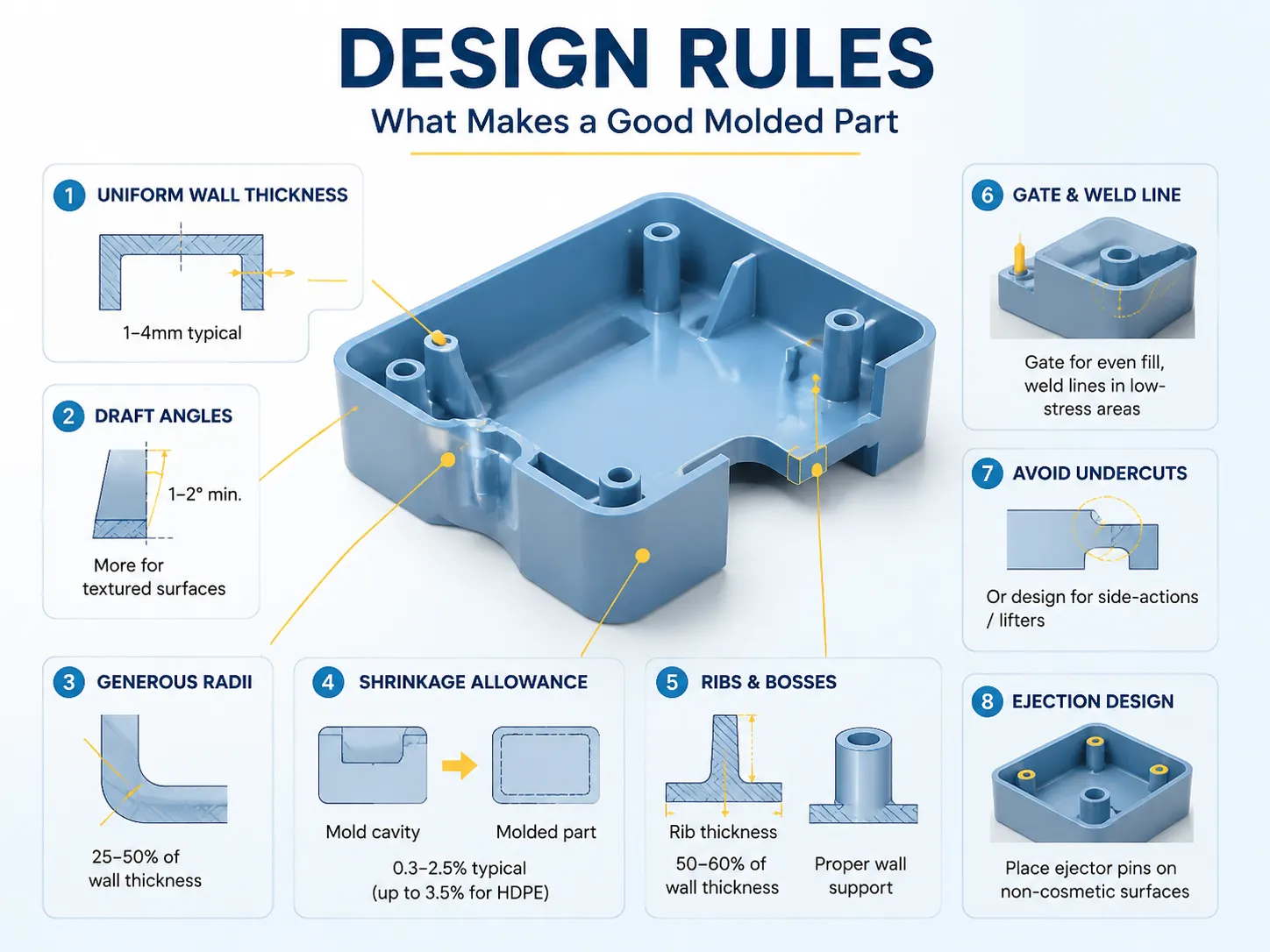
Design Rules: What Makes a Good Molded Part
The proper production of injection-molded components requires compliance with the accepted guidelines for design-for-manufacturing (DFM):
- Wall thickness uniformity: The wall thickness should be as uniform as possible (normally 1-4 mm) to eliminate sink marks, warping, and uneven cooling.
- Draft angle: All vertical surfaces must have a minimum draft angle of 1-2 degrees (higher for textures).
- Rounding of edges: The radius of internal and external corners must be rectangular (at least 25-50% of the wall thickness).
- Shrinkage allowance: The cavity must be overbuilt to account for shrinkage (0.3-2.5% shrinkage for conventional plastics; 3.5% for HDPE).
- Ribs and bosses: Ribs should be used to reinforce walls (50-60% thick at the bottom) and the boss should be designed for proper insert/screw support.
- Gates and weld lines positioning: Gates must be located to facilitate even filling and weld lines must be positioned in low-stress zones. Avoid undercuts.
- Ejection design: The location of ejector pins must be designated on non-visible parts of the item.
Types of Injection Molding & Machines
- The most common application of thermoplastic injection molding is its use with re-meltable resins.
- Thermoset injection molding, used with thermoset plastics, results in materials that cannot be melted or reshaped again.
- Insert molding, a technique in which moldable plastic is used to surround a pre-inserted metal insert, finds its main application in electrical parts creation.
- Overmolding, which is also sometimes called two-shot or multi-material molding, occurs when some other material (like soft thermoplastic elastomer) is used to coat the first molded product.
- Gas-assisted molding includes gases and/or water utilized to hollow the thick part.
- Thin-wall injection molding implies the fabrication of wall thicknesses that do not exceed 1 mm for faster operation, usually performed in drug packaging or electronics.
- Micro-molding specializes in producing very small parts used in electronics and in medicine.
In terms of machines, the first type is hydraulic (widely used and inexpensive), the second type is electric (with servos; energy efficient), and the last type is hybrid (combining the hydro-mechanical approach with electric means). Firms involved in machinery production include such giants as Haitian (largest according to the output), Engel, Arburg, KraussMaffei, and Sumitomo-Demag.
Common Defects & How to Fix Them
| Defect | Cause | Fix |
|---|---|---|
| Short shot (incomplete fill) | Low injection pressure/speed, cold material, blocked gate | Raise pressure/temp; increase injection speed; check gate |
| Flash (excess plastic at parting line) | Clamp force too low, worn mold, high injection pressure | Increase clamp tonnage; repair mold; reduce pressure |
| Sink marks (depressions on thick areas) | Insufficient packing, thick walls | Increase packing time/pressure; reduce wall thickness; relocate gate |
| Weld lines (visible seams where flow fronts meet) | Melt fronts meeting around inserts/holes | Raise melt/mold temp; increase speed; move gate |
| Warpage / distortion | Uneven cooling, shrinkage differences | Balance cooling; uniform walls; adjust mold temp zones |
| Burn marks (brown/black spots) | Trapped air, melt temperature too high (“diesel effect”) | Add vents; reduce injection speed; lower melt temp |
| Flow lines / streaks | Material flow variations, moisture in resin | Dry the resin; increase temp; increase speed |
| Splay / silver streaks | Moisture, contamination, or additive breakdown | Dry material properly; purge barrel; check contamination |
| Jetting (snake-like lines) | Melt injected too fast through a small gate | Slow initial injection; enlarge gate; change gate location |
| Ejector marks / part sticking | Insufficient draft, over-packing, mold surface | Increase draft; reduce packing; polish cavity; add ejectors |
Golden troubleshooting rule: change one variable at a time and allow 10–15 cycles to stabilize before judging — chasing multiple parameters at once makes problems worse.
Surface Finishes & Post-Processing
- As-molded finishes depends on both surface features of the mold used to produce the parts and SPI/VDI finishing grades ranging from mirror finish (A) to rough textured finish (D) with the addition of texture etching.
- Cosmetic post-production: includes painting, pad printing, laser marking, heat stamping, plating, and ultrasonic welding.
- Secondary machining consists of CNC cutting of gates/risers, drilling, and tapping for special features.
- Surface treatments include hard coatings (e.g., for PC lenses), anti-scratch and UV clear coatings, and flame treatment for paint adhesion.
Quality Control & Assurance
Quality of molded parts is controlled at various levels:
- First article inspection (FAI): checking shape and visual accuracy of the first produced pieces.
- In-process checks: regular checks of dimensions, weight and visual appearance of molded parts.
- Statistical process control (SPC): constant monitoring of weight and dimension parameters.
- Material certification: obtaining resin analysis information, moisture check before production of molded parts.
- Standards: ISO 9001 and product-specific standards; in case of electrical parts applicable IEC and UL standards.
On automated lines, vision systems and automatic weight/dimension checks can test 100% of parts — the same quality philosophy that governs automated vs manual testing in downstream assembly.
Costs: Tooling, Part Price & When It Makes Sense
| Cost Item | Typical Range | Notes |
|---|---|---|
| Mold (tooling), simple | $1,000–$10,000 | Aluminum / single-cavity, low volume |
| Mold, production steel | $10,000–$50,000 | Steel, multi-cavity, tight tolerance |
| Mold, complex / large | $50,000–$150,000+ | Multi-cavity, slides, complex geometry |
| Mold lead time | 4–16 weeks | Depends on complexity |
| Part price (per piece) | $0.01–$5+ | Material + cycle time + overhead; drops with volume |
| Economic minimum volume | ~500–1,000 pieces | Below this, 3D printing/CNC may be cheaper |
Injection molding is cost-effective when the production volume is large enough to cover the tooling cost. The volume at which one would switch from 3D printing to injection molding varies from the hundreds to thousands of parts, depending on the part’s size and material used.
Frequently Asked Questions
What is injection molding in simple terms?
Injection molding is a manufacturing technique that produces plastic pieces through liquefying plastic beans into liquid state, putting that liquid into a metal mold that has a shape resembling the desired piece, letting it harden, and finally popping the molded piece out. You can think of injection molding being an extremely high-pressure type of cookie cutting, where the mold is the cookie cutter and the heat and pressure are responsible for cutting. It is a typical means of manufacturing plastic elements due to its speed, reliability, and cost efficiency in terms of produced parts.
Which company is the largest injection molding company in the world?
There are different interpretations of the term “largest.” Jabil is generally referred to as the largest injection molder by revenue (its plastics division has an extensive number of machines deployed worldwide and manufacturing for electronics, automotive, and medical clients). When it comes to manufacturing injection molding machines, Haitian International (China) is the leader worldwide in terms of machine units shipped. Major custom molders are also companies like Flex, Nypro/Jabil, HTI Plastics, and Berry Global. Therefore, it is possible to argue about what entity should be considered the largest by machine count and the largest by revenue since in both cases Jabil/Flex and Haitian are at the forefront of this respectively.
What is a disadvantage of injection molding?
The major negative aspect is that production molds require a greater investment of time and money – costs anywhere from $1,000 to over $150,000, while the process of producing the mold itself takes from four to sixteen weeks. This renders injection molding unfeasible economically for small quantities (500-1,000 pieces) and non-productive in terms of modification (changing the mold can be expensive). Other drawbacks: limited size of the part; unfavorable geometries (geometric features of the part that is not possible to make using normal methods of production; limited removal of waste material; too many purges in cases of changing of color or material; and high costs of the process due to the requirement of a special mold being used for production.
What are the 5 steps of injection molding?
The injection molding cycle has five main steps: (1) clamping – the two parts of the mold come together and lock; (2) injection – the plastic is injected in liquid form into the mold; (3) holding/packing – the mold keeps the plastic under pressure so it can be solidified and shrink; (4) cooling – the finished product is cooled down and the mold (which is usually at this point being in the longest phase of the process) is held; (5) ejection – the mold is opened, and the part is taken out of the mold by the ejector pins. During the cycle time, the plasticizing process (melting of the resin) occurs as well.
References
- ASTM — plastic material testing standards (D638 tensile, D790 flexural, etc.)
- ISO — plastic and molding standards (ISO 1133 melt flow, ISO 294 molding)
- ENGEL — injection molding technology and process documentation
- Arburg — injection molding machine and process resources
- KraussMaffei — injection molding process technology
- Protolabs — injection molding design guidelines and material data
Conclusion
Injection molding is the most significant process of plastic manufacturing techniques, which occurs through repeated cycles of clamping, injecting, packing, cooling, and ejecting of substances, and gives certain homogeneous and complicated objects at mass production with low price for each item produced. The process relies on well-designed tools (molds), and is characterized by parameters specific to a certain material (temperature, pressure) and certain specific features wherever it comes to the design of the molded part (design of the wall, drafts, radii, and shrinkage).
In this case, the economic aspect is simple: considerable cost of molds and long period of time for their manufacturing, but lower price for one item. Later it will be easy to detect the defects and change only one variable at a time.