

什麼是轉換測試?了解其在行銷中的目的和優勢

發佈時間:2026年6月6日

Real field failure: “A new hotel had 500 wall switches installed. Three months later, twelve of those switches were malfunctioning because their contacts had welded together. The supplier had performed only a basic continuity test, not a full endurance test of the product.” – Project manager, a contractor specializing in commercial electrical installations.

Besides just seeing if a switch’s contacts work or not, the switch test must also verify mechanical endurance, electrical life, contact resistance, insulation integrity, and temperature rise when energized for products such as industrial/highly used switches (e.g., wall switches, isolators, auxiliary contacts, pressure switches). This Guide talks about what the five main types of testing switches are, what equipment can be used to carry out the tests (each type has its own equipment, from basic multimeters to fully automated test benches), and how to select the correct testing method based on your products.

本指南涵蓋以下內容:

  • The five types of tests conducted on switches include: mechanical test, electrical test, contact resistance test, dielectric test and temperature rise test.
  • The purpose of each test and the standards behind it (IEC 60669, IEC 60947‑1)
  • Professional test equipment vs. basic tools (multimeter, megohmmeter)
  • How to select a switch test bench based on your production volume
  • General price ranges and reliable manufacturers
  • FAQs: from basic (testing a light switch with a multimeter) to advanced (pressure switch testing)

What is a Switch Test Understanding Its Purpose and Benefits in Marketing

1. Mechanical endurance test (operation cycles)

What it tests: The switch’s ability to withstand repeated mechanical actuation without failure.

How it works: At a fixed speed (for example, fifteen operations per minute), an actuator (electric or pneumatic) moves the switch button or toggles the lever. The number of cycles tested is between ten thousand and one hundred thousand cycles according to the applicable standard. After the test, the switch must be electrically functional and able to close and open.

Equipment: A Mechanical Endurance Test Bench (e.g., Auxiliary and Signal Contact Test Bench). Basic Version: Solenoid Actuator and Counter Advanced Version: Accessory (Servo Controlled) and Force Monitoring.

2. Electrical endurance test (making/breaking capacity)

What it tests: The switch has the ability to create or interrupt electrical current while under load, without suffer from excessive arc or contact welding.

How it works: This test involves switching the switch through its rated current (such as 10A for standard wall switches) or three times its rated current (like motor switches) and measuring voltage drop across contacts to ensure that there was no welding of the contacts after each operation. International Electrotechnical Commission (IEC) 60669 specifies the number of times (usually between 5,000-20,000) for which a switch is required to perform this operation.

Equipment: A resistive/load bank and a controller. The “ATS Aging Test Bench” with automatic Benches can test several switches. If the production volume of switches is high enough, then multiple switches will be tested completely in an automated manner using the ATS aged tests.

3. Contact resistance test (static and dynamic)

What it tests: The resistance of the closed contacts – a key indicator of contact pressure and cleanliness.

How it works: A milliohmmeter (or micro-ohmmeter) operates by sending DC current (between 1A to 10A) through a switch that is in the closed position and thereby measuring the voltage drop across the contacts. The acceptable value of resistance measured should be less than 50 milliohms for silver contacts and less than 100 milliohms for copper contacts. When dynamic testing, the micro-ohmmeter is used to measure the resistance while the switch is cycling to identify if there are any bounces or intermittent connections in the contact surface.

Equipment: An automated test bench such as the RCBO semi-automatic comprehensive test bench that incorporates measuring contact resistance; or micro-ohmometer (handheld) for portable use in the field.

4. Dielectric strength (hi‑pot) and insulation resistance test

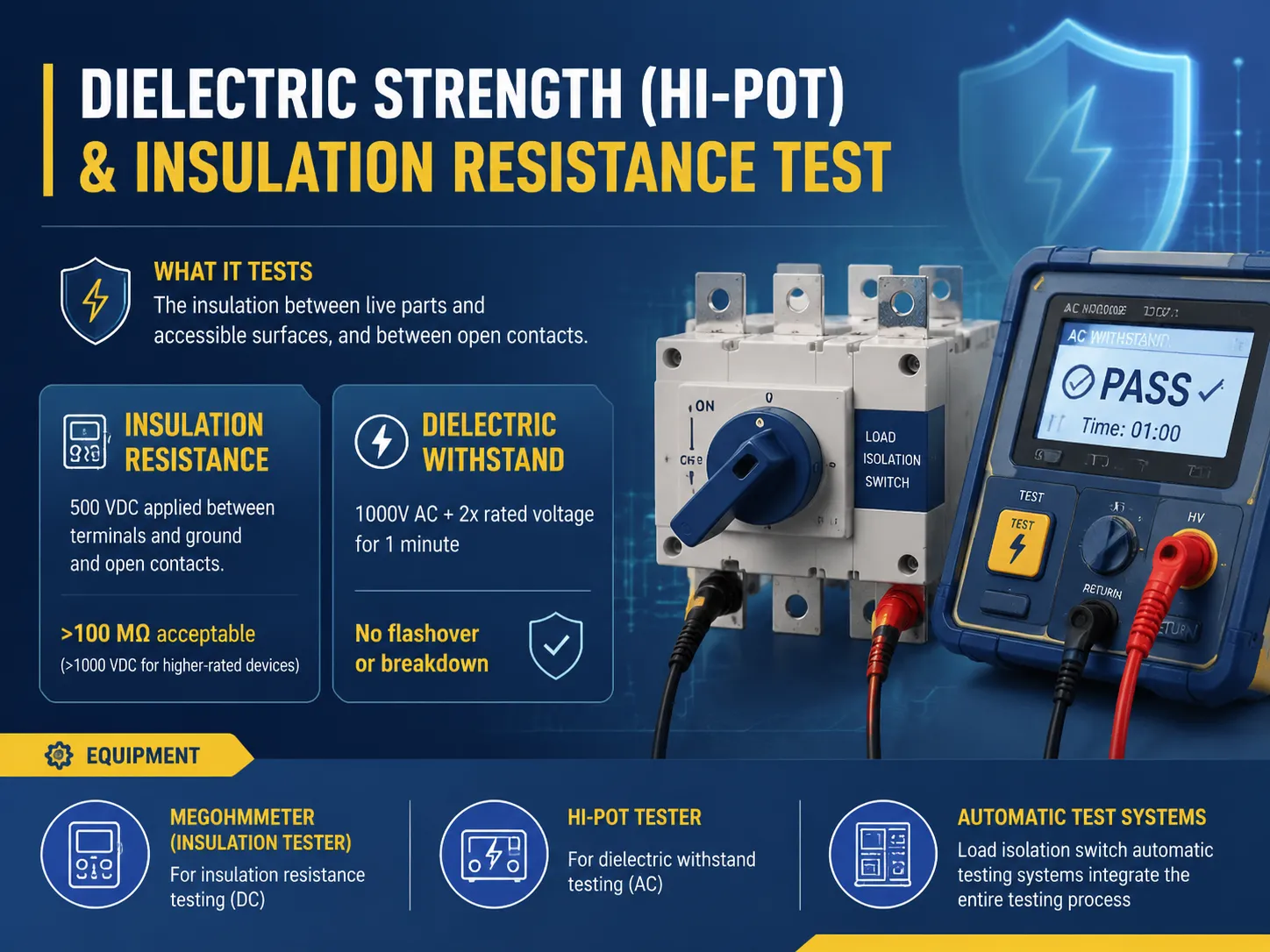
What it tests: The insulation between live parts and accessible surfaces, and between open contacts.

How it works:

  • 絕緣電阻: Subject devices (for switch rating ≤250V) shall have 500 VDC applied between terminals and ground and open contacts. > 100 MΩ acceptable. For higher-rated devices, >1000 VDC applicable.
  • Dielectric withstand: Apply 1000V AC + 2x rated voltage for 1 minute – no flashover or breakdown.

Equipment: For field testing purposes, a megohmmeter (also known as an insulation tester) or a dedicated hi-pot tester may be used. Among the options available to conduct the insulation testing are load isolation switch automatic testing systems, which automatically include the testing process.

Dielectric strength hi‑pot and insulation resistance test

5. Temperature rise test

What it tests: The switch’s ability to dissipate heat generated by current flow without exceeding material limits.

How it works: A box will be placed in to simulate the maximum worst case installation and then the switch load will be tested at 1.1x rated current for 1-2 hours. The temperature will be measured at both the terminals and on the housing using thermocouples. Temperature rise of the switch shall not exceed standard requirements of 45K (45°C above ambient).

Equipment: A data logger using thermocouples and a constant current supply; for production lines in an automated testing environment, a test chamber with a PLC-controlled current supply and automated data recording.

Professional switch test equipment: what you can buy

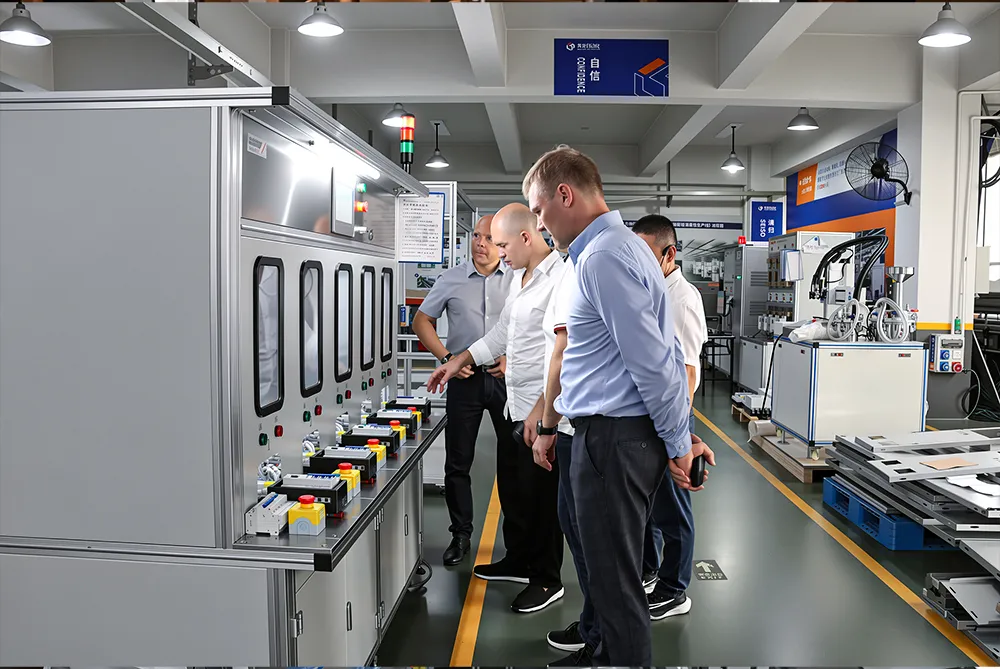
Automated test benches are an essential tool for manufacturers producing thousands of switches per day. Several suppliers such as Benlong Automation offer various types of automated test benches, including:

  • Single‑station semi‑automatic tester (for contact resistance + insulation): $8,000 – $20,000
  • Rotary table tester (mechanical endurance + electrical life): $25,000 – $60,000
  • Inline automated test bench (all 5 tests, MES integration): $80,000 – $200,000

The major global manufacturers of wall switches, pressure switches, or auxiliary contacts, and other types of switches are as follows: Benlong Automation (China), Schleich (Germany), Eaton (USA), and HVTest (China). Most of these companies provide custom solutions that are based on the type of switch that you have.

The selection of the equipment is determined by the specific functions that it will perform. In this case, an automatic riveting machine for wall switches/silver contact rivets would typically be referred to as “welding/rivet machine” and does not perform in-line testing. Electrical testing will be performed downstream on a different piece of equipment such as the Auxiliary & Signal contact Test Bench.

How to choose the right switch test equipment: a 3‑step process

  1. Identify your switch type and standard: Wall switch (IEC 60669), industrial isolators (IEC 60947-3), pressure switch (often custom made), auxiliary contact (IEC 60947-5-1).
  2. Define your production volume: If you need to produce less than 1,000 units per day, you can use either a fully manual or semi-automated bench setup. For anything over 1,000 units per day, you should utilize a fully automated inline testing system with an integrated conveyor accepting bulk output and sorting product by type.
  3. Mandatory test suite: Minimum requirements should include contact resistance and insulation/capacitance levels. For safety switches (emergency stops), also include mechanical durability assessment; for power switching devices, include consideration of temperature rise through operation.

Whenever possible, request a test report from your supplier that uses your actual samples. This will prove your switch design and the capability of the tester being used.

How to choose the right switch test equipment

常見問題解答

How to test a light switch with a multimeter?

To test the resistance in ohms, set your multimeter to resistance mode (200Ω). If the switch is off you should see OL or “1,” (similar to infinite resistance). When you turn the switch on, you should see a measurement close to zero (less than 0.5Ω). If you see a large amount of resistance (greater than 10Ω), the contacts are either pitted or have some type of oxidation on them. Although this is a functional test, it will not provide verification for insulation or endurance. You will need additional equipment mentioned in Sections 2-5 above to verify complete functionality.

How to test a pressure switch?

A pressure switch (e.g., for a well pump or air compressor) is tested in two parts:

  1. Setpoint verification: You can apply increasing pressure with a calibrated pressure source, and at some point the switch will change states (continuity test using a multi-meter).
  2. Electrical test: Once the pressure is cycled 5,000 times or more repeated, then perform this function of performing the test as referenced above but also determine contact resistance and dielectric resistance according to sections 3 and 4 again.

Automating the electrical and pressure test of a load isolation switch will typically be accomplished through the use of dedicated test benches that have an integrated, automated solution.

How to test a light switch without removing it from the wall?

A simple way to do a quick safety-check using a non-contact voltage tester will allow you to ensure that your power is off. To do this, perform a simple functional test of the switch by turning it on and off with a lamp connected; if the lamp operates, the switch is likely functioning properly.

Keep in mind that high resistance at a contact could cause the switch to overheat without showing sign of damage. To properly test for high contact resistance, you need to remove the switch from the device and test the contacts for continuity using a multimeter as outlined above, or use a simple switch-testing device (available at some electrical wholesalers).

What is the difference between a manual and an automated switch test bench?

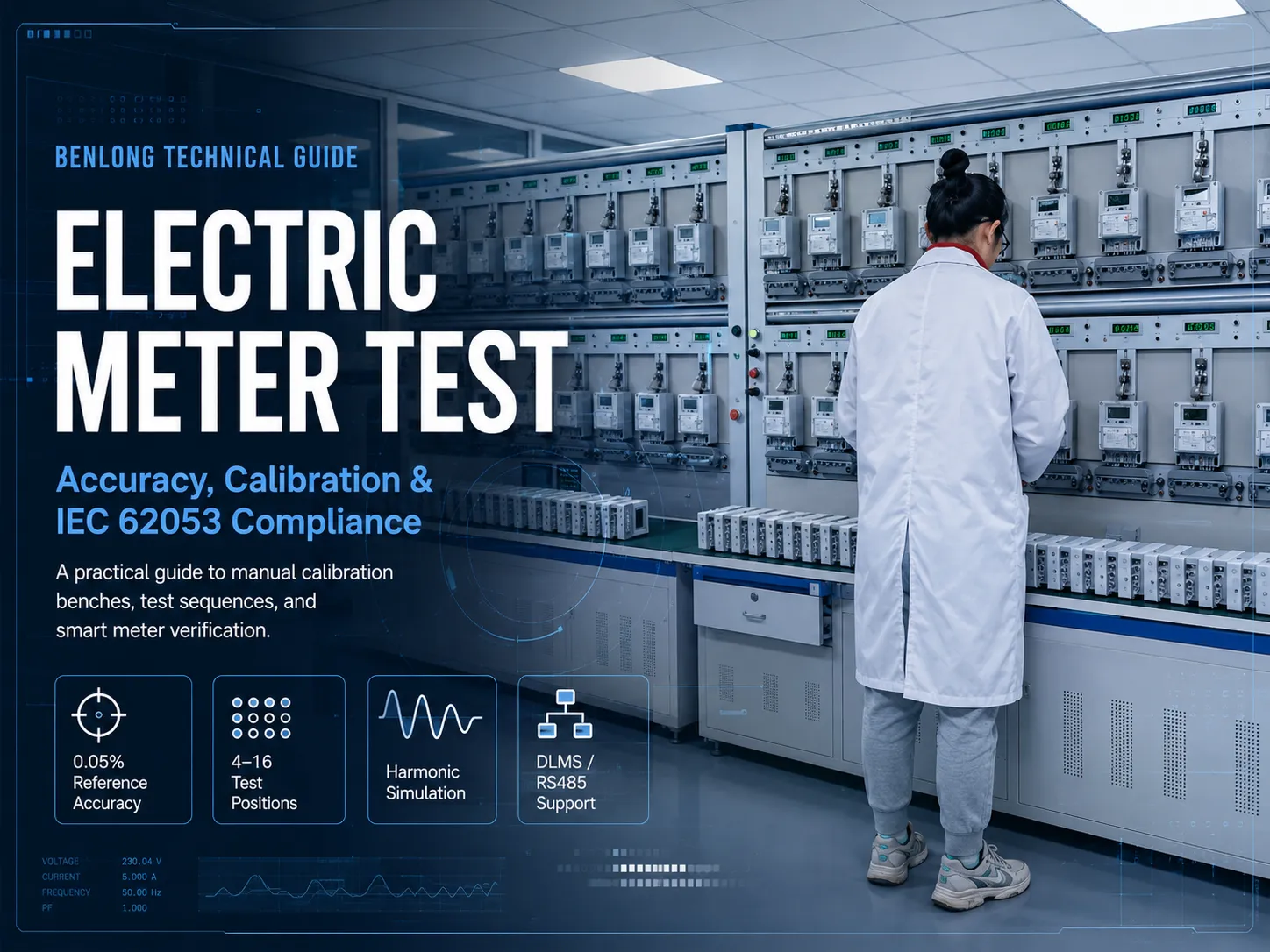
An operator has to manually set the switch, press a button to activate a single test (for example, contact resistance), read out the result, then move the switch. This process is time-consuming and very susceptible to error. An automated switch testing system with a PLC, actuators, and sensors can automatically load and test (many at once), sort as pass/fail, and record data for you (like the equipment used for ATS aging tests or the comprehensive testing of RCBO). The use of automated testing benches increases throughput by 5-10 times and completely negates human errors.

Which international standard applies to wall switch testing?

IEC 60669‑1 Generally speaking, the most popular standard for switches is that which is contained within the IEC 60669-1 standard for fixed electrical installations such as (switches for household and similar use). The standard provides definitions for mechanical endurance (from 10,000 to 40,000 cycles depending on the type of switch), electrical endurance (from 1,000 to 10,000 cycles at the rated current), temperature rise (≤45K), and insulation testing. If you’re looking for the industrial equivalent standard, you would want to refer to IEC 60947-1 and IEC 60947-3. However, as always confirm current standard with your customer or regulatory body.

Five types of switch testing programs are required to perform a complete switch test: mechanical endurance, electrical endurance, contact resistance, dielectric/insulation, and temperature rise.

Field service technicians typically use a multimeter or insulation tester as part of a go/no-go testing process; they will tell you if a switch passes or fails.

Manufacturers or other users who require high levels of reliability will utilize automated test benches (e.g., Auxiliary/Signal Contact Test Bench or Load Isolation Switch Automatic Test Lines) to test switches to ensure they meet product quality standards, comply with IEC requirements, and provide tracing information.

To determine what type of test equipment you need to purchase for your application, you should first determine the switch type, switch volume, and what standards your switches are required to meet. Once you have this information, you can then contact various suppliers and request sample switch tests be performed using your switches. The price for professional-grade test benches can range from $8,000 for a standard single-station test bench up to $200,000 for a fully automated inline testing system.

By investing in the correct test equipment to test switches, you can reduce the incidence of switch failures in the field, protect brand name, and have a return on investment (ROI) within 12 to 18 months through the use of reduced warranty claims.

WhatsApp
+86 150 5837 0007
Email
xsb@benlongkj.cn