benlong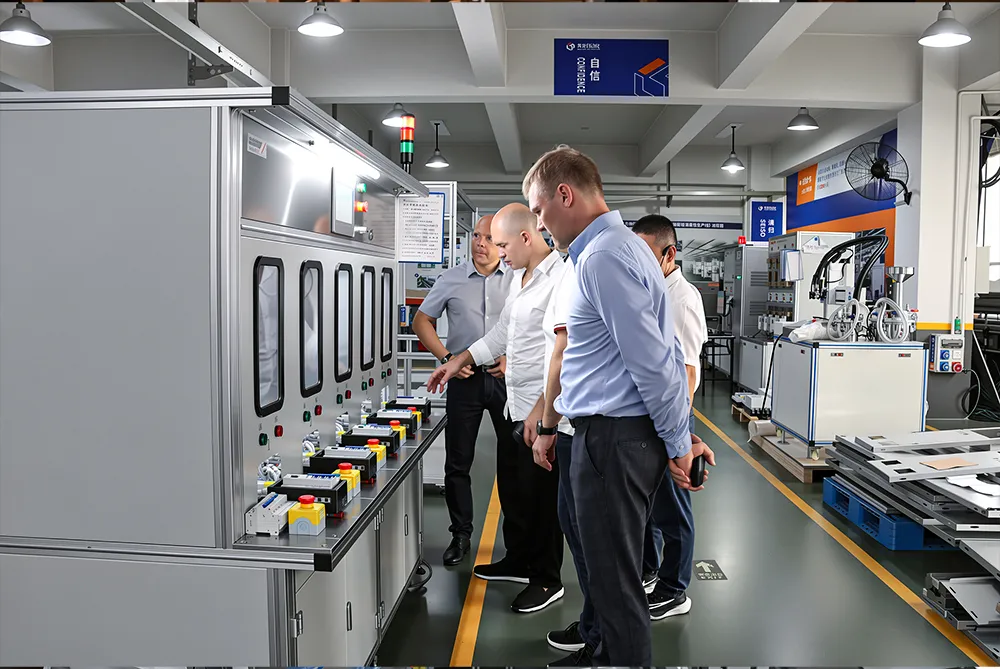
Les 10 principaux fabricants de machines de moulage par injection en Inde
Une entreprise de Pune, spécialisée dans les accessoires électriques et en pleine croissance, a récemment choisi de fabriquer elle-même ses boîtiers de disjoncteurs miniatures (MCB) plutôt que de recourir à des fournisseurs externes. Au départ, leur question n'était pas “ quelle machine choisir ? ” mais plutôt “ qui assurera le support technique de notre machine dans quinze ans ? ”. Les fournisseurs de presses à injecter comptent de nombreux fabricants (nationaux et internationaux) qui produisent désormais leurs articles localement. Le type de presse à injecter que vous choisirez aura un impact direct sur la qualité globale des pièces, le temps de cycle, les coûts énergétiques et la disponibilité du service après-vente, notamment en cas de panne de la carte de contrôle, par exemple à 2 h du matin. Avant d'effectuer cet investissement (dont le retour sur investissement est attendu sur plusieurs décennies), renseignez-vous sur les fabricants de presses à injecter leaders sur leur marché et sur leurs points forts respectifs.
Aperçu du marché indien des machines de moulage par injection
Le moulage par injection est l'un des marchés à la croissance la plus rapide au monde, une croissance principalement due à l'expansion de la production nationale indienne, notamment dans les secteurs de l'automobile, de l'emballage, du médical et de l'électronique. Les fournisseurs indiens se composent de fournisseurs entièrement locaux, de multinationales ayant implanté des filiales en Inde et, dans une moindre mesure, d'importations en provenance de Chine et de Taïwan. Les machines utilisées dans l'industrie du moulage par injection comprennent des modèles hydrauliques, hybrides et entièrement électriques. La force de fermeture varie considérablement, de quelques tonnes à plus de 4 000 tonnes, en fonction du type et du poids de la pièce en plastique fabriquée. Pour la fabrication de composants électriques (par exemple, les corps de disjoncteurs, les plaques d'interrupteurs, les porte-contacts, les boîtiers), la force de fermeture la plus courante se situe entre 80 et 350 tonnes. Dans ce cas, la vitesse, la précision et la répétabilité sont primordiales, plus encore que la force de fermeture brute. Pour comprendre comment ces composants moulés s'intègrent dans le paysage plus vaste de l'automatisation, consultez notre aperçu de… Qu'est-ce que l'automatisation ? fournit un contexte sur l'ensemble de la chaîne de production.
Les 10 principaux fabricants de machines de moulage par injection en Inde
1. Milacron Inde (Ferromatik)
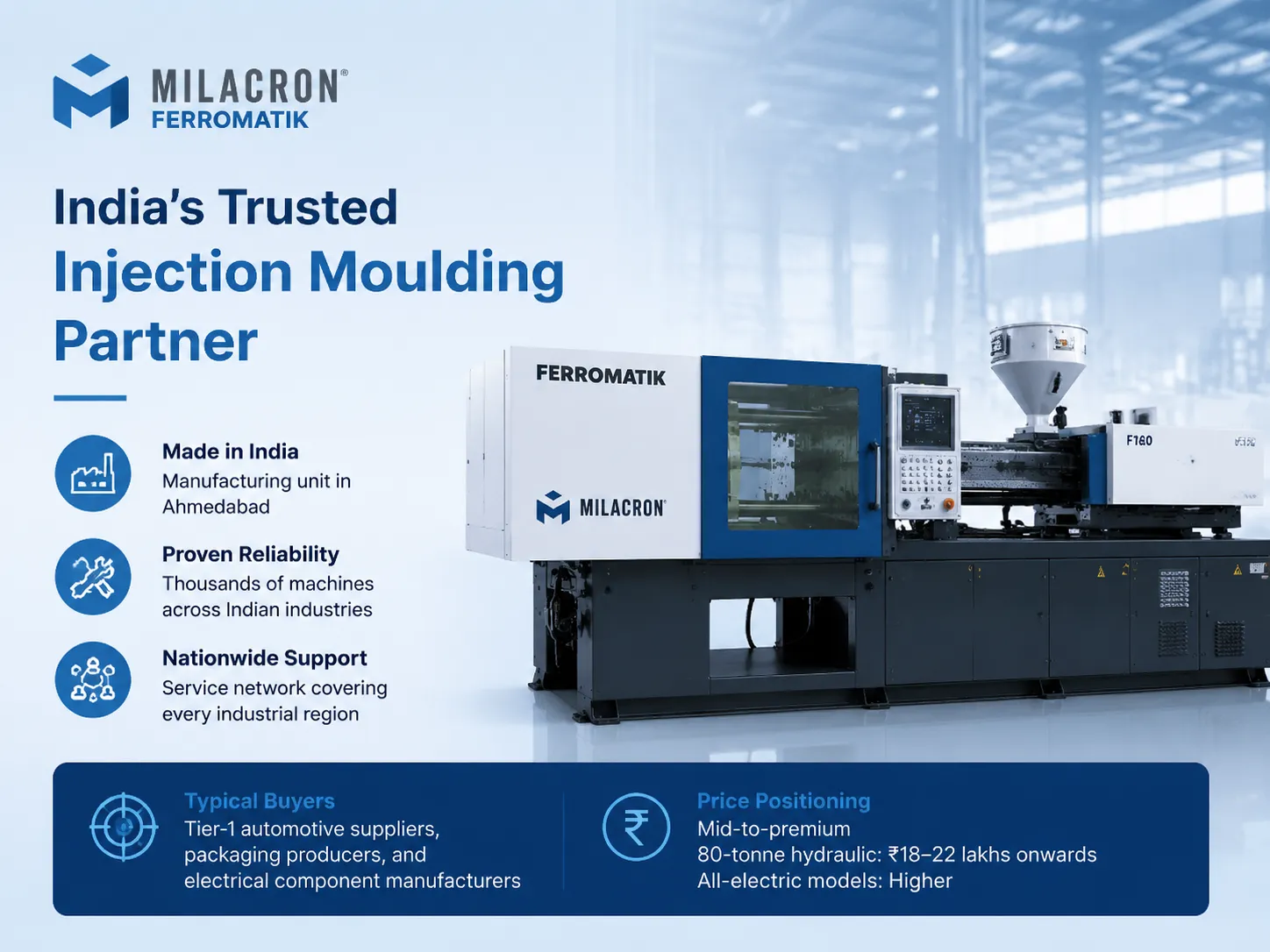
Force du troncMilacron, sous la marque Ferromatik, est une référence en matière de moulage par injection en Inde. Son usine d'Ahmedabad fabrique des machines hydrauliques et électriques. La force de Milacron réside dans son parc installé de milliers de machines dans les usines indiennes et dans un réseau de service après-vente couvrant toutes les régions industrielles.
Acheteur type: Fournisseurs automobiles de premier rang, producteurs d'emballages et fabricants de composants électriques qui nécessitent une machine offrant un accès facile aux pièces de rechange et à l'entretien.
Positionnement des prix: Milieu à haut de gamme. Une machine Milacron hydraulique de 80 tonnes coûte généralement entre 18 et 22 lakhs de roupies, les modèles tout électriques étant nettement plus chers.
2. Haïtien Inde
Force du troncHaitian est le leader mondial de la production en série de presses à injecter, et sa filiale indienne est en constante expansion. Les gammes Mars et Zhafir de Haitian proposent des solutions hydrauliques, hybrides et 100 % électriques. Son envergure lui permet également de maintenir des coûts de composants bas à l'échelle mondiale, et son réseau de distribution indien couvre désormais la majorité des zones industrielles.
Acheteur type: Fabricants soucieux des prix et recherchant une machine fiable et éprouvée offrant un excellent rapport qualité-prix, notamment dans le segment des machines de tonnage moyen.
Stratégie de tarification: Moyen de gamme compétitif. Les machines haïtiennes sont généralement 15 à 25% moins chères que leurs homologues japonaises et allemandes, ce qui en fait un bon choix pour les petites et moyennes entreprises.
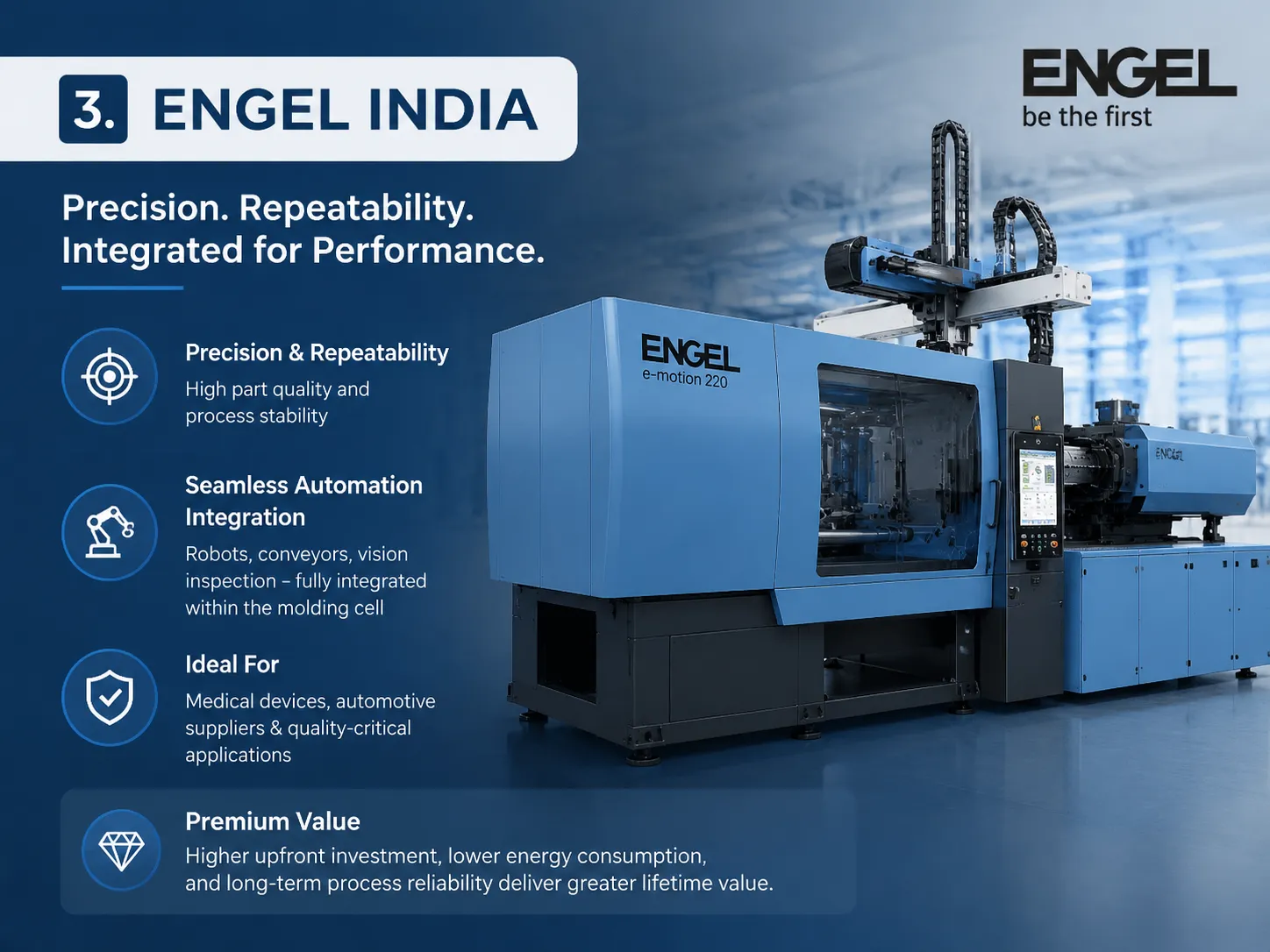
3. Engel Inde
Force du troncEngel, entreprise autrichienne de renom, figure parmi les meilleurs fabricants mondiaux de machines de moulage par injection. Sa filiale indienne, dont le siège social est situé à Pune, fabrique des machines pour le marché local et propose des services d'ingénierie d'application. Engel excelle en matière de précision et de répétabilité, ainsi que dans l'intégration harmonieuse de l'automatisation (robots, convoyeurs, contrôle par vision) au sein de la cellule de moulage.
acheteurs types: Les entreprises de dispositifs médicaux, les équipementiers automobiles et toute application où la qualité des pièces et la documentation des processus sont importantes.
Positionnement des prix: Haut de gamme. Une machine Engel représente un coût initial plus élevé, mais son efficacité énergétique et la stabilité de son processus peuvent compenser cette différence au cours de sa durée de vie.
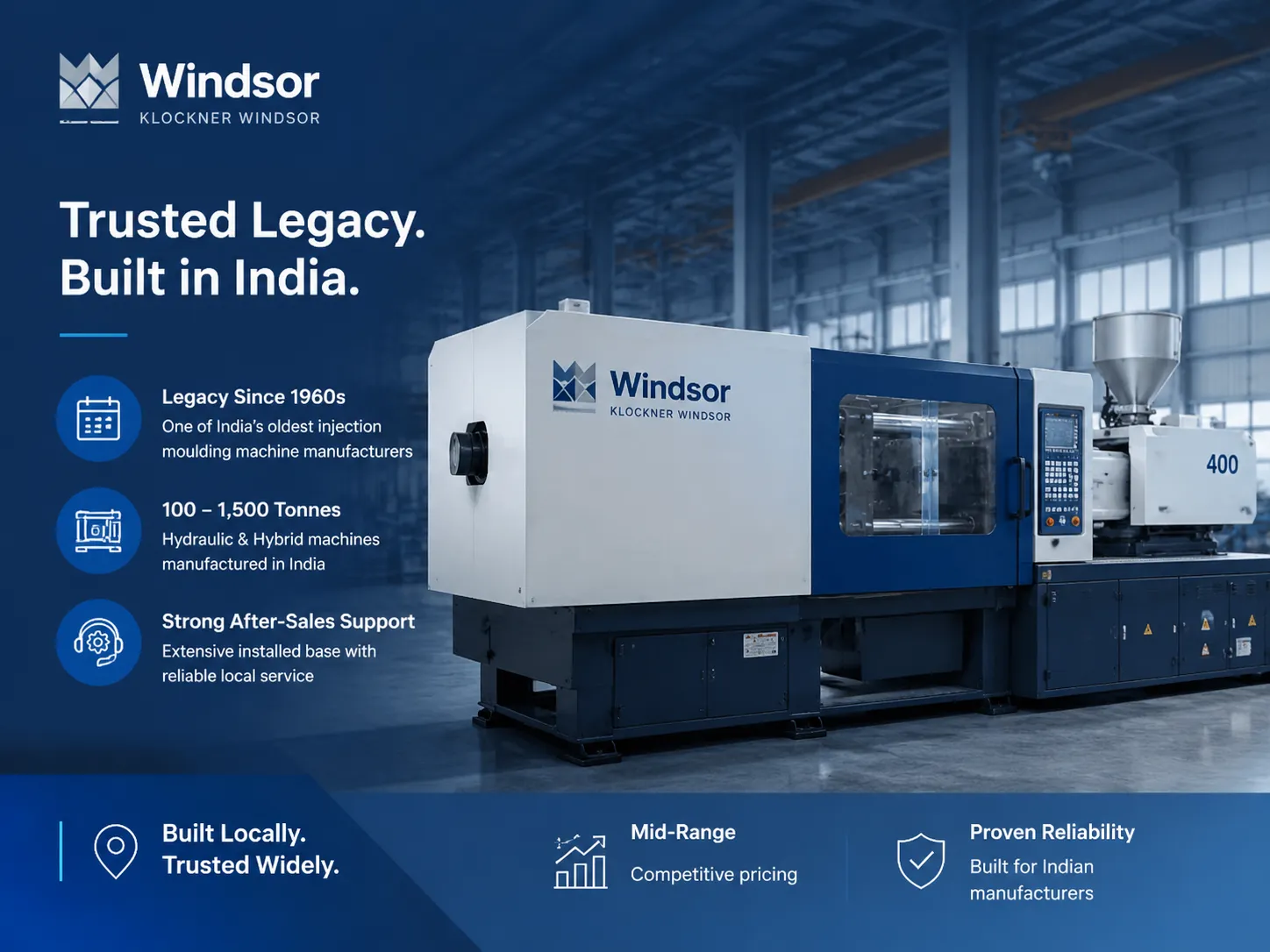
4. Machines Windsor (Klockner Windsor)
Des bases solides pour la croissanceWindsor, l'un des plus anciens fabricants indiens de machines de moulage par injection, bénéficie d'un héritage remontant aux années 1960. L'entreprise fabrique en Inde des machines hydrauliques et hybrides, notamment dans la gamme de 100 à 1 500 tonnes. Buffalo dispose d'une importante base installée dans le secteur manufacturier indien grâce à Windsor et son service après-vente est très performant.
Acheteur type: Les fabricants indiens recherchent une machine à la fiabilité éprouvée, fabriquée localement et bénéficiant d'un support technique local.
Positionnement des prix: Gamme moyenne, compétitive face aux constructeurs indiens et asiatiques.
5. Toshiba Machine Inde
Force du troncLa filiale de moulage par injection de Toshiba, désormais Shibaura Machine, est solidement implantée en Inde. Ses machines sont précises, robustes et particulièrement performantes en fonderie sous pression et en moulage par injection plastique. La série EC-SX, entièrement électrique, de Toshiba est la référence en matière de haute précision pour les applications électriques et électroniques.
L'acheteur typeFabricants de composants électroniques, de connecteurs et de composants automobiles exigeant un contrôle strict des tolérances.
Positionnement des prixHaut de gamme, en concurrence avec Engel et d'autres fabricants japonais/allemands.
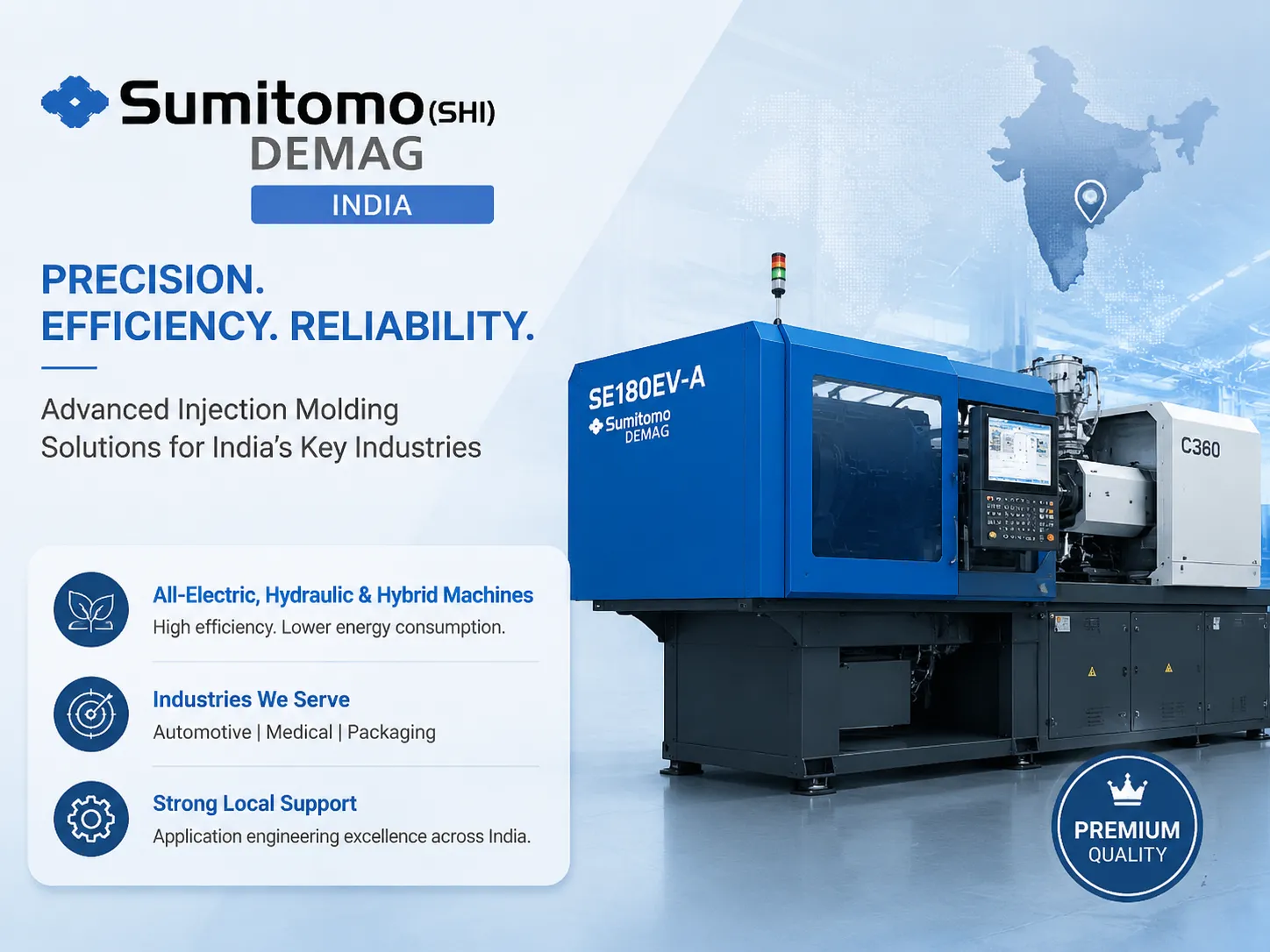
6. Sumitomo (SHI) Demag Inde
Compétence de baseSumitomo Heavy Industries Demag propose une gamme complète de machines électriques, hydrauliques et hybrides. En Inde, l'entreprise dessert les secteurs de l'automobile, du médical et de l'emballage. Les machines électriques Sumitomo sont très performantes et l'entreprise dispose d'une solide expertise en ingénierie d'application en Inde.
Acheteur type: Fabricants à forte production et haute précision qui valorisent l'efficacité énergétique et le contrôle des processus.
Tarification: Prime.
7. Machines électroniques pour le plastique (EPM)
Force du troncEPM est une entreprise indienne basée à Pune, spécialisée dans la fabrication de presses à injecter hydrauliques d'une capacité de 50 à 1 500 tonnes. L'entreprise se concentre sur le marché indien, avec un potentiel d'exportation. Les machines EPM sont conçues pour répondre aux exigences spécifiques du secteur manufacturier indien : robustes, faciles à entretenir et abordables, elles permettent aux entreprises indiennes de devenir leaders sur leur marché.
Client type: Un petit et moyen fabricant indien qui a besoin d'une machine fabriquée localement et qui bénéficie d'un accès facile au service après-vente et aux pièces détachées.
Positionnement tarifaire: Compétitif et généralement inférieur à celui des marques mondiales pour un tonnage équivalent.
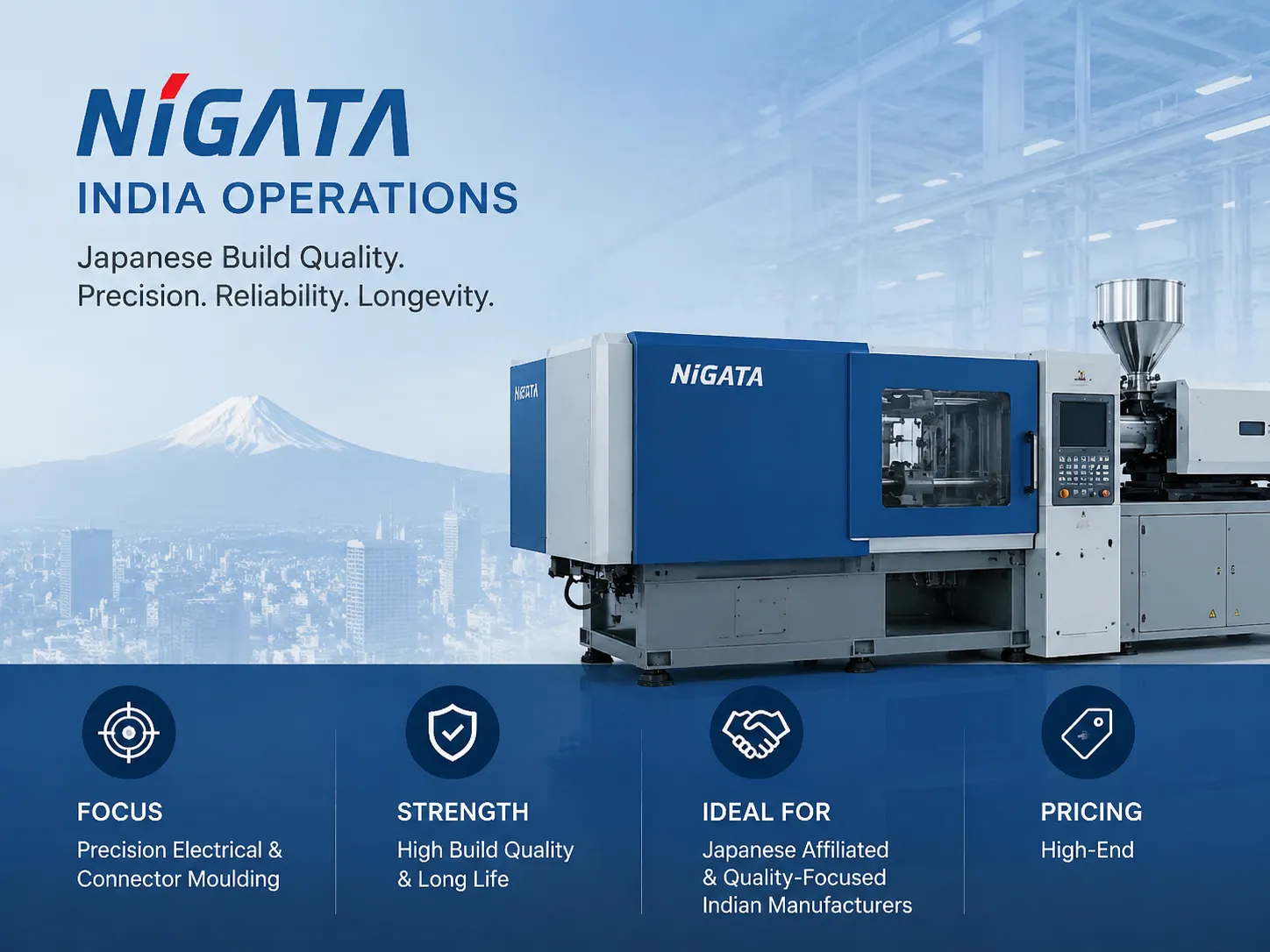
8. Opérations de Nigata (Japon) en Inde
Nigata, une entreprise japonaise, fabrique des presses à injecter électriques et hydrauliques. Bien que sa présence en Inde soit plus modeste que celle de certains concurrents, elle est solidement implantée dans le secteur du moulage de précision pour l'électronique et les connecteurs. Les machines Nigata sont réputées pour leur qualité de fabrication et leur longévité.
Utilisateur prévu: Les fabricants japonais affiliés résidant en Inde et les entités indiennes qui apprécient la qualité de fabrication japonaise.
Stratégie de prixHaut de gamme.
9. Machines de moulage par injection L&T (désormais intégrées à L&T Switchgear)
Atouts du secteur : Larsen & Toubro, le plus grand conglomérat d’ingénierie en Inde, est également présent sur le marché des machines de moulage par injection via ses divisions Électrique et Appareillage. Bien que L&T ne se spécialise pas principalement dans les machines de moulage par injection autonomes, son expertise en la matière peut être mise à profit par les acheteurs du secteur électrique pour le moulage d’armoires électriques, de boîtiers de disjoncteurs, de composants d’appareillage et autres produits similaires, notamment pour les moules multi-empreintes.
Le client type: les fabricants d'appareils électriques qui ont besoin de solutions de moulage combinées à une automatisation de l'assemblage et des tests.
Tarification: De milieu à haut de gamme, pour refléter l'intégration et le support technique.
10. Fu Chun Shin (FCS) Inde
Force du troncFCS, fabricant taïwanais, renforce actuellement sa présence en Inde. Ses équipements couvrent les technologies hydrauliques, hybrides et électriques, avec une spécialisation sur le segment moyen de gamme. FCS pratique des prix compétitifs par rapport aux fabricants haïtiens et autres producteurs asiatiques, tout en garantissant la qualité d'ingénierie taïwanaise.
Acheteur type: Les petites et moyennes entreprises (PME) indiennes à la recherche d'un bon rapport qualité-prix et de fonctionnalités dans la gamme de 100 à 500 tonnes.
Prix: ” En compétition sur le segment moyen. »
Quel est le prix d'une machine de moulage par injection en Inde ?
| Force de serrage (tonnes) | Hydraulique (Indienne/Économique) | Hydraulique (Marque mondiale) | Tout électrique (Premium) |
|---|---|---|---|
| 80 à 100 tonnes | 15 à 22 lakhs de roupies | 25 à 40 lakhs de roupies | 45 à 70 lakhs de roupies |
| 150 à 200 tonnes | 22 à 40 lakhs de roupies | 40 à 65 lakhs de roupies | 70 lakhs – 1,2 crore de roupies |
| 350 à 500 tonnes | 50 à 85 lakhs de roupies | 85 lakhs – 1,5 crore de roupies | 1,5 à 2,5 crores de roupies |
| 800 à 1 000 tonnes | 1 à 1,8 crore de roupies | 1,8 à 3 crores de roupies | 3 à 5 crores de roupies+ |
Les prix indiqués sont départ usine et ne comprennent pas les moules, les équipements auxiliaires, l'installation ni les taxes. Le coût réel dépend de la configuration spécifique, du niveau d'automatisation et du pouvoir de négociation de l'acheteur. De nombreux fabricants indiens proposent également des machines reconditionnées à un prix représentant 50 à 70 000 TP3 % du prix du neuf, une option courante pour les petites entreprises. Les acheteurs souhaitant obtenir plus d'informations peuvent consulter les catalogues de machines et les analyses techniques publiés par industrie.com, qui suit les équipements industriels sur les marchés mondiaux, ou consultez les catalogues de produits des principaux constructeurs de machines mondiaux tels que Arburg et KraussMaffei.
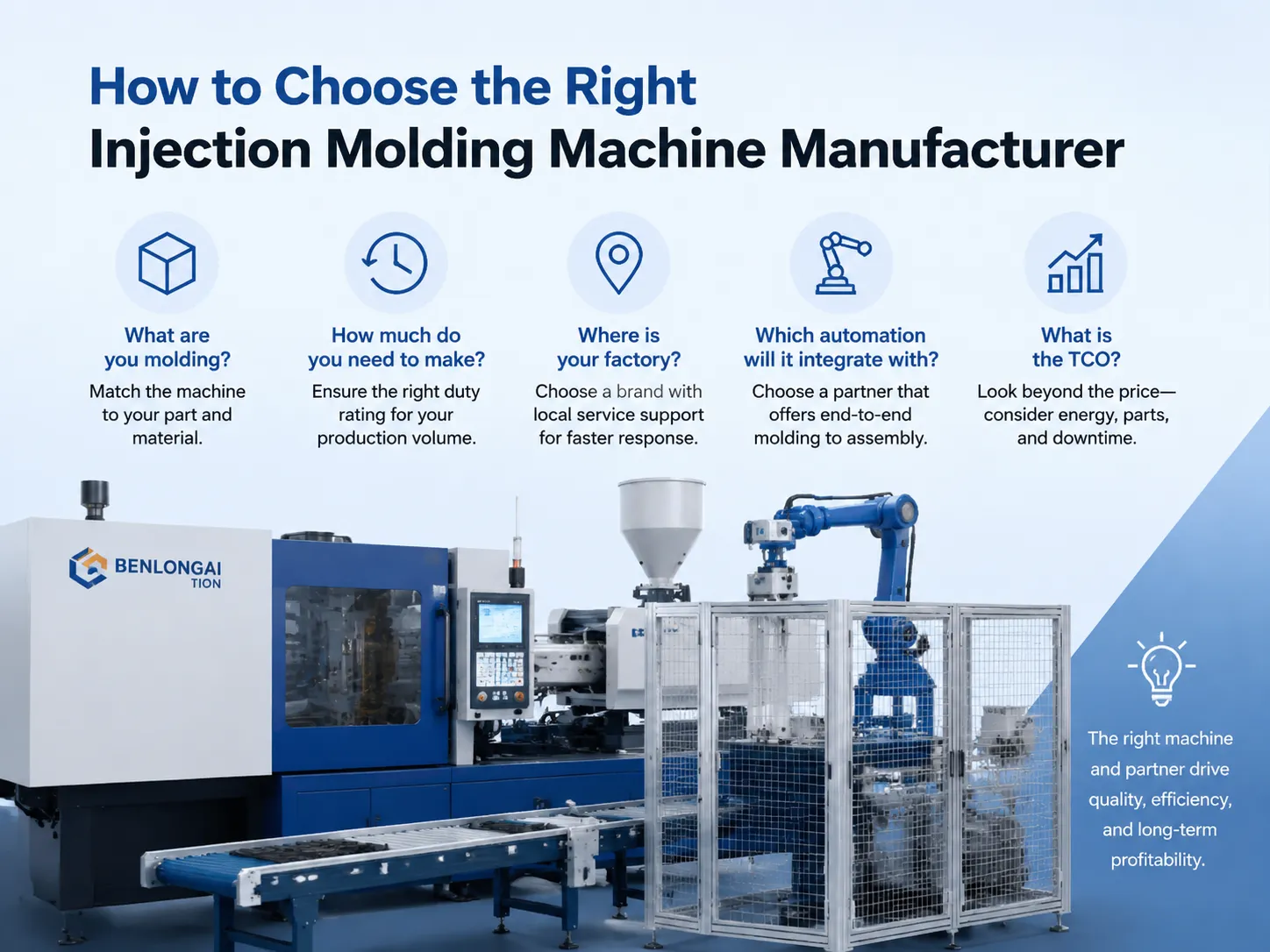
Comment choisir le bon fabricant de machines de moulage par injection
Choisir parmi les Les 10 principaux fabricants de machines de moulage par injection en Inde Cela se résume à cinq questions pratiques :
- Que moulez-vous ? Un connecteur électrique nécessitant une tolérance de ±0,02 mm requiert une machine différente de celle utilisée pour une poubelle. Le type de matériau (polycarbonate, nylon, PBT ou résine chargée de fibres de verre) détermine le profil de la vis et du cylindre, la vitesse d'injection ainsi que la force de serrage.
De combien avez-vous besoin ? Une machine fonctionnant 24 h/24 et 7 j/7 pour la production de boîtiers de disjoncteurs miniatures (MCB) nécessite un facteur de marche et un intervalle d'entretien différents de ceux d'une machine fonctionnant en une seule équipe. Les machines tout électriques sont économes en énergie à des cycles de fonctionnement élevés, mais leur coût initial est plus important.
Où se trouve votre usine ? Votre appareil a plus de chances d'être remis en service plus rapidement s'il s'agit d'une marque disposant d'un centre de service après-vente dans votre région, plutôt que d'une marque dont le technicien le plus proche se trouve à 1 000 km. Demandez au fabricant de vous indiquer la date et la durée de sa dernière intervention dans votre secteur. - Avec quel système d'automatisation la machine sera-t-elle compatible ? Dans l'industrie électrique, le moulage n'est généralement pas la dernière étape. La pièce moulée doit être démoulée, désalignée, éventuellement assemblée et testée. Un fabricant de machines maîtrisant l'ensemble de la chaîne de production (moulage, assemblage, tests) peut intégrer l'ensemble du processus. C'est là que les partenaires d'automatisation spécialisés apportent une réelle valeur ajoutée. Par exemple, Benlong Automation a mis en place des lignes de production automatisées pour les disjoncteurs miniatures (MCB), les disjoncteurs de puissance (MCCB) et autres dispositifs de protection électrique dans ses usines en Inde et en Chine. Un boîtier de disjoncteur moulé, passant directement de la presse à injection à une ligne d'assemblage et de test automatisée, élimine la manutention, les stocks intermédiaires et les variations de qualité inhérentes aux cellules de production isolées et désintégrées.
- Pour examiner plus en détail la partie assemblage de cette intégration, consultez notre guide sur meilleurs produits d'automatisation MCB couvre l'équipement qui transforme un boîtier moulé en un disjoncteur fini et testé.
- Qu'est-ce que le TCO ? Le prix d'achat est un montant unique. La consommation d'énergie, la disponibilité des pièces détachées, la maintenance préventive et le coût d'une journée d'arrêt s'accumulent sur la durée de vie de la machine, soit 15 à 20 ans. Une machine entièrement électrique, dont le prix initial est supérieur de 50 %, peut amortir cette différence grâce aux seules économies d'énergie réalisées en 5 à 7 ans.
Foire aux questions
Quel est le meilleur fabricant de moules d'injection en Inde ?
Il n'existe pas de solution unique et universelle. Pour les composants électriques et médicaux de précision, Engel et Sumitomo Demag font généralement figure de référence. Pour le marché des volumes importants et soucieux des coûts, Haitian et Windsor ont fait leurs preuves. Le fabricant idéal est celui qui répond le mieux à vos exigences en matière de matériaux, de tolérances et de volumes, et dont l'équipe de service après-vente est située à proximité de votre usine.
Qui est le plus grand fabricant mondial de machines de moulage par injection ?
Haitian International est le premier fournisseur mondial de machines de moulage par injection, tant en termes de chiffre d'affaires que d'unités expédiées. Son siège social est situé en Chine. L'entreprise fabrique plus de 40 000 machines par an, appartenant aux séries Mars, Zhafir et Jupiter, et bénéficie d'une forte présence en Inde, où elle connaît une croissance continue.
Qui fabrique les meilleures machines de moulage par injection ?
Le terme “ meilleur ” dépend de l'application. Les entreprises allemandes et autrichiennes telles qu'Arburg, Engel et KraussMaffei sont réputées pour leur précision, leur longévité et leur maîtrise des processus. Les entreprises japonaises – Toshiba, Sumitomo et Nigata – sont tout aussi performantes dans les secteurs de l'électronique et de l'automobile. Leur prix plus élevé est justifié dans les applications où une variation d'un micron peut affecter le fonctionnement des pièces.
Quel est le prix d'une machine de moulage par injection de 500 tonnes en Inde ?
En Inde, une presse à injecter hydraulique de 500 tonnes coûte généralement entre 85 lakhs et 1,5 crore de roupies pour une marque internationale. On peut trouver des machines hydrauliques fabriquées en Inde pour 50 à 85 lakhs de roupies. Une presse électrique haut de gamme de 500 tonnes d'une marque premium peut coûter entre 1,5 et 2,5 crores de roupies. Les prix varient en fonction de la configuration, de l'automatisation et des spécifications du moule.
Références
- Milacron Inde (Ferromatik) — Machines de moulage par injection hydrauliques et entièrement électriques fabriquées à Ahmedabad.
- Haïti International — Le plus grand fabricant mondial de machines de moulage par injection en volume, avec des activités en Inde.
- Engel Autriche — Machines de moulage par injection haut de gamme et intégration de l'automatisation, avec une filiale indienne à Pune.
- Machines Windsor — L'un des plus anciens fabricants indiens de machines de moulage par injection.
- Machine Toshiba (Machine Shibaura) — Machines de moulage par injection de précision pour applications électriques et électroniques.
- Sumitomo (SHI) Démag — Machines de moulage par injection entièrement électriques et hydrauliques, implantées en Inde.
- Arburg GmbH — Fabricant allemand de machines de moulage par injection de haute précision.
- KraussMaffei — Fabricant allemand de machines de moulage par injection et de solutions d'automatisation.
- Industr.com — Marché mondial des équipements de production et référence technique pour les machines de moulage par injection.
Le marché indien pour machines de moulage par injection Benlong Automation offre un large éventail de solutions : du leader local historique fort de quarante ans d'expérience au leader mondial des volumes proposant des prix compétitifs, en passant par les sociétés d'ingénierie de précision japonaises et autrichiennes, et l'intégrateur spécialisé qui maîtrise l'intégralité du flux de production d'un secteur spécifique. Choisir le bon fabricant est une décision qui impactera votre ligne de production pendant vingt ans. La machine doit être adaptée au moule, au matériau et au temps de cycle. Elle doit également s'intégrer à son écosystème : l'automatisation qui l'alimente, la chaîne d'assemblage qui reçoit sa production et le banc d'essai qui contrôle chaque pièce. Benlong Automation intervient à l'intersection de ces deux éléments, en concevant les systèmes automatisés d'assemblage et de test qui transforment un composant moulé en un produit certifié, prêt à être expédié.