benlong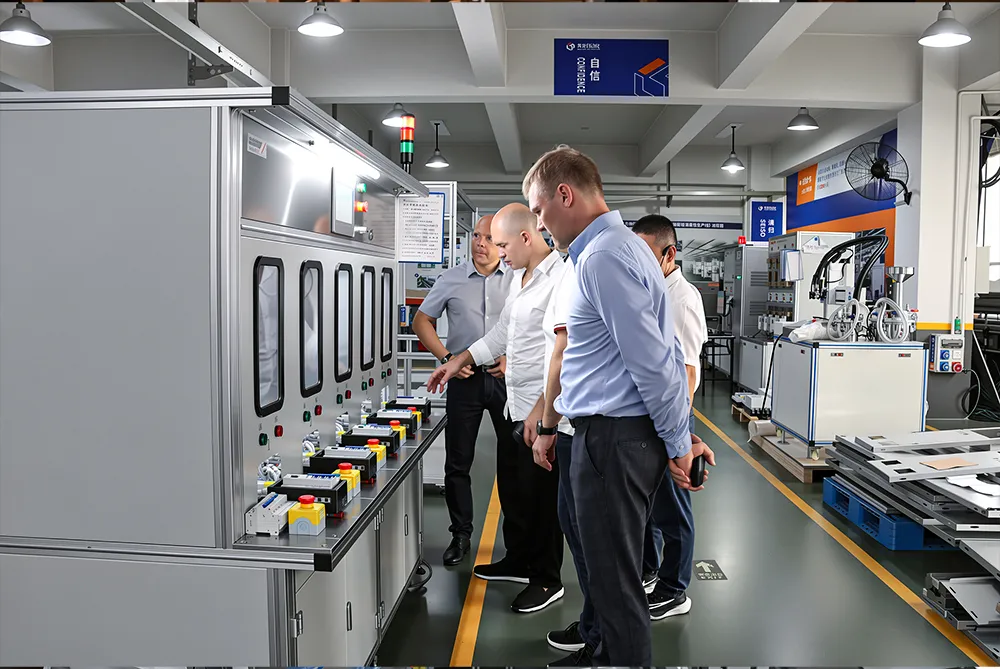


Thermal vs Magnetic Trip: How a Circuit Breaker Really Protects a Circuit
Inside every miniature circuit breaker (MCB), there are not one but two protection mechanisms that protect the system against different types of faults. Being able to grasp the meaning of thermal and magnetic trip will help you understand how a circuit breaker works in terms of keeping a building safe, and this is one of the most frequent questions that arise from consumers, electricians, and factory quality controllers.
This guide will explain in simple terms the basic functions of thermal trip and magnetic trip, how they differ, and how companies check these trips using thermal calibration and magnetic trip testing methods before any particular breaker is shipped from the factory. The guide will also cover how Benlong Automation produces the systems that conduct the tests on the equipment of MCB and MCCB manufacturers all over the world.
The Thermal as Well as Magnetic Trips
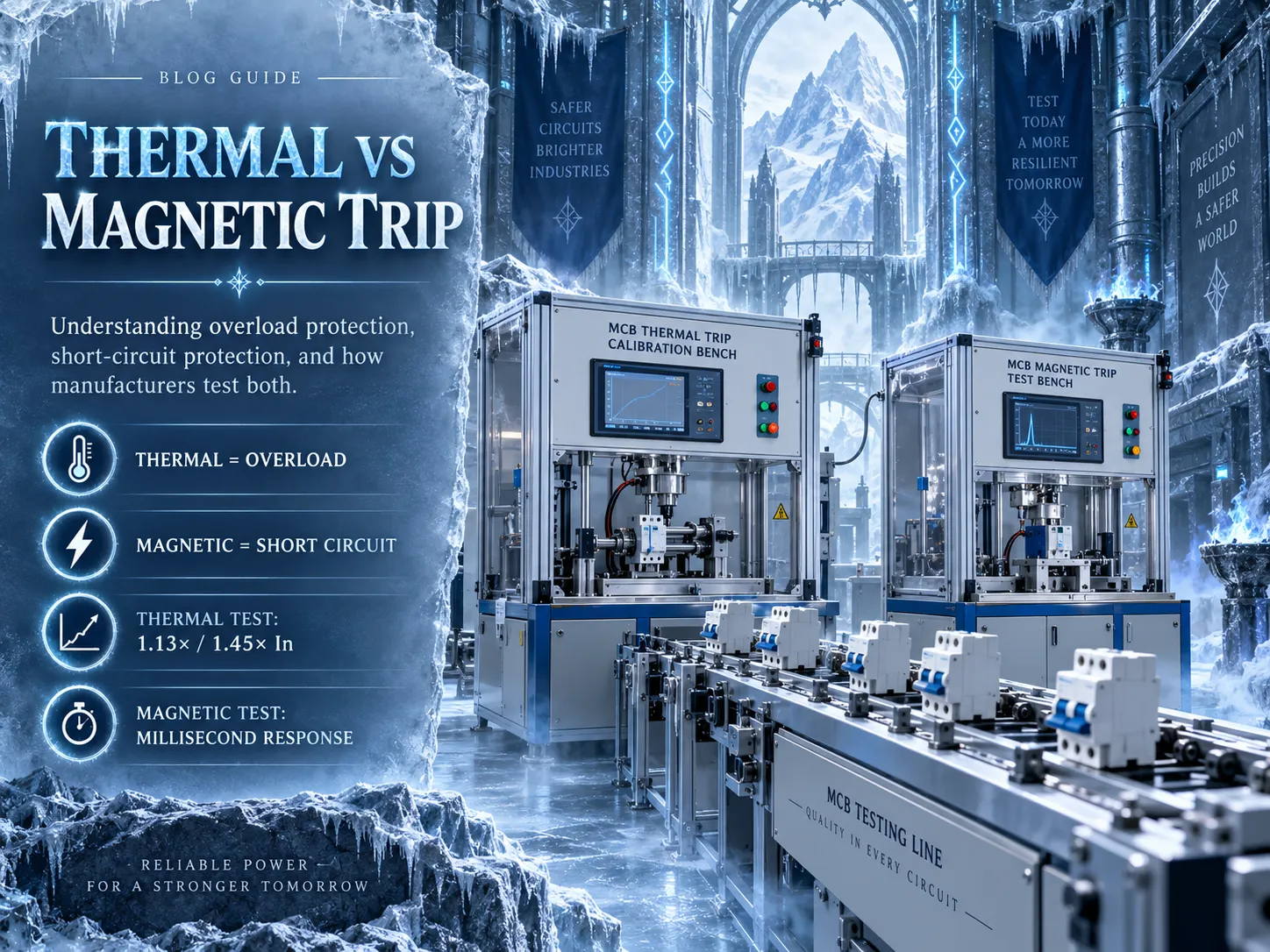
There are two different trip systems embedded in thermal-magnetic circuit breakers. The thermal part of the trip helps to protect from overload. The term overload is used here because the current is excess but it is not dangerous so as to lead to damage. The magnetic part of the trip is to be used to react to a short circuit. Each miniature circuit breaker has a trip mechanism making the operation of a circuit breaker secure.
The fastest way to remember about thermal trip compared to the magnetic is through speed. The motion of the thermal trip is slow because there is no reason to act differently in case of small overload — the fact that there is overload does not constitute an emergency. The motion related to magnetic trip is immediate in terms of milliseconds.
What Is the Thermal Trip? (Overload Protection)
The thermal trip is built around a bimetallic strip — two metals bonded together that expand at different rates when heated. If a current exceeding the capacity of the breaker exceeds the limit for a long time, the strip gets heated, deflects, and eventually triggers the mechanism that opens the circuit. The higher the current, the faster the bending of the strip occurs which is where the breaker gets its unique feature of inverse-time response from: when there is a small current overload, the breaker does not stop it immediately, whereas, in the case of a large overload, the breaker reacts with almost no delay.
Such a slow response works perfectly well for overloads. When a household circuit has a current more than it is supposed to have because several appliances are using electricity simultaneously, there is no emergency situation as wiring simply should not be allowed to get overheated. A thermal trip allows a very short surge such as the inrush when a generator starts while still protecting a wire from prolonged current overloading. Usually, such case is taking place within fractions of seconds to many minutes depending on the magnitude of the overload.
Relying on heat has certain implications such as the importance of ambient air temperature. A bimetallic strip already heated up on a hot factory floor will bend even before the same strip on the cool floor which alone necessitates precise calibration of the device under controlled conditions while each modern device includes temperature compensation. In addition, thermal trip level is defined as a band, and not as a single value; this means that the standard approves of the time of operation span so that normal temperature changes do not turn a good breaker into a fail.
What Is the Magnetic Trip? (Short-Circuit Protection)
The magnetic trip works on a completely different principle: electromagnetism. A coil inside the breaker generates a magnetic field that corresponds to the amount of current passing through it. When the current is normal, the magnetic field is weak and no action occurs. However, when a short circuit sends a huge amount of current through — often exceeding the rated value by many times — the magnetic threshold becomes strong enough to swing an armature over, triggering the trip breaker almost immediately.
As a short circuit is a real emergency, it is measured in milliseconds, rather than seconds. There is no delay and there is no gentle inverse-time curve in the instantaneous mode. The moment the current exceeds the magnetic threshold, the breaker opens as fast as the mechanism can allow. This is the mechanism that prevents the fire and protects equipment from the moment of the circuit failure that brings the resistance down to almost nothing and increases the current to the dangerous levels.
The magnetic threshold is adjusted in the design and is what specifies the trip curve of the breaker. If it is set too low, the breaker will trip every time the motor takes the enormous start-up current; if it is too high, it will delay when the fault happens. The manufacturers, thus, tune the coil and the armature to the multiple of the rated current and then check at the test bench that the trip breaker does work in that frame.
The Key Difference Between Thermal and Magnetic Trip
Putting the two side by side makes the contrast clear. They respond to different faults, on different timescales, using different physics — yet they live in the same breaker and share the same pair of contacts, which is why the device is called a thermal-magnetic circuit breaker.
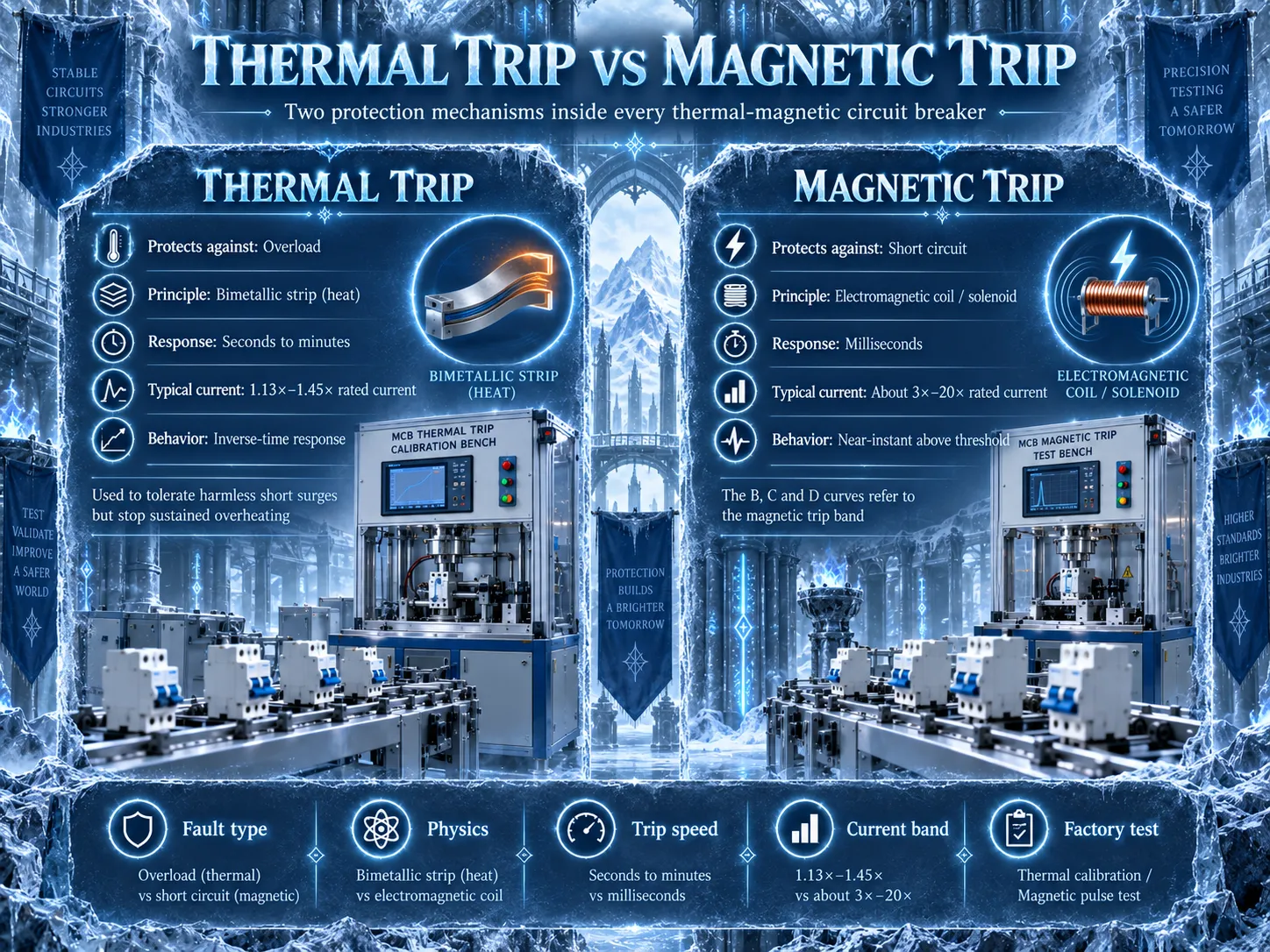
| Aspect | Thermal trip | Magnetic trip |
|---|---|---|
| Protects against | Overload (sustained overcurrent) | Short circuit (sudden surge) |
| Physical principle | Bimetallic strip (heat) | Electromagnetic coil / solenoid |
| Response speed | Seconds to minutes | Milliseconds |
| Typical trip current | Around 1.13–1.45× rated | Around 3–20× rated |
| Behaviour | Inverse-time; slower for small overloads | Near-instant above the threshold |
One point causes endless confusion, so it is worth stating plainly: the B, C and D curves printed on an MCB refer only to the magnetic (instantaneous) trip band — not the thermal overload response. A B-curve breaker trips magnetically at roughly 3 to 5 times rated current, a C-curve at roughly 5 to 10 times, and a D-curve at roughly 10 to 20 times. Their thermal overload behaviour is essentially the same; it is the short-circuit sensitivity that changes. That is why a motor circuit prone to large start-up inrush uses a C or D curve rather than a B, which would nuisance-trip every time the motor started.
How Manufacturers Test the Thermal Trip: Thermal Calibration
Thermal calibration is the factory process of verifying and fine-tuning the overload trip so that every breaker trips within the time window the standard allows. Under IEC 60898-1, a bench applies two key currents: 1.13 times the rated current, at which the breaker must not trip within a conventional time, and 1.45 times the rated current, at which it must trip within the allowed time. If the measured trip time falls outside the window, a technician adjusts the position of the bimetallic strip and re-tests until it sits inside the specification.
Benlong’s semi-automatic thermal trip calibration bench is built for exactly this task. It applies the programmed overload current — up to 200A — measures the trip time automatically, and shows pass or fail against the IEC window on a touchscreen, while a shift mechanism lets a single bench handle many different MCB housings without rewiring. Because the current is applied and timed automatically rather than by an operator with a stopwatch, results are far more repeatable, and every reading can be exported for quality records. This is the difference between a breaker that merely looks correct and one that is proven to trip on time.
How Manufacturers Test the Magnetic Trip: The Magnetic Trip Test
The magnetic trip test checks the other half of the breaker: its instantaneous short-circuit response. Here a bench delivers a short, high-current pulse — typically 5, 7.5 or 10 times the rated current, depending on the trip curve being verified — and measures how many milliseconds the breaker takes to open. The pulse must have a fast, clean rise so that the measured trip time reflects the breaker itself and not the test equipment.
Benlong’s semi-automatic magnetic trip test bench generates programmable multiples of rated current, up to several thousand amps peak, and times the trip to the millisecond, with the same touchscreen control and automatic data logging as the thermal bench. Because the current multiplier is selectable on the HMI, one bench can verify B, C and D curve breakers simply by choosing the right setting. A typical test takes only a few seconds per breaker, which matters when a production line has to check thousands of units a day without becoming the bottleneck.
Clearing Up Some Common Confusions
Often considered interchangeable, the MCB and RCCB components are actually quite different when it comes to their features. The first thing to remember when distinguishing between them is that MCB offers no protection against electric shocks caused by earth leakage – rather, that is the job of the RCCB or the residual current part of an RCBO, which detects earth leakage instead of overload or short circuit occurring. The thermal and magnetic tripping mechanisms work to protect the installation and equipment; on the other hand, residual current protection is meant for that purpose.
Another thing to clarify is that tripping should never be mistaken for a problem with the circuit breaker. Sometimes the circuit breaker trips as a result of doing its job well. Therefore, one of the main things understood by quality departments is whether the circuit breaker trips under the proper current conditions and acts within the appropriate time frame – neither too soon to cause nuisance tripping nor too slowly to allow a fault to occur. It is thanks to these two points that thermal calibration is done and a magnetic trip test is carried out.
Moreover, we should remember that the circuit breaker rating (for example, 16A or 32A) refers to the maximum continuous current that can be passed by the circuit breaker, but is not related to the current level that causes tripping.
Why Both Tests Matter for Quality and Safety
A breaker that succeeds in one of the tests could be more dangerous than one that fails both tests since it creates a false feeling of safety. The breaker that has an impeccable magnetic response but a malfunctioning thermal response is capable of causing cable overheating if subjected to a moderate overload. Another breaker has a perfect thermal response, but its magnetic response is weak due to which it will be not able to switch off a short circuit in time to avoid a fire. This is the reason that honest manufacturers check both responses for every batch and often for every device produced.
The relevant standards — IEC 60898-1 for household breakers and IEC 60947-2 for industrial ones — specify exactly which currents to apply and which trip windows are acceptable, and they are the currency that lets a manufacturer earn CE, UL or CB certification for export markets. For a fuller picture of how these tests fit into a complete quality operation, Benlong’s guide to what an MCB testing laboratory does walks through the whole test programme and the standards behind it.
Manufacturers that export products to challenging markets like Europe, the Gulf states, India, or Latin America know that compliance is not just a concept. More and more, buyers are asking for data on the tests conducted on each unit, and if a failure happens in the field — for example, a circuit breaker that should have tripped but didn’t — the manufacturer might face an audit, recall, or even loss of the contract. Thus, consistent documented thermal and magnetic testing is an inexpensive form of insurance for the circuit breaker manufacturer and does not compare with the cost implications of shipping products to markets with no proof of their proper performance.
From Bench to Line: Automating Thermal and Magnetic Testing
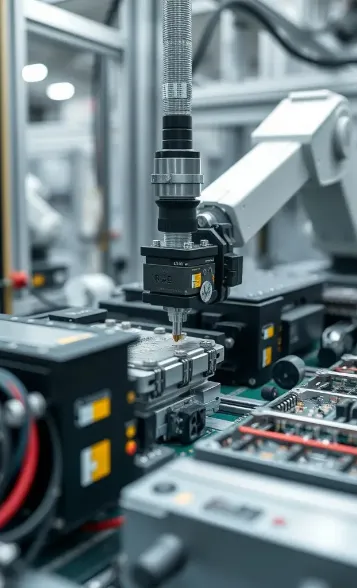
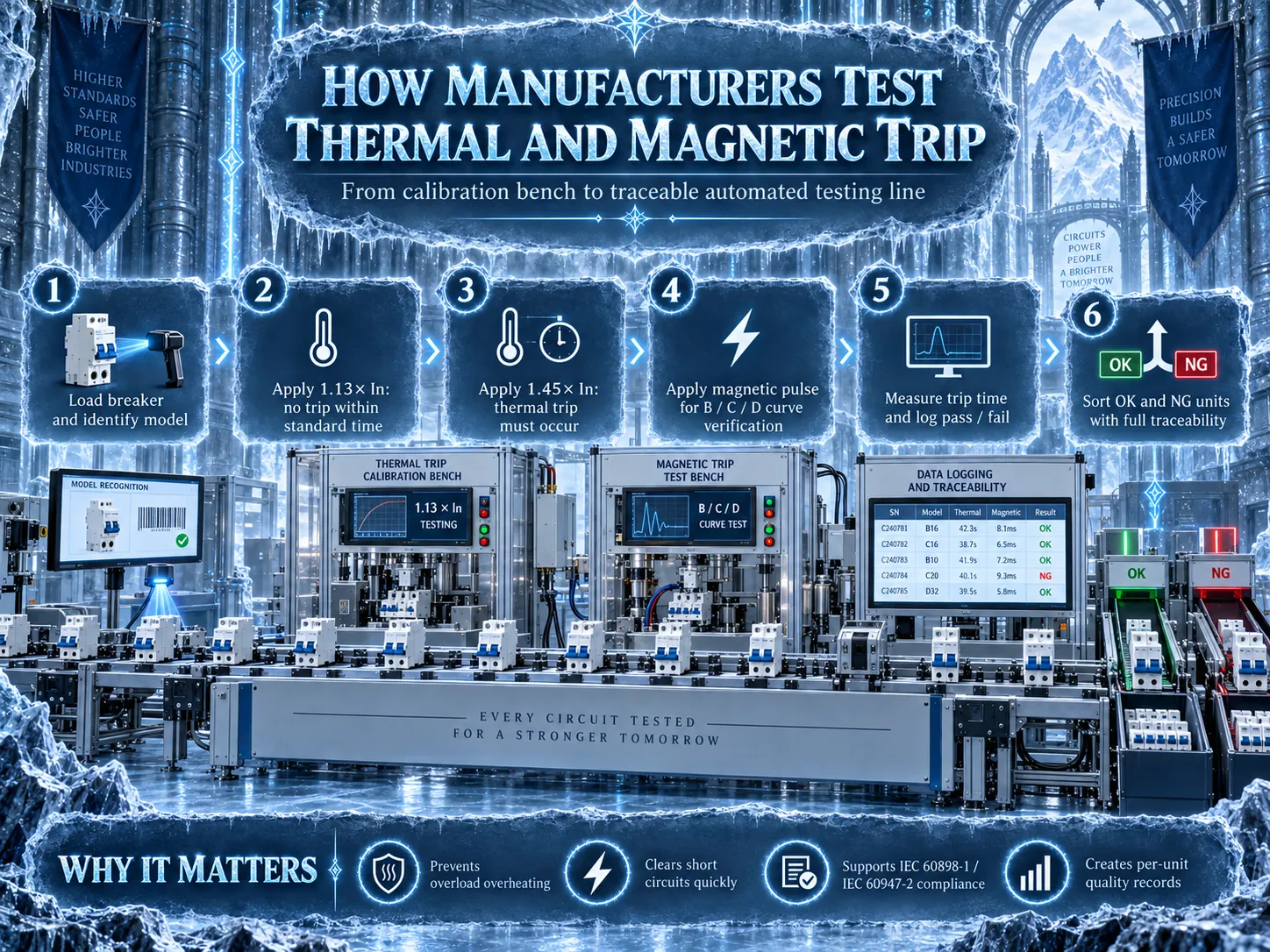
In the case of low-volume manufacturing, a laboratory or plant will perform thermal calibration and magnetic trip testing using two distinct semi-automatic workstations whereby the breaker will be placed and taken out of testing by hand. As production increases, these two tests are integrated into one automated line called conveyorizing, whereby the breakers will be moved from one station to the other via a conveyor, going through the following operations: thermal calibration, magnetic trip test, insulation strength check, switch on-off activity, followed by sorting out based on results — all of this done without the need for manual handling of every piece.
With the integrated approach, not only speed is involved, but also the tracking of what is going on with the product. Each breaker bears a unique barcode which allows to trace the results of the tests done for that particular product thus enabling a manufacturer to create a database of the units sold to clients that does not only have a history of sales, but also allows tracking of any issue arising in operation of the product that is on the market. Moreover, such an approach facilitates monitoring of the production process: if something goes wrong with the calibration bench, for example, and trip times are visibly exceeding the ones required for normal operation, the production can be brought to a stop before the majority of the outgoing units fail to comply with the necessary standards.
The choice concerning what is the right setup to choose will depend on the production volume and available budget. Small workshop or development lab may feel satisfied with two semi-automatic workstations where a technician would perform thermal calibration on one bench while conducting tests regarding magnetic trip on the other one. A medium-sized manufacturer will typically go for a semi-automatic cell with pneumatic clamping and data logging. Lastly, high-volume manufacturers sending out products to demanding buyers will apply fully automated approaches to the process of manufacturing thousands of units per day thus ensuring that the operation is carefully monitored at every stage of the process.
Conclusion: Same Breaker, Two Very Different Jobs
The key difference between thermal trips and magnetic trips lies in the faults for which they protect the electrical circuits. The thermal trip protects from slow and gradual overloads using a heat-sensitive bimetallic strip and thus requires time to react, as opposed to the magnetic trip, which is responsible for instantaneous short circuits through the action of electromagnetic force. Both types of trips are found in circuit breakers, follow the international standards, and need to pass the temperature testing procedure for the thermal trip or magnetic trip checking, respectively, to be able to operate properly.
Benlong Automation presents a variety of thermal calibration benches, equipment for executing a magnetic trip test, and fully-prorogated automation for circuit breaker manufacturers worldwide. Provide us with your circuit breaker models and requirements as well as target standards, and our engineers will recommend the best testing solutions for your needs and give you an assessment of the ROI based on our technology.
Huang Xiaolei | Benlong Automation