benlong

Metal Injection Molding vs Machined or Cast
As a purchasing manager working on a drawing for a small stainless steel part — maybe a hinge, connector body, or a gear weighing about 20 grams with a complex internal cavity — you receive quotations for three different production methods from three manufacturers: one wants to apply plastic injection (metal injection molding), second prefers a solid bar stock machining (CNC), and the third offers casting (investment casting). The prices are different by a factor of ten, the timelines differ by several months, and there is no way to figure out which offer is reasonable. The challenge lies in determining whether the manufacturing process can lead to a part that costs $0.80 or $8.00 in bulk.
The guide evaluates metal injection molding (MIM), CNC machining and casting (with particular focus on investment casting as the closest competitor) based on the criteria which matter for buyers — the way each process works, accuracy, part size, material options, price formation, lead times, and application areas.
Quick answer: Metal injection moldings are similar to plastic injection moldings in that metal powder is used in a binder to make parts in a mold. In this case, a fine powder is mixed with binder and fed into a mold, Subsequently, the binder is removed and the piece is sintered to become hard metal. This method is more lucrative in creating tiny and complicated metal parts with high consistency and at a relatively low cost. However, expensive tooling is required for it. Similar to CNC machining, the process of making parts from solid metal provides very accurate work with no tooling expenses, however, it is only viable for prototypes and short-run productions of about 1-1000 pieces. The lost wax investment casting involved pouring the molten metal into a shell that is made around the wax pattern providing a medium processed parts method with more reasonable tooling costs.
What Is Metal Injection Molding?
Metal injection molding refers to the process that merges the design flexibility offered by plastic injection molding with the characteristics of metals. The process is carried out in five basic steps.
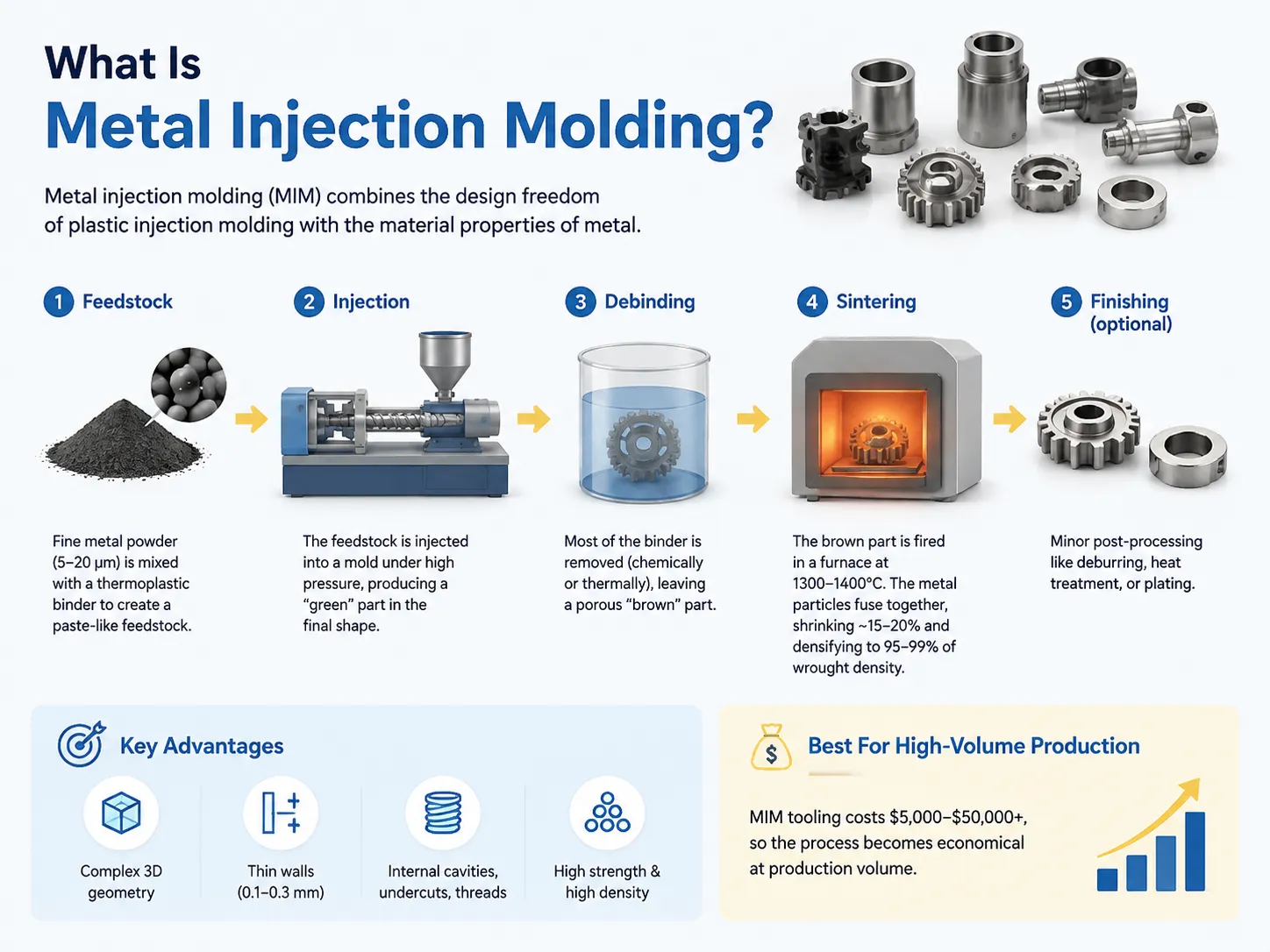
- Material: Fine powder metal (leadingly, stainless steel, titanium metal, tool steel, and cobalt-chromium among others) is combined with the thermoplastic polymer binder to form the paste-like material.
- Injection process: The resulting material is injected into the mold using high-pressure machinery, as with plastic molding. A green component is formed.
- Debinding process: Most of the binder is removed using thermal or chemical methods to obtain a porous brown component.
- Sintering: The brown part undergoes firing in the furnace to obtain a part with a density of 95-99 percent.
- Finishing process (optional): Various post-processing procedures are available, with minimal costs associated with heat treatment, plating, or deburring.
The fact that mold technology allows the making of complex three-dimensional designs means that such process can be used in the case with internal cavities, undercuts, threads, and extremely thin elements with thickness of 0.1-0.3 mm. However, it should be noted that a mold will cost a lot, which will make it profitable only at high volumes of production.If you’re new to the molding side of manufacturing, our overview of injection molding explains the same mold-based logic for plastics, which shares design rules like draft angles and gate placement with MIM.
What Is CNC Machining?
Computer Numerical Control (CNC) machining, being a type of subtractive manufacturing, uses computerized cutting tools to cut away material from a solid piece of metal until the expected component is created. The device processes its steps according to a program that has definite path for each tool.
- Precision: It is the best of three with tolerances ranging from ±0.005 to ±0.01 mm (classes of ground surface Ra 0.1-0.4 µm is achieved).
- No tooling necessity: The only investment before starting is the preparation of the program and its setup; that’s why CNC is commonly used for making prototypes.
- Drawbacks: It is impossible to produce products that could have complicated inside features and very deep recesses. Material wastage is usually significant – it could be over 10-50% of the block that will be acquired as shavings.
CNC is the main solution for prototypes and small production lots (1-1,000 pieces) and produces components of any size and any metal – even complicated and exotic alloys which are impossible to mold or cast.
What Is Casting (Investment Casting)?
Investment casting (also called lost-wax casting) is a method for manufacturing parts from molten metal through the use of a ceramic shell.
- The first step requires the production of a pattern from wax (typically through injecting wax to form a pattern).
- Then, these wax patterns form a tree and get covered in a ceramic slurry to make a shell.
- In the third step, the wax gets lost in the heat.
- Finally, the molten metal is poured, and upon cooling, the ceramic shell is fractured to reveal the finished metal piece.
Investment casting is the most adept at producing items with complex shapes and is capable of manufacturing items weighing from several grams to over 50 kg. In addition, the investment casting method can also handle almost every metal known including difficult-to-process ones such as titanium and Inconel. The investment casting process is ideal for turbine blades and pump impellers. Tooling costs are moderate, and the investment casting process will be both economically viable and cost-effective if at least 500 to 10,000 items are produced per year.
Head-to-Head Comparison Table
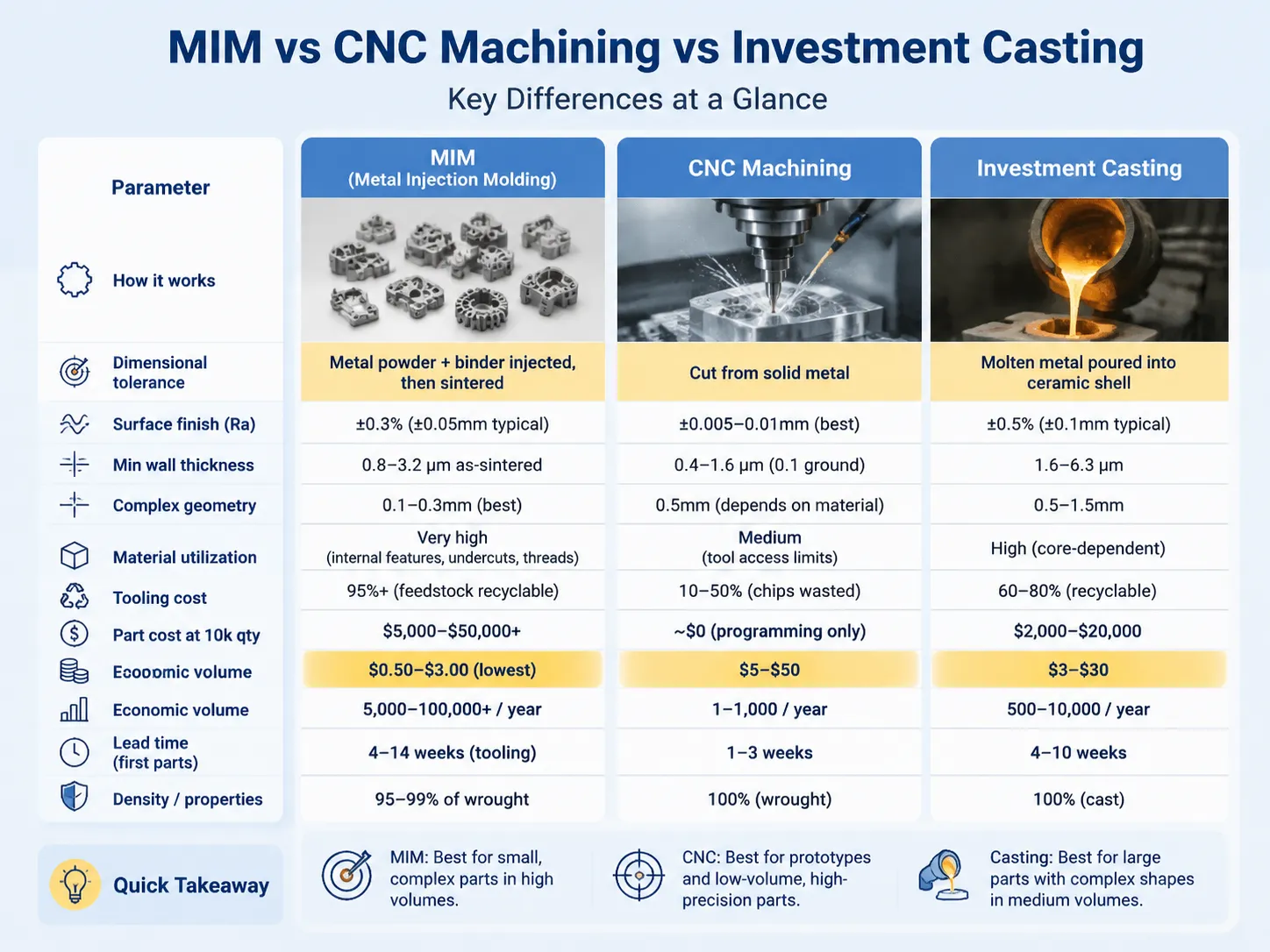
| Parameter | MIM (Metal Injection Molding) | CNC Machining | Investment Casting |
|---|---|---|---|
| How it works | Metal powder + binder injected, then sintered | Cut from solid metal | Molten metal poured into ceramic shell |
| Typical part size | 0.03–200g, under ~100mm | No practical limit | 10g – 50kg+ |
| Dimensional tolerance | ±0.3% (±0.05mm typical) | ±0.005–0.01mm (best) | ±0.5% (±0.1mm typical) |
| Surface finish (Ra) | 0.8–3.2 µm as-sintered | 0.4–1.6 µm (0.1 ground) | 1.6–6.3 µm |
| Min wall thickness | 0.1–0.3mm (best) | 0.5mm (depends on material) | 0.5–1.5mm |
| Complex geometry | Very high (internal features, undercuts, threads) | Medium (tool access limits) | High (core-dependent) |
| Material utilization | 95%+ (feedstock recyclable) | 10–50% (chips wasted) | 60–80% (recyclable) |
| Tooling cost | $5,000–$50,000+ | ~$0 (programming only) | $2,000–$20,000 |
| Part cost at 10k qty | $0.50–$3.00 (lowest) | $5–$50 | $3–$30 |
| Economic volume | 5,000–100,000+ / year | 1–1,000 / year | 500–10,000 / year |
| Lead time (first parts) | 4–14 weeks (tooling) | 1–3 weeks | 4–10 weeks |
| Density / properties | 95–99% of wrought | 100% (wrought) | 100% (cast) |
Precision & Tolerances Compared
When it comes to the best tolerances possible on a part, CNC is the clear winner (±0.005–0.01mm), followed by MIM (±0.05mm on average), and then investment casting (±0.1mm on average). However, the term “average tolerances” only conveys part of the story.
- MIM provides tight tolerances for small parts even with complex shapes, and by using a secondary CNC processing of important faces, MIM parts can achieve CNC tolerances on those faces while maintaining a cheap body.
- Investment casting gives good results regarding size but limits the fine details (thin walls, sharp corners) due to metal flow and shell quality.
- Lastly, CNC makes sense only if one datum face needs to be perfect (bearing holes and flat surfaces) or if tolerance is lower than IT7.
Cost Comparison: Tooling, Per-Part Cost & Volume Curves
Cost is where process choice is really decided. The three processes have completely different cost structures:
| Annual Volume | MIM | CNC | Casting | Best Choice |
|---|---|---|---|---|
| 100 pieces | Not viable (tooling) | $500–$5,000 | $3,000–$8,000 | CNC |
| 1,000 pieces | $15,000–$25,000 | $5,000–$50,000 | $5,000–$15,000 | Casting or CNC |
| 10,000 pieces | $20,000–$40,000 | $50,000–$500,000 | $15,000–$50,000 | MIM or Casting |
| 100,000 pieces | $50,000–$200,000 | $500,000–$5M | $100,000–$300,000 | MIM |
| 500,000+ pieces | $200,000–$1M | Not viable | $400,000–$1.5M | MIM |
Important points regarding costs:
- For CNC, per-part costs hardly decrease as the volume increases – almost every part needs processing on CNC machines so CNC will be the most expensive method.
- MIM costs reduce significantly after tooling costs are spread over production of parts. For example, MIM can reduce costs by 40-60% versus CNC for parts weighing 5g or more and produced in quantities of more than 50,000/year.
- Cost overlaps are about: 500-1,000 parts → CNC; 500-10,000 → casting (especially for larger parts); above 5000-10,000 small complex parts → MIM.
- Moreover, part weight plays an important role – MIM has an advantage below 50-100 g, whereas die casting or CNC is preferred above 500 g.
Materials Each Process Can Use
| Process | Material Range | Density | Notes |
|---|---|---|---|
| MIM | 316L, 17-4PH, 420SS, other stainless, titanium, cobalt-chrome, tool steels, soft magnetic alloys | 95–99% | Powders optimized for sintering; mechanical properties 90–98% of wrought |
| CNC | Almost all metals (steel, aluminum, brass, titanium, Inconel, plastics too) | 100% | Widest range; no melting, so heat-treated materials keep their properties |
| Investment casting | Carbon steel, stainless, aluminum, bronze, nickel alloys, titanium, superalloys | 100% (cast) | Directional solidification / single-crystal casting for turbine blades |
If your material is unsuitable for being shaped or molded, the safest alternative is CNC. In instances where you require an alloy with a high melting point that needs to be shaped into a complex form, the only viable option you may be left with would be casting or Metal Injection Moulding (MIM) for smaller components.
When to Choose Each Process
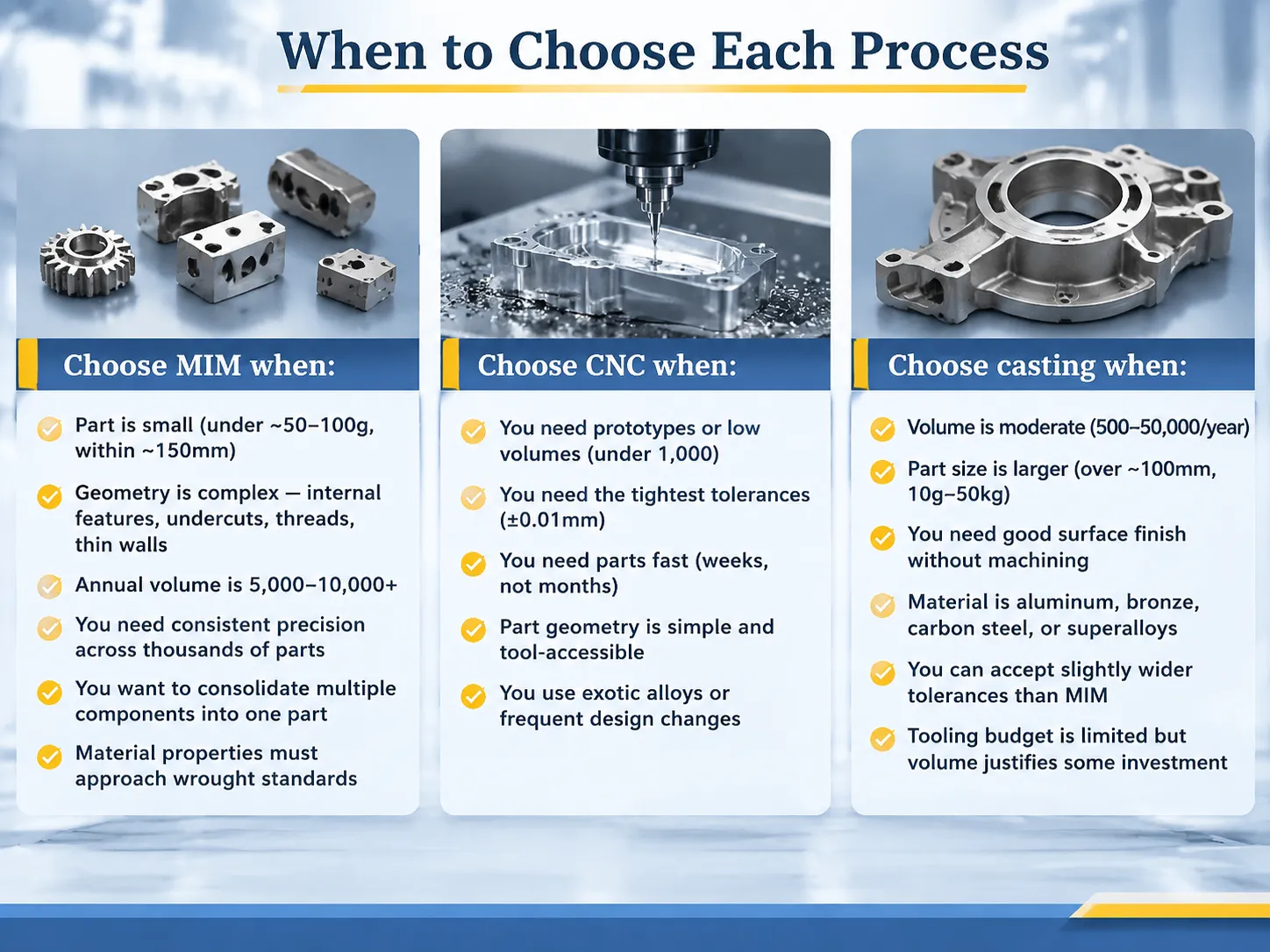
Choose MIM when:
- The component is tiny (weighing about ~50–100g and being ~150mm in size).
- Features of the part are sophisticated (like internal elements, undercuts, threads, or thin walls).
- Annual production volume of components is around 5,000–10,000+ pieces.
- Parts must meet the same quality standard across thousands of units.
- You want to consolidate multiple parts in one.
Choose CNC when:
- You need prototypes or low volumes (less than 1,000 units).
- You prefer strict tolerances (±0.01 mm).
- You need parts quickly (within weeks, not months).
- Part geometry is not complicated and tool-accessible.
- You use special alloys or change your designs often.
Choose casting when:
- Amount of production is mid-range (500–50,000 annually).
- Dimensions of the part are larger (greater than ~100mm, 10g–50kg).
- Quality surface finish without machining is required.
- Material is aluminum, bronze, carbon steel, or superalloy.
- Tolerance can be a little bit wider than MIM.
- The budget for tooling exists, but production quantities allow some investments.
Industries & Real-World Applications
| Industry | Typical Part | Recommended Process | Why |
|---|---|---|---|
| Medical | Surgical instrument components | MIM | Complex shape, biocompatible stainless, high volume |
| Consumer electronics | Phone hinge / connector components | MIM | Micro-precision, high volume, stainless |
| Automotive | Sensor housings, fuel system parts | MIM | Thin walls, complex geometry, 50,000+/year |
| Aerospace | Custom brackets, turbine blades | CNC (brackets) / Casting (blades) | Low volume + titanium for brackets; superalloys + complex cooling for blades |
| Industrial | Pump impellers | Casting | Large size, moderate volume, good flow |
| Electrical industry | Breaker contacts, small structural inserts | MIM or CNC | Precision contacts at volume; machined prototypes for development |
| Prototyping / R&D | Test fixtures, one-off parts | CNC | Fast turnaround, design iterations |
Hybrid Approaches: Combining Processes
Top manufacturers do not stick to just one method; they utilize many processes.
- Metal Injection Molding (MIM) plus CNC: MIM works perfectly for the complex structure, and CNC ensures that surfaces fit together precisely.
- Casting plus CNC: Casting gives the basic shape while CNC delivers precision engineering.
- CNC prototype followed by MIM production: While investing in MIM tooling may entail great risks, CNC prototypes guarantee that the design is right.
This principle works in the electronics industry where machines made prototypes and ensured validation of the design before production starts moving to molding and assembly of products like electrical switches, automated on assembly lines.If you’re evaluating mold development for a precision component, our guide to the mold development process walks through the design-to-qualification steps that apply to MIM molds as well.
Frequently Asked Questions
What is the difference between metal injection molding and metal casting?
The principal difference between the two processes lies in the way the metal is produced. Metal injection molding (MIM) uses special metal powder with a plastic-like binder. This powder mixture is placed into a mold and heated. After the binder is removed the metal part undergoes sintering in an oven (1300–1400°C), which results in solidification of the metal (95–99%). Casting (lost-wax technology or investment casting) begins with making a wax pattern wrapped in the ceramic material. The metal is then poured into the ceramic shell and when it solidifies, the shell is removed. In other words: MIM is used to manufacture small and light parts (maximum weight from 0.03g to 200g, production level is over 5,000 parts annually) with strict tolerances, whereas casting is used for heavier (from up to 50kg) and various materials production (superalloys included).
What is a disadvantage of injection molding?
Among all drawbacks of using injection molding (in metal or in plastic) the main problem is the very high initial cost of tooling with MIM molds costing between $5,000 and $50,000 and more, which makes it unfeasible for small productionlots. Other disadvantages of this process include possible size limitation of the components (MIM is almost impracticable for the parts of more than 200 g and 100 mm in size), expensive design modification because you have to change a steel mold, high level of required surface finish which means that extra polishing is usually needed, and various constraints such as wall thickness and location of gates. Therefore, MIM is reasonable only for mass production and prototypes are manufactured by means of machining first;
Is injection molding the same as casting?
While injection molding and casting may share similarities in that they both shape metal (or plastic) substances, they come with different physics principles. The technique of injection molding involves injecting material into a closed mold while using high pressure. In the case of metal injected molding (MIM), metal powder are used in the process and they later undergo sintering. On the other hand, casting involves pouring molten metal into the mold made of ceramics, metal, or sand and allowing the molten to solidify under low pressure or gravity influence. There are major practical differences between these two processes. Thus, injection molding has a more efficient manufacturing process, but it is limited to a small number of products manufactured each time; casting makes it possible to produce larger objects and use different alloys but with wider tolerances. Therefore, the processes and economic effects will vary according to the size and the material used in each particular case.
When to use metal injection molding?
MIM can be used in case of small components with weight below 50g, complex geometry with internal features, undercuts, or thin sections and the annual production volume of 5,000–10,000 pieces. Other situations when using MIM makes sense is when you need to consolidate multiple components into one part, need to ensure the same precision with high volume production, or expect performance similar to wrought materials (95%–99% density). It is popular in manufacturing of medical devices, electronic connectors, automotive sensors, and some gun parts.
References
- Metal Powder Industries Federation (MPIF) — MIM process standards and materials specifications
- ASTM International — metal injection molding and powder metallurgy standards (e.g., ASTM B883)
- BRM Metal — Metal Parts Cost Optimization: A Multi-Process Comparison
- Advanced MIM — MIM vs CNC vs Precision Casting: Comparison Guide
- ENGEL — injection molding technology and MIM solutions
- ISO — manufacturing process and tolerance standards
Conclusion
There is no one “best” process; there are only processes right for your part’s size, complexity, amount, materials, and tolerances. The decision-making path is fairly simple: low-volume prototypes → CNC machining; mid-volume; mid-sized parts → investment casting; small, complex parts produced at high volume → MIM. CNC is fast and precise and has no tooling cost; the casting solutions are placed somewhere in-between; finally, MIM allows for making parts in a mass scale at a cost that is 40-60% lower than CNC processes.
It is wise to ask the manufacturer three questions before going forward with quotes: what production volume refers to my part? Is my part design (undercuts, grooves, thin walls) compatible with the production method? And what tolerances I should have for each surface? It is especially important for companies in the field of electronics manufacturing precise parts, especially those that are supposed to be included in the fully automated production lines for parts, to choose the right technology and machinery to avoid the failure of technology and associated costs.