benlong



How to Test AC Contactor: A Manufacturer’s Guide
The method of testing an AC contactor makes the distinction between a plant that produces reliable switching equipment from one that wastes money on warranty repairs and field failures. An AC contactor is, for the most part, a straightforward device: it consists of an electromagnetic coil, a movable iron core, and a series of main and auxiliary contacts. However, most measurable potentials that ensure proper switching of a motor for years are invisible at the production site: the contact overtravel, timing between the poles, and dielectric strength of the contactor, as well as behavior of the coil on fluctuations of the supply voltage. In this article, the author tells in simple language for the manufacturing plants and procurement teams what the correct AC contactor testing involves and why those checks are necessary for protecting the brand.
The value of AC contactor testing for manufacturers
When you send an AC contactor to your client, you promise that this device will operate for years making and breaking the current thousands of times without welding, rattling, or failing in any other way. If such a promise is broken during operation, this entails negative consequences, and the loss that a manufacturer incurs is not limited to just the new part that should replace the malfunctioning one. In fact, such a mistake will also lead to downtime on the production line, loss of reputation, and loss of orders. Proper AC contactor testing allows to identify a faulty unit before it is dispatched, enabling the sales team to possess irrefutable quality reports and to comply with the standards set by the markets of export.
How to test an AC contactor: the core checks explained
A modern comprehensive test bench performs the following checks, often within a single automated cycle. Here is what each one measures and why it matters to the finished product.
1. Opening distance and overtravel
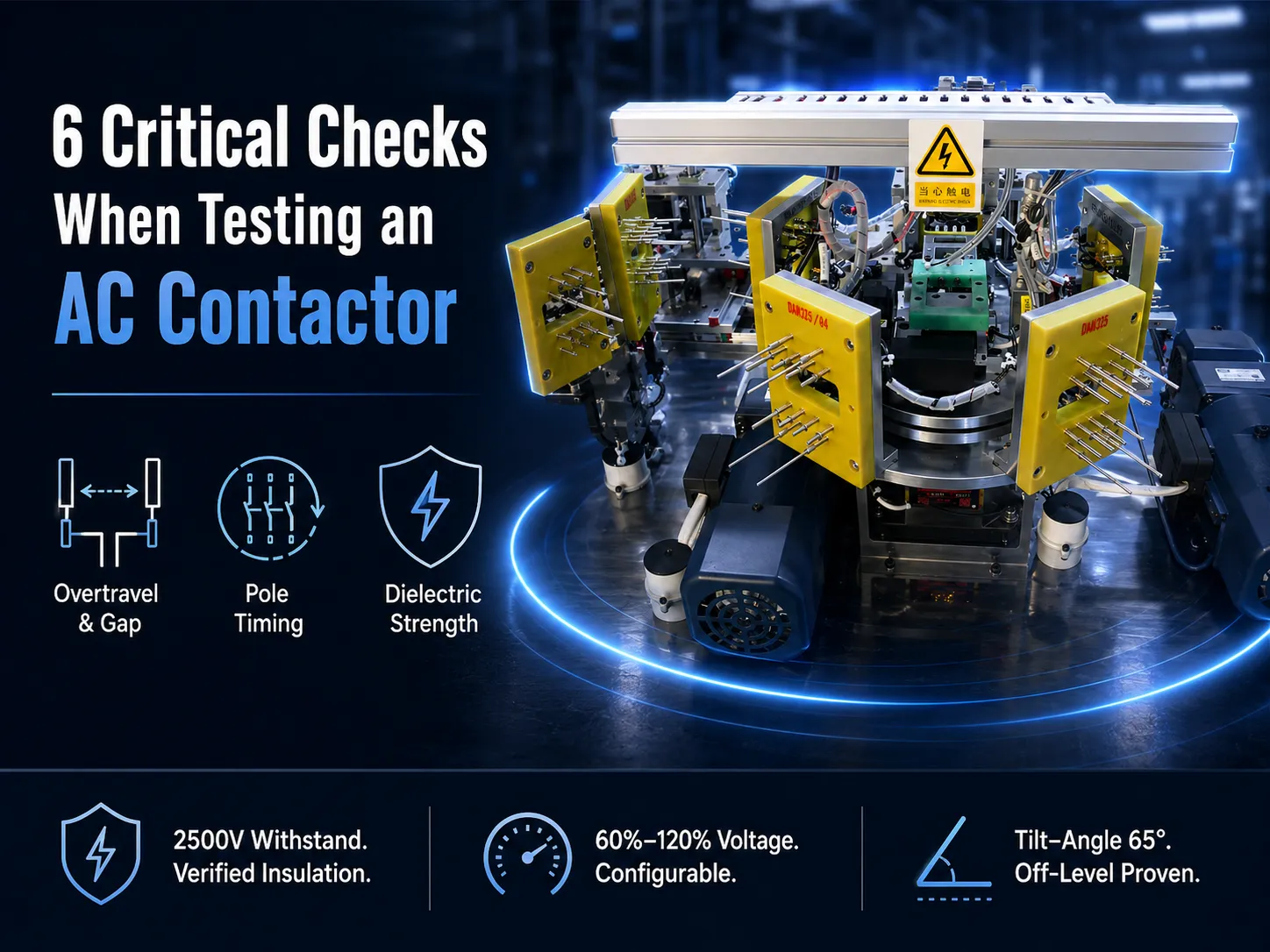
The bench uses a servo mechanism and a measurement module to advance against the contact system. As it moves, it registers the point where the contacts meet and the point where they part, then records that reference position. The coil is then energized so the core pulls the contacts fully closed, and the machine compares the engaged position against the recorded reference. The difference is the overtravel — the extra travel the moving contact makes after it first touches the fixed contact. Together with the opening distance (the air gap between the contacts when open), overtravel governs contact pressure, arc-quenching behaviour, and ultimately electrical life. Too little and the contacts overheat; too much and the mechanism is strained.
2. Contact synchronization
With the contactor de-energized, probes are placed on each pole. The coil is energized, and the bench records the exact closing moment of every pole to the millisecond. If phase A closes at 100 ms while phase B closes at 101 ms, that gap is the pole-to-pole asynchrony. When you test an AC contactor for synchronization, you are confirming that all three phases make contact almost simultaneously; poor synchronization causes uneven current sharing, contact bounce, and premature wear.
3. Withstand voltage and make-break endurance
Two related checks live here. For the dielectric withstand test, the bench applies 2500 V across the open contacts of each pole to confirm the open gap does not break down, then — with the contactor closed — applies the high voltage phase-to-phase (A–B and B–C) to verify inter-phase insulation. For the make-break, or on-off, test the coil is repeatedly energized and released so the contactor cycles open and closed under load; a short endurance run confirms the mechanism and contacts operate cleanly. This pair of checks sits at the heart of how to test an AC contactor for real-world safety.
4. Tilt-angle operation and acoustic noise
Contactors rarely sit on a perfectly level surface in the field, so the bench mounts the unit on a fixture that tilts — commonly 60° to 65° — and operates it to confirm it still picks up and drops out reliably when off-level. The same station can capture operating noise, although, as the process stands today, sound is an indicative reading rather than a hard pass/fail figure, because equipment vibration influences the measurement.
5. Overvoltage and undervoltage operation
Real supply voltage sags and surges, so a programmable regulator drives the coil below and above rated voltage — typically down to 60% for undervoltage and up to 120% for overvoltage — to confirm the contactor still pulls in and releases correctly at the edges of its operating window. Because thresholds differ by market, the setpoints are configurable: if a customer specifies 70% or 110%, the bench switches to those values on demand. That flexibility matters when you sell into regions with different national standards.
6. Aging, conversion time and main-standby switching
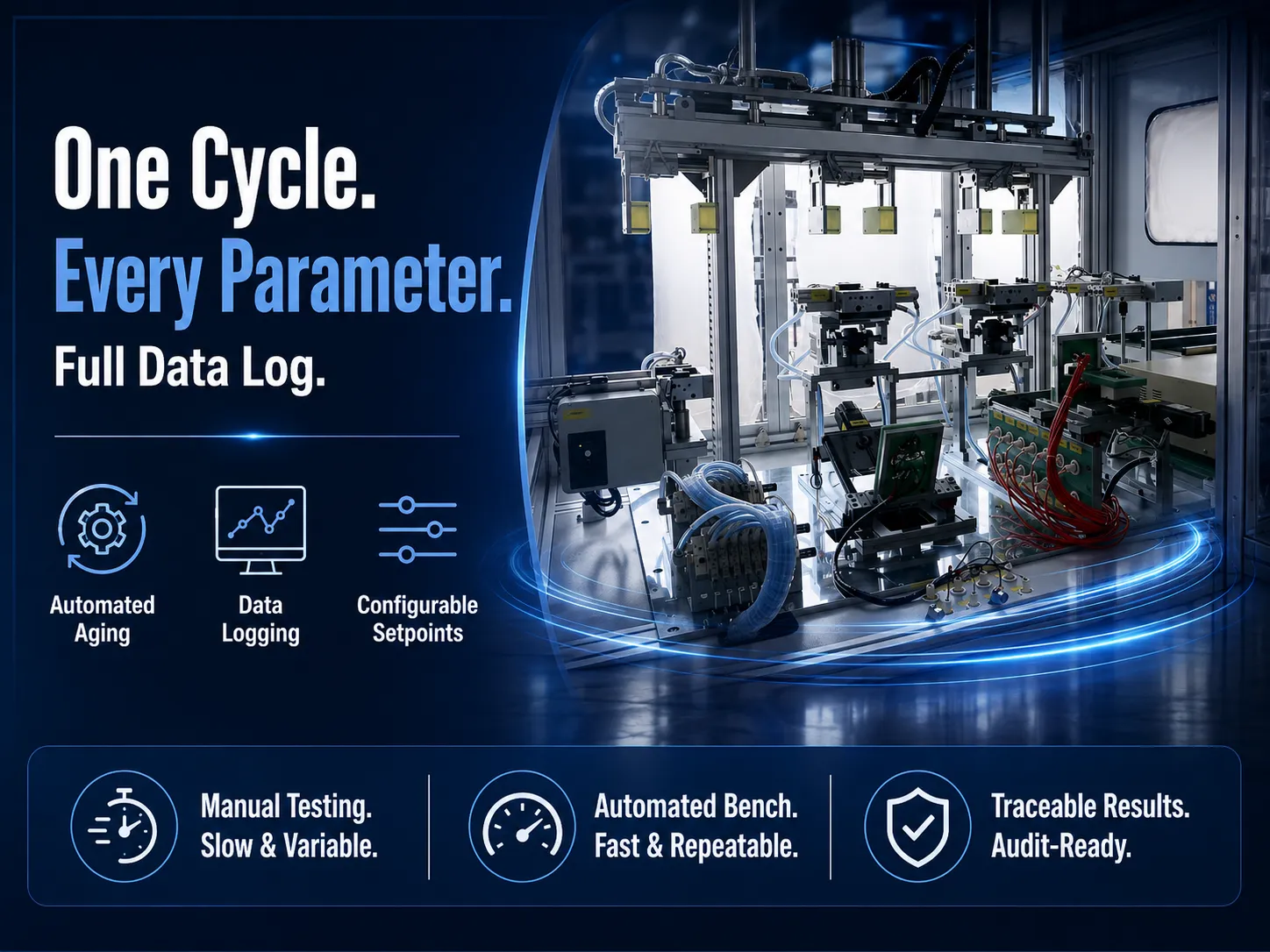
Beyond single-shot measurements, the same platform runs an aging (endurance) mode that cycles the contactor open and closed automatically — useful when production volume is modest and you want to run life testing after the functional checks. It records conversion time and closing/opening time, and for changeover duties it can switch repeatedly between a commonly-used source and a standby source, with the switching time and the number of operations set by the operator.
Manual testing vs. an automated AC contactor test bench
You can measure many of these parameters manually with separate instruments — a hi-pot tester here, a timing analyzer there, a dial gauge for travel. The trouble is that manual AC contactor testing is slow, hard to repeat operator-to-operator, and difficult to turn into the traceable data your customers increasingly ask for. An automated AC contactor test bench runs the full sequence in one clamp-and-go cycle, logs every result, and removes the human variation that lets marginal units slip through. For a factory shipping in volume, the throughput and consistency usually pay back the investment quickly.
Choosing the right AC contactor test machine
When you evaluate an AC contactor test machine, look for the features that separate a serious bench from a basic jig: measurement of overtravel and opening distance in one motion; millisecond pole-timing for synchronization; built-in high-voltage withstand and make-break cycling; configurable overvoltage and undervoltage setpoints so you can match any market’s standard; a tilt fixture for off-level operation; and an aging mode with full data logging. A bench that combines all of these lets one operator cover the entire quality profile of a contactor instead of shuttling parts between separate stations.
Benlong Automation’s AC Contactor Comprehensive Test Machine brings these checks together on a single characteristic test bench — from opening distance and synchronization through withstand voltage, tilt-angle operation, over/undervoltage, and automated aging — so you can verify every unit against one repeatable standard. If you are planning how to test an AC contactor line at production scale, it is a practical place to start.
Huang Xiaolei | Benlong Automation