benlong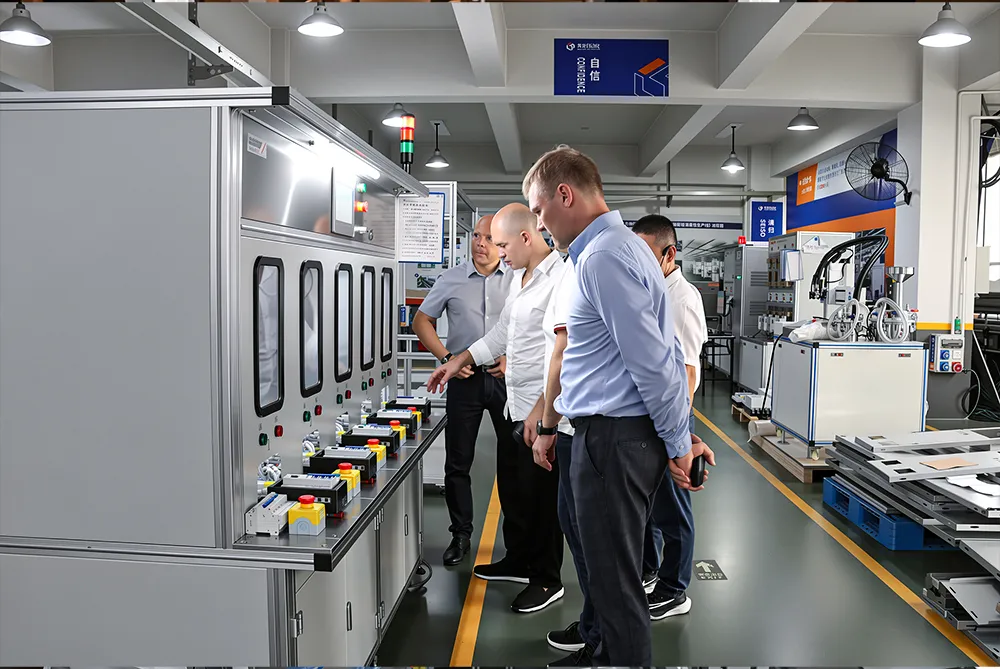

Evidence of Manual or Semi‑Automated Manufacturing Processes
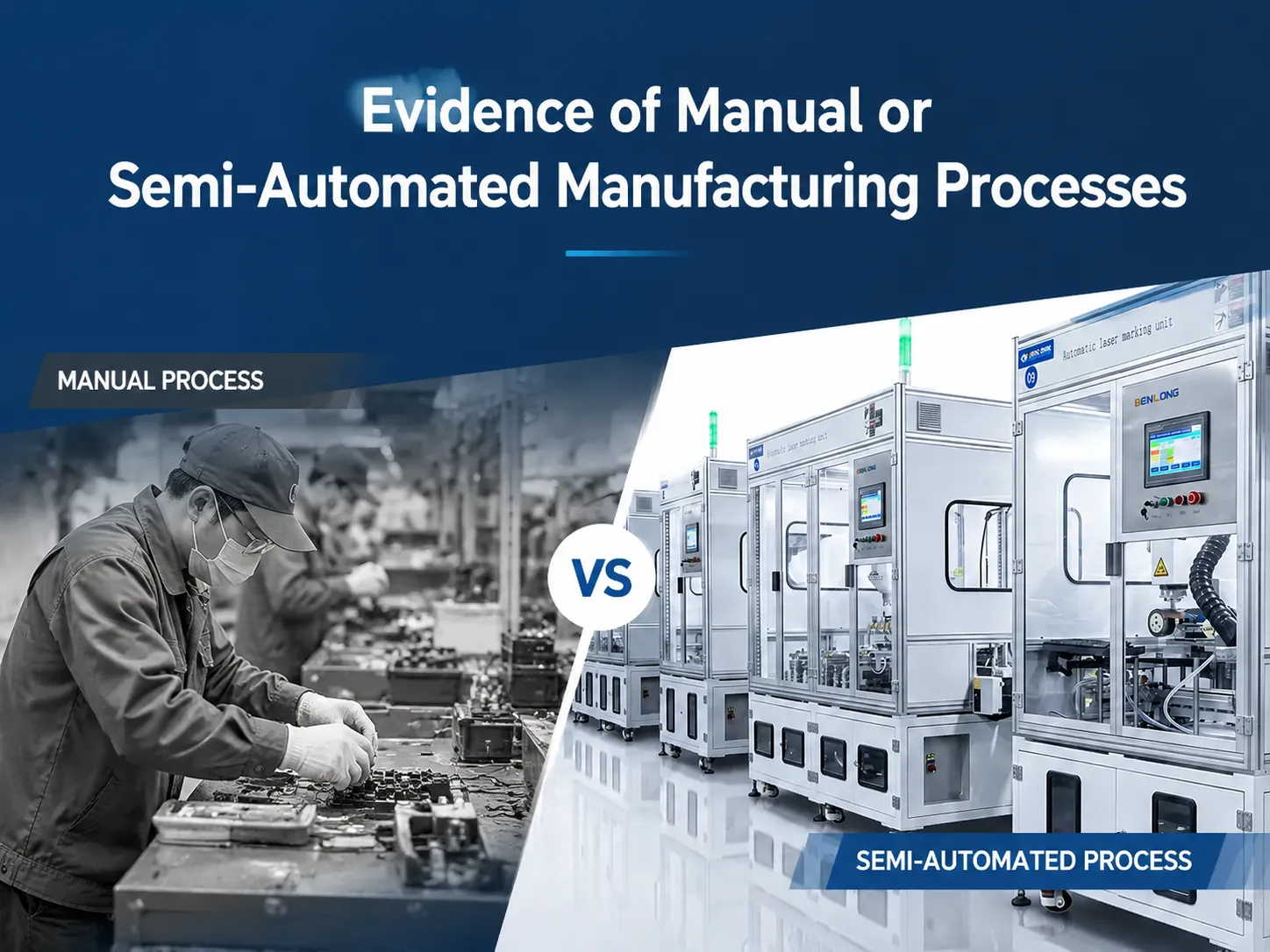
A European electrical wholesaler’s procurement manager went to a new potential supplier’s circuit breaker factory. Instead of asking for company brochures, he asked to see the production floor. In less than ten minutes, he could see that hand calibration of thermal trip devices was handled by workers and that a whole row of thermal trip devices was assembled with manual work. The factory was a mostly manual operation, and a second visit to a competing factory showed a completely different scene: an operator placed circuit breaker casings into a fixture, and then the entire process was automated. This shows how manual and semi-automated production processes differ.
Defining Manual and Semi‑Automated Production
Before one can determine the evidence, there is a need for precise definitions. A manual process is associated with human effort in performing every activity; loading, working, monitoring, and unloading. The effectiveness of every process depends on a worker’s performance. In a semi‑automated process, the crucial and sophisticated steps like welding, dispensing, switching, and testing become automated while the human worker does everything else like loading, unloading, and transferring the pieces. While the machine is undertaking the process, the human operator must provide the feed and receive the product. The distinction does not depend on whether any machinery is used or the presence of computer systems but whether the equipment will be adequately controlled.
A manual worker employs a conventional torque wrench. A semi-automatic operator presents parts to an automatic system that performs operations such as applying the calibrated torque, documents it, and rejects the faulty joints automatically. For a broader overview of automation levels, our guide on what automation is provides the foundational context.
The Visible Evidence: How to Recognise a Manual Process
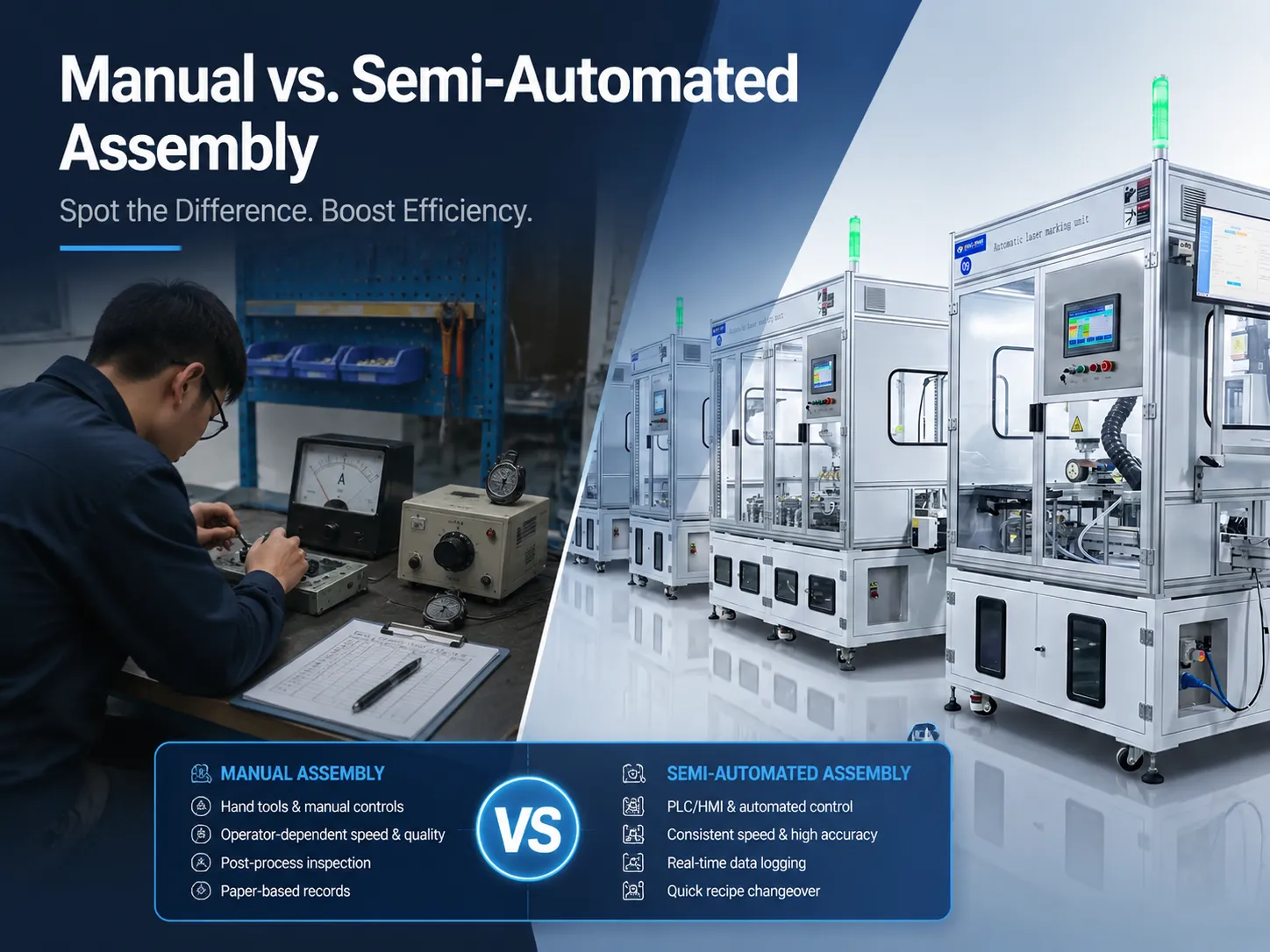
A manual assembly line can be identified by a number of physical and operational indicators. On the shop floor, there are workstations with no PLC screen, HMI, or pneumatic or servo actuation, but are equipped with hand-held tools, jigs, and fixtures. The operator determines the speed and quality of the output. Quality control is mainly conducted after the process; hence, a separate inspector is available to check a sample of finished products, and the data, if collected, is stored on paper. Changing from one kind of product to another requires worker training rather than changing production parameters.
In a manual calibration cell for mini circuit breakers, the actions of the technician are distinct: he places a screwdriver on an adjustment screw of a bimetallic strip, looks at an analogue ammeter, and adjusts a variac in order to apply the current. The calibration curve is not registered digitally and the trip time is determined by a stopwatch or a simple timer. Such method may result in a working breaker but the accuracy of the measurements is determined by keeping the hand steady and avoiding fatigue. The presence of absence of closed-loop control in the process is indication of the manual nature of the process.
The Visible Evidence: How to Recognise a Semi‑Automated Process
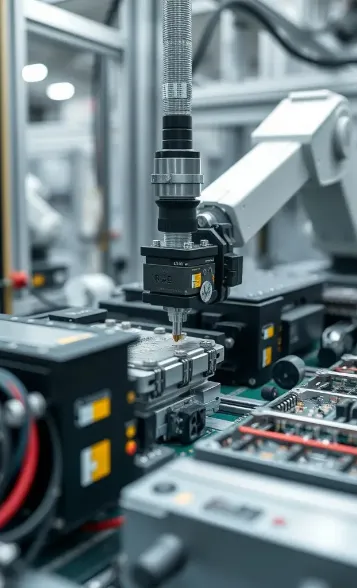
In a semi-automatic manufacturing operation, a different set of indicators is being used. Each unit has PLC, HMI monitor, and some means of mechanization represented with cylinders, motors, or robot arms. The operator places the product in the device, starts the process using a light curtain or two-hand control, and the equipment does the step. The green light means that the process is successful while the red light means that it fails. Data on the process is recorded such as torque, pressure, cycle duration, and calibration data, and is saved with a unique number. The technology allows changing recipes via HMI.
The semi-automated MCB calibration bench manufactured by Benlong Automation clarifies in a very straightforward manner the very nature of automation of the concept of calibration. The calibration process is carried out in the following way. First, the operator inserts an MCB into a fixture. The equipment automatically applies overload or short circuit current, measures the trip time in milliseconds, and it adjusts the calibration screw using a motor driven device. The result of the calibration is recorded, and the MCB is either released or rejected. This semi-automatic process can be described in the following way; the operator is responsible for material handling, while everything else is done automatically. Benlong’s MCB semi‑automatic thermal calibration bench and magnetic trip test bench are examples of this approach, widely used by manufacturers moving from manual to controlled, documented production.
Data Trails: The Paperless Evidence of Automation Level
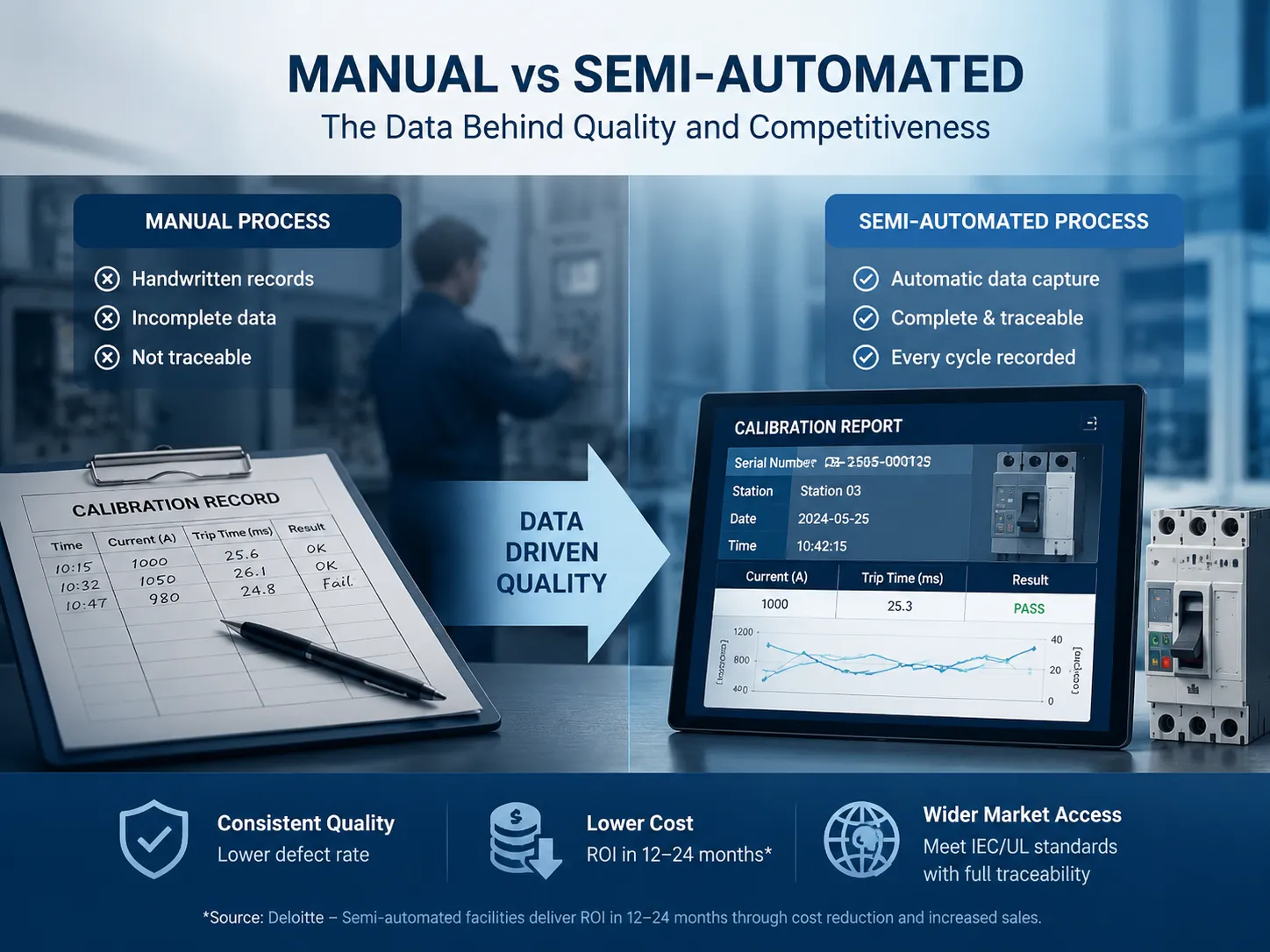
The biggest sign of whether a process is manual or semi-automated lies outside the equipment itself. In manual processes, there is hardly any binary data left. Quality records are written by hand, incomplete and generally not linked to single devices. Semi-automatic processes, on the other hand, live up to all of the data requirements. The result of every cycle is recorded; if a breaker was calibrated at 10:42 a.m. on a particular station, an appropriate record will indicate the value of the calibration current, the trip time, and whether the test passed or failed. Those records are what allow manufacturers to certify their products, analyse product warranty issues, and improve quality continuously. For buyers assessing a supplier, the ability to provide a calibration report for any serial number from a batch is one of the strongest proofs of process control. An industry research paper published by McKinsey & Company continually emphasises that data capture and digital traceability is the major difference between simply automated and competitive industries.
Why the Distinction Matters: Quality, Cost, and Market Access
Evidence of the utility of manual or semi-automated production processes and their impact on business outcomes. Under manual calibration, the circuit breakers manufactured are generally functional, but they do differ slightly from one unit to the next, as the calibration process depends on the technicians performing the task. While this may not pose any problems in domestic markets, lenient regulations being in place, it may pose problems when exporting goods, especially if IEC or UL certifications are required to be obtained. In contrast, with semi-automated production, the calibration process involves setting every product to a predefined calibration mode that can be reproduced irrespective of the operator that performs it. As a consequence, the defect rates improve, and the waste output is reduced and the clientele of the factory extends to include consumers that do not accept the products produced without appropriate documentation and certification. As indicated by Deloitte, the investment into semi-automated facilities leads to the return on investment within 12-24 months due to cost reductions and boosted sales.
Upgrading from Evidence to Action: The Path to Automation
Identifying the indicators of manual or semi-automated processes is the initial stage. The following step consists of identifying the course of action to be taken. Many producers choose gradual process implementation; the most crucial quality processes are automated at first while the material handling process is done manually. This practice brings down the initial investment, decreases risks, and ensures quick advancements in the quality of goods and in documentation. If the production increases, the material handling activity requires automation, and these stations can be connected to create a fully automated line. Benlong Automation’s solution is based on this phased approach. A manufacturer can begin with a standalone semi‑automatic assembly machine for a specific process step, and later integrate it into a complete MCB automatic assembly line with automated feeding, testing, and marking. The evidence of the initial semi‑automated investment — the process data, the reduced defect rate, the certification confidence — becomes the justification for the next step.
Frequently Asked Questions
What are some examples of automated manufacturing?
For example, there are robotic welding cells for automotive assembly, completely autonomous bottling and packaging lines for food and beverage production, and circuit breaker assembly lines with testing that automatically feeds, calibrates, tests, and marks each product. The systems work with little human control and provide a digital history of all manufactured items.
Which is an example of an automated process?
An exemplar of an automated step in the electrical manufacturing process is an automatic thermal calibration process for miniature circuit breakers, which involves a machine providing the required overload current, timing the tripping operation, adjusting the calibration system accordingly, and saving the results without any human intervention.
What are the 4 types of automation?
There are four common types of automations: fixed (hard) automation for high-volume production of individual products, programmable automation for batch manufacturing, flexible (soft) automation for manufacturing involving various products and integrated automation which is characterized by computerized and interconnected factory processes. In cases when material handling is done manually semi-automated systems can be classified as programmable or flexible according to their periodic use of automated and manual tasks.
What are the 4 stages of process automation?
The process automation develops along four levels: firstly, the manual process where operations are performed by the humans; secondly, semi-automated level where the main part of the technology operation is done by machines, while the worker handles the loading and unloading processes; thirdly, fully automated process where machine processes everything from the beginning to the end; and lastly, integrated automation that is based on different automated systems.
References
- McKinsey & Company — The Future of Manufacturing and Automation. Research on the productivity, quality, and data impacts of automation investment.
- Deloitte — Digital Manufacturing and Industry 4.0. Insights into the payback and competitive advantage of semi‑automated and fully automated production.
- International Federation of Robotics (IFR) — World Robotics Report. Annual data on robot installations and automation density across manufacturing sectors.
The evidence of manual or semi‑automated manufacturing processes is visible on the factory floor, measurable in the defect rate, and traceable in the data. A buyer who knows what to look for can assess a supplier’s true capability in a single walkthrough. A manufacturer who recognises the evidence of manual variability in its own operations can take the first step toward semi‑automated control — automating the critical steps, capturing the data, and building the foundation for the next level of quality and market access. Benlong Automation builds the equipment that provides that evidence, turning a manual or semi‑automated process into a documented, repeatable, and certifiable production system.